






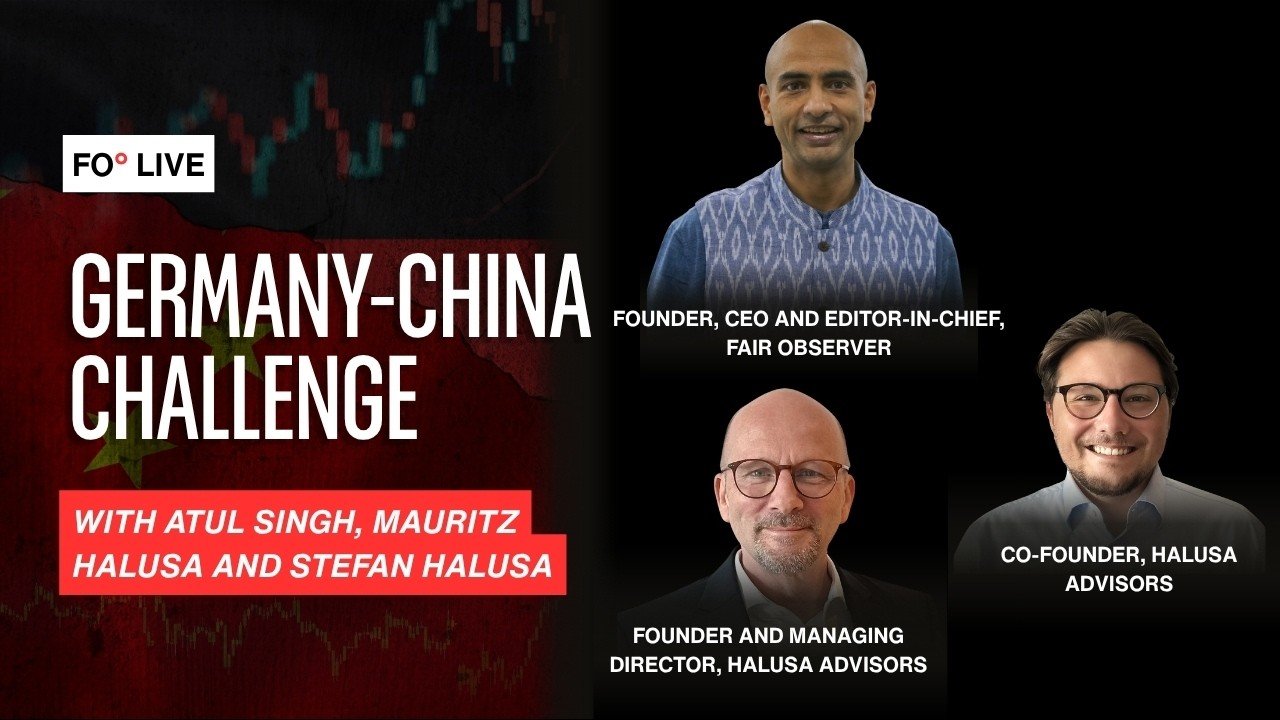
Editor-in-Chief Atul Singh speaks with Stefan Halusa, founder and managing director of Halusa Advisors, and Mauritz Halusa, its co-founder, about the mounting Chinese challenge to German industry. The father-son duo explains how China evolved from a lucrative market for German machinery and automobiles into a formidable competitor in many of the same industries. Atul, Stefan and Mauritz examine Germany’s growing trade deficit, the crisis facing its carmakers, the German struggle to innovate, rising energy costs and whether Europe’s largest economy can adapt.
China vs. Germany
Stefan began visiting China in 1997, four years before the country joined the World Trade Organization (WTO). China’s subsequent industrial expansion initially brought enormous benefits to Germany. In the years after Beijing joined the WTO, Chinese companies bought German machinery, Chinese consumers purchased German cars and German businesses became major investors in the country.
Trade between Germany and China was nearly balanced in 2001 and 2002, with China recording an annual surplus of only about €3 billion. Even in 2019, immediately before the Covid-19 pandemic, Germany’s bilateral trade deficit stood at approximately €13 billion. By 2025, however, it had approached €90 billion. Chinese exports to Europe continued growing in 2026 while German exports to China declined.
Several factors drove this reversal. The collapse of China’s property market damaged household wealth because many Chinese families had placed much of their savings in real estate. Falling property values weakened consumer confidence and reduced domestic consumption. Beijing responded to slowing growth by emphasizing industrial production and exports, particularly in electric vehicles (EVs), robotics, industrial automation, advanced materials, medical devices and biotechnology.
These are also sectors in which German manufacturers traditionally excel. China and Germany are therefore no longer competing only for Chinese consumers. Their companies increasingly confront one another across international markets.
Stefan points to Chinese state subsidies and what he considers a significantly undervalued renminbi as additional advantages for Chinese exporters. Meanwhile, US tariffs have restricted access to the American market, redirecting more Chinese products toward Europe, Germany’s most important trading region.
For decades, Germany pursued Wandel durch Handel, or change through trade. This policy rested on the liberal expectation that deeper commercial ties would encourage political openness in China. Mauritz calls that assumption a “drastic miscalculation.” Trade enriched both countries, but it did not produce the political transformation Germany anticipated.
China’s low consumption may be permanent
Mauritz argues that China’s dependence on exports is not simply a temporary response to economic weakness. In his view, the Chinese Communist Party (CCP) has consistently prioritized manufacturing and exports over household consumption. The CCP’s Five-Year Plans devote far greater attention to production and trade than to stimulating domestic demand.
Low consumption enables China to direct resources toward industrial expansion, but it also creates excess production that must be sold abroad. This pressure has intensified as the property crisis has reduced household spending and increased dependence on exports. Falling prices, factory closures and job losses could depress consumption further, creating a damaging economic cycle.
Atul adds that Chinese society has endured the Taiping Rebellion, foreign occupation, civil war, the Great Leap Forward and the Cultural Revolution. Such upheavals can produce habits of caution and saving that outlast a political system. Germany also saves more and consumes less than many English-speaking economies, partly because of its own history of hyperinflation, war and economic destruction.
Atul therefore doubts that Chinese consumption would rise dramatically even if the country became a liberal democracy. Mauritz accepts the importance of culture but maintains that China’s political economy reinforces these tendencies through deliberate planning.
Whatever combination of history, culture and state policy explains Chinese behavior, Stefan believes German companies must accept the result. China’s export orientation is “not just a phase of two or three years,” he says. Germany cannot wait for the old commercial relationship to return. Its industries must prepare for sustained competition from Chinese companies in China, Europe and the wider world.
Chinese speed tops German quality
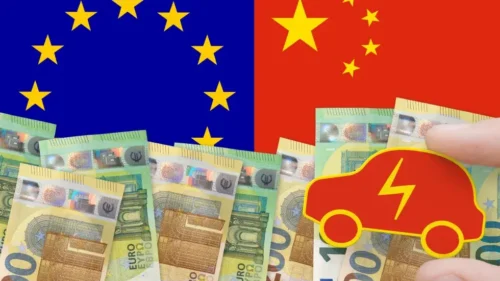
The automotive industry exposes Germany’s predicament particularly clearly. Mercedes-Benz, BMW, Porsche and Volkswagen built their reputations on engineering excellence, reliability and carefully controlled development. Yet EVs have changed the basis of competition. Software, batteries, digital features and rapid product updates now matter as much as traditional mechanical engineering.
Stefan divides the challenge into two related contests: cost and technology. German carmakers typically take 30 to 36 months to develop a vehicle. This method produces a refined and high-quality product, but Chinese manufacturers can release a model and update it two or three times before a German competitor completes one development cycle. Their initial product may be less polished, but they improve it rapidly in response to consumer demand.
German companies must consequently learn how to shorten development cycles and integrate software more effectively. Stefan says this helps explain why several manufacturers are transferring research and development capacity to China. They want to operate closer to the world’s largest automotive market and absorb the speed and customer focus of their Chinese competitors.
China also offers a substantial cost advantage. German manufacturers pay higher wages and energy prices while carrying a heavier administrative burden. Major German manufacturers and suppliers still make between 20% and 40% of their products in Europe, with Porsche producing an even larger share there. Stefan does not regard high wages as a problem in themselves, since prosperous societies should compensate workers well. He instead emphasizes automation, industrial artificial intelligence and reduced bureaucracy as ways to improve productivity.
Germany can learn from countries besides China. South Korean companies adapt products quickly to local markets, while India combines engineering talent with unconventional and economical approaches to innovation. German companies are already establishing research and competence centers in India to incorporate industrial AI into their production processes and products.
The opportunity (and danger) of moving to China
Volkswagen’s expanding innovation center in the Chinese city of Hefei illustrates the difficult choices facing German industry. The facility contains over a hundred laboratories for software, hardware, batteries and electric powertrains. In November 2025, Volkswagen said it could manufacture an EV entirely in China for half the cost of producing one elsewhere.
Stefan describes the logic as “if you can’t beat them, join them.” Volkswagen has invested heavily in China and earned substantial profits there; it cannot easily abandon the world’s largest automotive market. China’s rapid adoption of electric and plug-in hybrid vehicles also gives German companies access to valuable battery expertise and an enormous base of consumers.
Yet relocation carries serious risks. Research facilities do not move alone. Technical knowledge, skilled jobs and manufacturing expertise move with them. Atul warns that Germany could gradually lose the industrial capabilities on which its prosperity depends.
The competitive payoff is also uncertain. According to Stefan, German manufacturers account for less than 5% of China’s EV market. This is dramatically low compared to their earlier dominant position in internal combustion engine vehicles. Chinese producers benefit from immense scale, government support and intense domestic competition. Mauritz questions whether German manufacturers can win this contest even after shifting investment into China. They may spend billions to join an industrial system in which local competitors retain decisive structural advantages.
This produces a painful dilemma. German carmakers risk becoming technologically isolated if they stay away from China, but they could weaken their domestic industrial base without securing a sustainable position if they move more research and production to the Middle Kingdom.
Germany searches for a response
Germany’s political system makes rapid reform difficult. Proportional representation encourages coalition governments and consensus, but the country’s political center has weakened as support has grown for parties at the extremes. Coalitions are harder to form and, when they emerge, disagreements complicate attempts to reduce bureaucracy, lower costs and implement major economic changes.
Mauritz sees some movement nonetheless. German officials have promised a period of reform, although businesses are still waiting for many concrete measures. More significantly, attitudes toward China are changing within industry. German mechanical engineering associations that were traditionally reluctant to challenge Beijing have begun calling for retaliatory trade measures.
Mauritz describes this reversal as evidence of a developing “China shock 2.0.” Companies that once resisted European restrictions increasingly recognize that subsidized Chinese exports threaten their position at home and abroad. A tougher policy toward Beijing may attract broader support than it did in the past.
Protectionism alone cannot restore German competitiveness. Stefan argues that Germany must seek fairer trading conditions while drawing upon the strength of its decentralized economy. The Mittelstand, Germany’s network of specialized small and medium-sized companies, retains deep technical knowledge and considerable capacity for innovation. These businesses can compete if they adopt new technology and face more equal market conditions.
Germany’s greatest opportunities may lie at the intersection of its established industrial expertise and AI. It does not need to create every foundational AI model itself. German companies can instead apply advanced models to manufacturing, product development and industrial processes. Mauritz also points to process-mining software and environmentally sustainable technologies as areas in which German and European companies remain innovative.
Energy insecurity compounds the industrial challenge
Germany’s industrial model once benefited from cheap Russian natural gas. That supply is no longer available. Furthermore, conflict in the Middle East has made other sources of gas more expensive and less reliable. To make matters worse, Germany shut down its remaining nuclear power plants. Its manufacturers must now compete with Chinese rivals while paying higher energy prices and financing a difficult transition to other energy sources.
Atul questions whether Germany can remain an industrial power without dependable and affordable energy. Mauritz responds that renewable power offers Germany its best route toward greater independence. Renewables already provide about 60% of German electricity and approximately 20% of the country’s total energy needs, he says. Companies are also electrifying more of their production.
Germany’s initial renewable energy drive was motivated largely by climate concerns. The geopolitical disruptions of recent years have changed the debate. Renewable energy is increasingly regarded as a source of national resilience as well as a response to climate change. A foreign supplier cannot easily withhold domestically generated wind and solar power, unlike imported fossil fuels.
The transition nevertheless imposes substantial short-term costs. Germany’s electrical grid was not designed for the current scale and distribution of renewable generation. Industrial facilities require expensive upgrades at a time when many companies already face shrinking margins and tougher competition.
Germany also cannot meet all its energy needs within its borders. Stefan advocates partnerships with sunnier countries capable of producing green hydrogen at scale, including Spain, Italy, India and countries in North Africa. Mauritz places particular emphasis on European integration — a stronger continental grid could connect hydroelectric and wind power from northern Europe with solar energy from Spain, Portugal and Greece.
For both men, the European Union (EU) is not merely a political project. The EU gives Germany access to a vast common market, complementary energy resources and partners whose combined scale can compete more effectively with China and the US.
Can Germany bounce back?
Atul concludes by asking whether Germany is undergoing a genuine Zeitenwende (turning point) and experiencing a new Zeitgeist (the spirit of the age). German Chancellor Olaf Scholz popularized Zeitenwende after Russia invaded Ukraine, primarily to describe the need to rebuild German military capacity. The economic challenge now requires an equally profound change in direction.
Related Reading

Germany can no longer depend on inexpensive Russian energy, continuously expanding Chinese demand and a stable US-led free-trade system. It must compete in an era of tariffs, industrial subsidies, geopolitical conflict and technological disruption. Reform will be painful because Germany’s consensual political system tends to move slowly unless pressure becomes impossible to ignore.
Stefan remains optimistic over the long term, despite expecting several difficult transitional years. Mauritz grounds his confidence in Germany’s skilled population, strong technological foundations and democratic society. He also sees ambition among younger Germans who are starting companies and building careers while seeking to preserve a free and democratic country as a sign of hope.
Germany does not lack talent or industrial knowledge. The country’s challenge is to leverage its strengths more quickly, reduce unnecessary constraints to growth, and work with European and international partners. The very crisis that exposes the weaknesses of Germany’s old economic model could force the country to construct a more innovative and resilient one. As Mauritz observes, “every crisis is an opportunity.” Whether Germany seizes this one will determine if the country continues to remain one of the world’s great industrial powers.
[Lee Thompson-Kolar edited this piece.]
The views expressed in this article/video are the author’s own and do not necessarily reflect Fair Observer’s editorial policy.







































Comment