



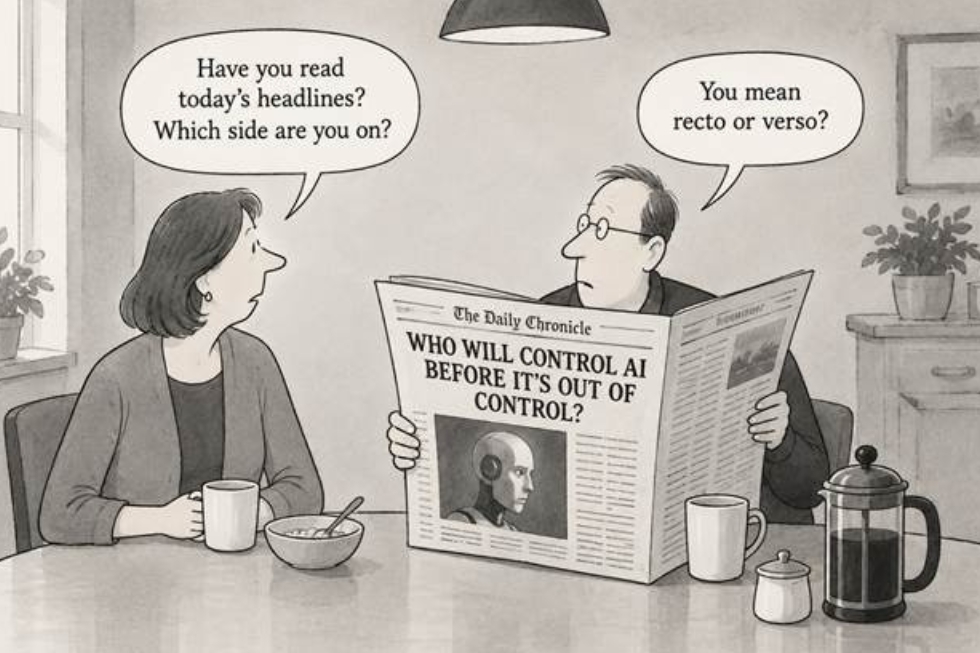



In democracies, citizens need to be informed. Luckily for all of us, we have our trusted news media who never fail to breathlessly report the dramatic facts surrounding the great issues of the day. And never has that reporting been more crucial to our sense of wellbeing. Whether it’s war, the economy or invasive technology, our media seeks to frame each of these existential issues as a question that, if left unanswered, may imply the collapse of civilization and increasingly the extinction of the human race.
Look at any day’s headlines. Take your pick between escalating wars attracting unexpected alliances, the suspicion of imperial and genocidal ambitions on the part of AI, the increasingly obscene wealth gap and an obviously worsening climate crisis. All these trends have been evolving for decades, the vacillating histories about which we all might be legitimately curious. Some of us could even consider it worthwhile taking the time to study in detail the contributing causes buried in a complex tangle of events and relationships.
Given the magnitude of the threat, we obviously need some guidance. So, what do our favorite news sources do to help us out? They do what makes the most sense for themselves. They invite us to listen to the voices of those who are convinced the danger is even greater than what we have been told to expect. Instead of encouraging us to explore and deepen our understanding of the multiple and often hidden dimensions of any of these issues, our media challenge us simply to think about what they see as the only question that matters: “Which side are you on?” Because there are always two sides.
Are you for Ukraine or Russia? Forget about the history, demography and cultural relations of both countries. Your role is to decide who is the victim and determine which one deserves victory or humiliation.
After the events of October 7, do you believe the dreadful, still unresolved conflict began on that particular day or with the Nakba of 1948? In other words, do you support Israel or Palestine?
And today, concerning events in the Strait of Hormuz, who should control the traffic: the United States or Iran?
On the question of whether we should seek to reign in billionaire wealth or encourage such people to build an ever more productive consumer economy, where do you stand?
And finally, should we mobilize all our resources to achieve AGI and superintelligence, or are you in the camp of those who wish to dismantle data centers and put a halt to AI’s mad progress?
Pick your side.
The duty to be decisive (within binary limits)
On any of these questions, sitting on the fence is not an option. The media have invested heavily in making things easier for you by defining the two competing camps. And they achieved this by removing all unnecessary sources of distraction, such as history, culture and civilizational values.
When it comes to debating issues so conveniently framed as binary choices, the rules of the game make it easy for everyone. Just as in every court case, the accused may be innocent or guilty. Every consumer of the news understands their task as a member of the jury. The first thing to do is select the issue. Use whatever evidence has been presented to decide who is the single, identifiable culprit. Don’t worry about missing evidence. You can count on the media to provide everything you need — and to ignore everything you don’t need — before making up your mind.
This leaves you with one more thing to do with your friends and acquaintances: Memorize the single prominent reason why the guilty verdict holds. If you want to show off, cite two or even three reasons that make your case. The result is that you will never need to examine facts or events in their detailed context. In the case of the Israeli–Palestinian conflict we have seen this work to perfection. Even supposed “debaters of the issues” such as television personality Piers Morgan could for a long time simply blurt out “October 7” to end any attempt at detailed discussion.
In cases of political conflict such as war, the key institutions, especially national governments, establish the narrative that the media will set as the standard from which one should never deviate. But in other cases where outcomes are unclear and there is no fixed national policy, there exists the possibility of a coexistence between two competing narratives. In such cases, the public will discover that it has a different kind of binary choice: that of believing or doubting. What the news media makes sure the public doesn’t have is the choice of examining the complex reasons for doubting. Why? Because the media has now learned its essential role is defining issues as the two sides of a binary opposition people may decide to align with. If anything, the media’s role is to confirm the idea that there is nothing to investigate.
The classic historical instance of this is the John F. Kennedy assassination in November, 1963. For more than 60 years the only interest legacy media has shown in that crime has been in denying the results of every independent investigation that has taken place. Despite a lapse of time that should have erased certain objective reasons for resistance, the media has consistently failed over the decades to show even the slightest curiosity about the release of the evidence known to exist in the government’s own archives. Even last year’s initiative by the Trump administration tasking Congresswoman Anna Paulina Luna to uncover the truth of the JFK assassination has left the media indifferent, if not hostile. And yet new evidence keeps appearing.
The JFK assassination was a traumatic event. So were the attacks of September 11. In its immediate aftermath the Bush administration claimed uncertainty about the precise identity of the perpetrator. Oddly, the president admitted no ambiguity about the unknown culprit’s motives: “They hate our freedoms — our freedom of religion, our freedom of speech, our freedom to vote and assemble and disagree with each other.”
The prime suspect, Osama bin Laden, explicitly offered as a motive his opposition to the establishment of the US military in his native Saudi Arabia. How many consumers of the media were aware of that or curious to know the history behind that reality? For the media, it made much more sense to repeat the president’s claim that “they hate our freedoms.” Once we know that, there’s no need to wonder about historical, political or even cultural context. Americans understand that the difference between themselves and the rest of the world is that they alone value freedom, to the point, by the way, of possessing a plurality of “freedoms.”
Where do you stand on AI?
What’s true of dramatic political events, assassinations and wars, is also true of other potentially existential issues. The latest, of course, concerns AI. The media is challenging us to take a stand. And with good reason, since the stakes are the survival of the human race.
In an interview last week on the podcast Breaking Points, AI researcher Nate Soares claims that “The track that we are on is that humanity is handing power over to the AIs as fast as we can.”
This sums up a belief about AI generally accepted by our media, including alternative media such as Breaking Points. Consistent with the media strategies I’ve described above, this reduces a complex issue to a simple binary opposition. Who should exercise power, AI or humanity? All reasonable people will “vote for” humanity. But all reasonably informed people should know that their vote will have at best negligeable influence.
Just as it was absurd on the part of George W. Bush to claim to know the motives of a person that no one had yet identified, I find it equally extraordinary in Soares’s assertion that neither he nor his interlocutors make any effort to define what they mean by “humanity” in terms of real agency. What’s important in their minds is to identify the two contestants — AI and humanity — not to understand who they are and how they interact.
As an exercise in the kind of critical thinking our media consistently eschews, let’s try to understand what it means to say “humanity is handing power over to the AIs as fast as we can.” Are we, the citizens of hundreds of nations, the “humanity” that is handing over power? The fact that even in our most evolved democracies the only power we citizens hold is that of voting — which means choosing between two pre-selected alternatives according to the reigning binary logic — should demonstrate that we are not the ones “handing power over” to AI.
Who then holds the power in the name of humanity? The broadest possible answer is everyone who is directly involved in financing and managing the development of AI. The narrowest answer would be Silicon Valley, Wall Street and the military-industrial complex. They are focused on empowering to the maximum AI to do the kinds of jobs that might eventually threaten humanity as a whole.
So let’s attempt to be precise and reformulate Soares’s sentence to say what it really means. “The track that we are on is that a complex US politico-economic oligarchy is handing power over to the AIs as fast as it can.”
Given the way all the issues have been defined as binary choices, some may legitimately object that China, who is also a leader in AI development, should be included in the “politico-economic oligarchy” just mentioned. That’s a case worth investigating. What are China’s motives? Do they hate us for our economic reasons, inciting them to threaten humanity in the same way Soares sees the Silicon Valley-led cabal doing it?
These are questions that deserve not just investigation but serious reporting from our media. Is that likely to happen? I think not, because it would take us out of our comfort zone of reducing complexity to a binary choice.
*[The Devil’s Advocate pursues the tradition Fair Observer began in 2017 with the launch of our “Devil’s Dictionary.” It does so with a slight change of focus, moving from language itself — political and journalistic rhetoric — to the substantial issues in the news. Read more of the Fair Observer Devil’s Dictionary. The news we consume deserves to be seen from an outsider’s point of view. And who could be more outside official discourse than Old Nick himself?]
[Lee Thompson-Kolar edited this piece.]
The views expressed in this article are the author’s own and do not necessarily reflect Fair Observer’s editorial policy.
The Death of the Expert? Why AGI Won’t Relieve Us of Dialogue — Part 1
Societies rely on “hierarchies of understanding,” where trusted experts interpret complex realities through ongoing dialogue. Tech visionaries claim Artificial Superintelligence...

For Historians, Was This a Pearl Harbor or a Suez Moment? Part 1
A conversation with Claude about the US–Israeli attack on Iran explores its potential psychological impact on Americans, the growing fracture...

FO° Talks: Is AI Now More Reliable and Trustworthy Than Today’s Journalists?
In this episode of FO° Talks, Peter Isackson and Yves Zieba explore how AI is transforming journalism, from newsroom automation...

Gray Ladies, Yellow Journalism and the Hidden Truth of Ukraine
Early in the 20th century, The New York Times earned the sobriquet “The Gray Lady.” Though the style of the...
White America’s Burden in the Holy Land
As the Biden administration bides its time, violence mounts in the apartheid state of Israel.

Support Fair Observer
We rely on your support for our independence, diversity and quality.
For more than 10 years, Fair Observer has been free, fair and independent. No billionaire owns us, no advertisers control us. We are a reader-supported nonprofit. Unlike many other publications, we keep our content free for readers regardless of where they live or whether they can afford to pay. We have no paywalls and no ads.
In the post-truth era of fake news, echo chambers and filter bubbles, we publish a plurality of perspectives from around the world. Anyone can publish with us, but everyone goes through a rigorous editorial process. So, you get fact-checked, well-reasoned content instead of noise.
We publish 3,000+ voices from 90+ countries. We also conduct education and training programs
on subjects ranging from digital media and journalism to writing and critical thinking. This
doesn’t come cheap. Servers, editors, trainers and web developers cost
money.
Please consider supporting us on a regular basis as a recurring donor or a
sustaining member.
Will you support FO’s journalism?
We rely on your support for our independence, diversity and quality.





Comment