

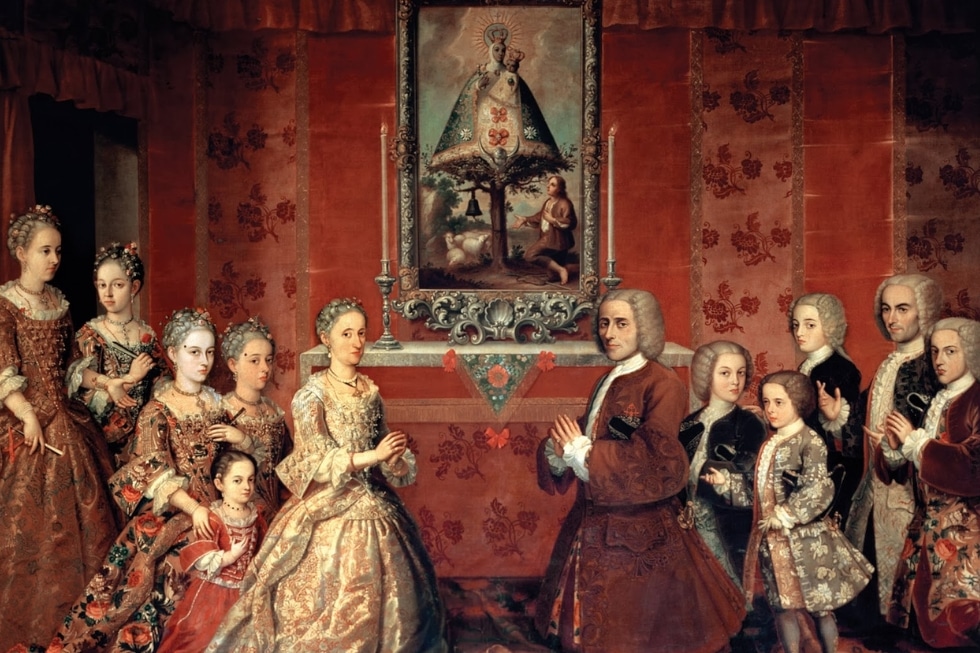



Colonial Hispanic American elites — meaning the Spaniard upper class born in the Americas — were immensely rich. In many cases, they also belonged to old Spanish lineages. Through endogamous marriages, they structured a closed social class. Depending on the countries involved and their acceptance or rejection of the independence process, they evolved in different manners. In some cases, they lost most of their power and riches but preserved an important symbolic prestige. In others, they were seen as traitors to their republics. The fortunate ones, though, maintained and increased their relevance and power after independence and were for a long time on top of the game.
This is a comparative study yet to be fully undertaken. Very little, indeed, has been written in this regard. Briefly comparing the evolution of such elites in Mexico, Peru, Colombia, Venezuela, Chile and Argentina can provide an interesting historical and sociological overview in this regard.
Mexico and Peru: standing at the top
The cases of the viceroyalties of New Spain (current Mexico) and Peru were very similar. After having respectively defeated the mighty and advanced Aztec and Inca empires, these colonies (or provinces as they were then called) were showered with gigantic silver mining riches. As a result, they represented the two main institutional and economic poles of the Spanish colonial presence in the Americas. Old aristocratic Spanish surnames and nobiliary titles abounded in them. In those two places, however, some leading members of the defeated royal Aztec and Inca families were also granted Spanish nobiliary titles.
As was to be expected, colonial elites in both cases had much to lose from independence and were strongly opposed to it. In Mexico, such a process was initiated and sustained from below, with the popular sectors rebelling against the Spanish authorities and the colonial upper class. In Peru, independence came from abroad. Initially from Argentinian and Chilean republican forces under the control of José de San Martín and later by Venezuelan and Colombian republican forces commanded by Simón Bolívar, who finally defeated the Spaniards.
Their class interests above all
Mexico’s extremely conservative colonial elites only accepted independence when the emergence of a liberal government in Spain threatened their interests. This led them to join forces with the popular insurgency that they had been fighting. Its condition in doing so, however, was that a Spanish prince of royal blood would be offered the crown of an independent Mexico. As Spain flatly rejected such an offer, the leader of this group, Agustin de Iturbide, crowned himself Emperor instead. It was, though, a short-lived experience that left those elites reputationally scarred in the eyes of their country’s citizens.
Confronted with a strong Liberal movement, Mexican conservatives, within which the old colonial elites held a forceful presence, never ceased to aspire to a monarchical regime. In the 1850s, the Liberals gained control of the country and began a series of reform laws that aimed at curtailing the power of the Church, the Army and the landed class. This provoked a military revolt by the Conservatives, within the so-called War of the Reform.
As the Liberals prevailed, the defeated Conservatives once again saw in the idea of a monarchical regime, under a European prince of royal blood, the natural solution to their predicaments. As a result, they proceeded to lobby French Emperor Napoleon III to impose a European monarch on Mexico under French stewardship and military support.
This proposal sounded like music to Napoleon’s ears, who, after his country’s military success in Indochina, aimed at expanding his Empire. The French invasion of Mexico and the enthronement of Maximilian of Habsburg as Emperor of that country followed. When, after a hard-fought war, this experiment was derailed, Conservatives and, chiefly among them, the old colonial elites were seen as traitors to their country. Moreover, whatever economic power they might still have retained was completely erased during the 1910s Mexican Revolution. On top of that, as a mixed-blood national ethos took root as a result of the revolution, the remaining members of the old colonial elite became not only utterly irrelevant but despised by a majority.
Argentina’s José de San Martín invaded the Viceroyalty of Peru, aiming at deposing its Spanish authorities. Locating his base at the north of its capital, Lima, he proposed the creation of a constitutional monarchy with a Spanish prince of royal blood on the throne of an independent Peru. Before concluding negotiations, the Viceroy and the Spanish army abandoned Lima and moved into the impregnable Andes highlands. As a result, although controlling Lima, San Martín’s army remained bogged down in a limbo for two years. As a result, Venezuela’s Bolivar and his forces took control of the campaign, organizing the difficult ascent of the Andes and, subsequently, utterly defeating the Spanish army.
A staunch republican, Bolivar didn’t want to hear anything about a constitutional monarchy. As a result, Peruvian elites who had felt at ease with San Martín’s monarchical ideas switched into supporting the Spanish side. With independence forcibly imposed upon them, Peruvian elites entered the new republic in a seriously diminished political position. Although they still preserved their economic commanding role for a few more decades, this was dwarfed by newcomers in the mid 19th century. This was when the exploitation of a then-famous organic fertilizer called guano became a sort of gold rush that gave rise to a class of new rich.
Still, at the end of the 19th century and beginning of the 20th, the old colonial elite shone for a brief and last time under the so-called “Aristocratic Republic.” When this ended in 1919, a reaction to all that they represented took shape, and a valorization of Peru’s indigenous inheritance became the ruling ideology. Amid this process, they too, as their Mexican counterparts, became increasingly irrelevant. Although not to the same extent.
Colombia and Chile: longstanding dynasties
Although coming from different backgrounds, the colonial elites from Colombia (then New Granada) and Chile evolved in similar ways. While New Granada was a Viceroyalty, like Mexico and Peru, Chile was a peripherical frontier Captaincy General (a lower administrative level). The former, though, did not have the same standing as Mexico (Nueva España) or Peru, as it was ascended to Viceroyalty status two centuries after the other two. Moreover, it never had their riches. As a result, its elites were not as economically powerful as those of Mexico and Peru, nor did they have the same aristocratic standing.
However, they were above the Chilean ones. While in Colombia the elites were mainly composed of royal officials, intellectuals and jurists, the Chilean elites were essentially military-territorial in nature, given the longstanding resistance of Chile’s indigenous populations to Spanish control. In the two cases, however, these elites also owned agricultural properties, plus gold mines in the case of Colombia.
However, both the Colombian and Chilean elites evolved in a similar way, becoming the absolute masters of the game once independence was attained. Moreover, they have retained a significant degree of presence and influence up to our days. Four reasons may explain why.
First, because they supported independence, thus being on the winning side. Second, because in both cases their independence wars were relatively light, thus allowing them to retain their properties mostly intact. Third, because they proceeded to organize the new republics on their own terms and in accordance with their own interests. Fourth, because they were essentially able to take control of the new sources of economic accumulation that appeared after independence (although sharing them with newcomers) — coffee in the case of Colombia, and copper, silver and saltpeter in that of Chile. Hence, powerful and longstanding dynasties became a feature of both countries.
Argentina: the supplanted elite
Argentina represented a particular case in many respects. Firstly, because its colonial elite was essentially commercial, as this province represented the natural interconnexion spot between Spain and Upper Peru, actively trading with both. Secondly, as it showed a lower aristocratic lineage when compared to other parts of the Spanish American empire. Thirdly, because independence (although being an extremely light process in their case) nearly shattered its commercial standing, destroying or turning upside down the trade circuits on which they depended. Fourthly, because as a result of the former, and to an important extent, these colonial elites were supplanted by a group of emerging big landowners that came to represent the new republican elite.
Fifthly, because in the second half of the 19th century those landowners integrated themselves with the world markets, thus becoming immensely rich and politically powerful. Sixthly, because between the final decades of that century and the beginning of the next, they promoted a massive European immigration that ended up cornering them — not only in political terms, but also economically. While their political control of the country disappeared as a result, they were forced to compete with an aggressive source of entrepreneurial talent that threatened to displace them. Nowadays, they are a shadow of their former selves.
Venezuela: the Canary Islands connection
Venezuela was, as well, a singular case. Within its colonial elites, perhaps the most interesting feature was the transfer into it of multiple branches of the Canary Islands’ ruling class. A process that took shape in the 17th century. In the conquest and subsequent colonization of the Canary archipelago, which dated back to the 15th century, top aristocratic Spanish lineages, Spain’s provincial gentry and Genovese banking families had converged. Among the latter, in charge of financing production and trade in the islands, were several offshoots of the so-called “28 alberghi” — the reduced group of patrician family houses that ruled the Republic of Genoa.
These Canarian elites were, above all, international agribusiness magnates. As such, when their economic model in the islands faced crisis, such as the collapse of the sugar industry, their natural reaction was to move capital and operations into Venezuela. It became a structural transfer of family and mercantile networks, as well as models of production and Atlantic trade.
The case of Simón Bolívar epitomizes well the kind of family transfer herewith involved. His father’s second surname was Ponte (that is, one of the “28 alberghi” families of Genoa), while his mother was a direct descendant of Diego de Herrera, the so-called first King of the Canary Islands, which in turn descended from medieval Castilian kings. Bolívar’s wife, also part of a Venezuelan family of Canarian bloodline, not only shared the same ancestor, Diego de Herrera, but also members of the Lercaro and Justiniani families (belonging, as well, to the “28 alberghi” of Genoa). Through this Canarian connection, and although being a peripheral colony, Venezuelan elites acquired sophisticated agricultural and trade techniques and lineage pedigree.
Resulting from the so-called Bourbon economic reforms of the 18th century, which revamped the importance of agriculture, Venezuelan elites became exceedingly prosperous. That prosperity, though, was erased with what was to be the longest, bloodiest and most destructive independence war within Spanish America. Mostly ruined in its aftermath, Venezuelan elites retained nonetheless the symbolic prestige of having initiated, led and suffered the consequences of independence. In the eyes of their country’s population, many within them became revered founding fathers.
Taking advantage of their superior education, they were able to transition into becoming the institutional backbone of the military strongmen governments that ruled the new republic. They also morphed into leading intellectuals, painters, diplomats, musicians, scientists and scholars. That is, embodying a kind of republican moral power. Within Venezuela’s extremely fluid and mobile environment, where oligarchies come and go, several of its members have been able to retain relevance up to our day.
This comparative study, which has yet to be undertaken, remains historically and sociologically important for better understanding Latin America.
[Kaitlyn Diana edited this piece.]
The views expressed in this article are the author’s own and do not necessarily reflect Fair Observer’s editorial policy.







Join the conversation
Share your perspective
Log in to share your thoughts and take part in the discussion.