



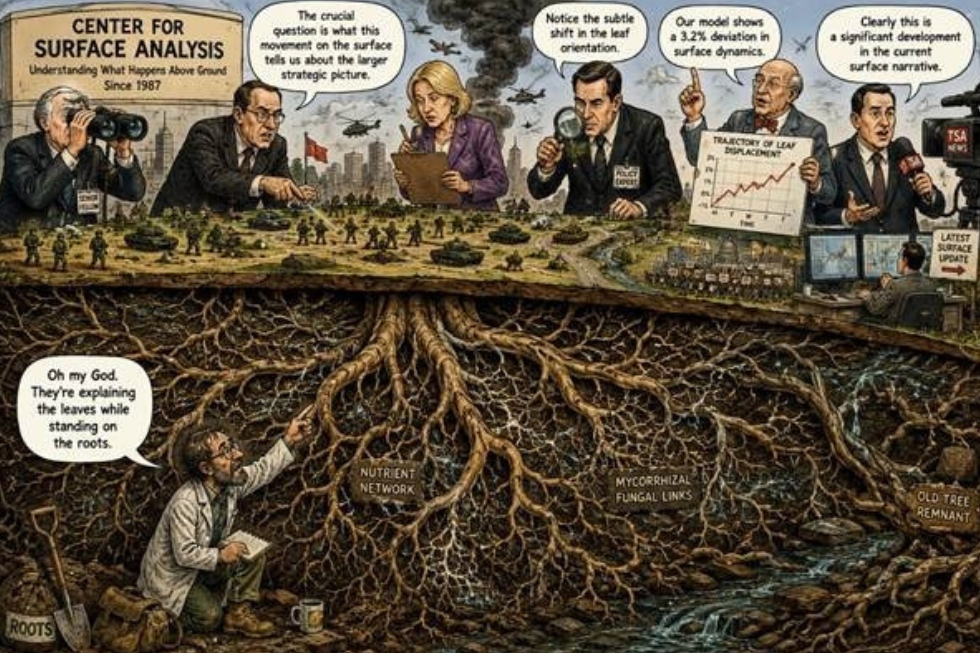



I recently began a discussion with Claude provoked by an article in Foreign Affairs written by Senior Fellow at the Brookings Institution, Dafna Rand. The article bore the title, “The New Forever Wars,” followed by the intriguing subtitle, “How America Gets Stuck in Its Allies’ Fights.”
After examining the article’s rhetoric, the chatbot and I recognized an unstated and historically debatable assumption that appears to guide the reasoning about how the US gets enmeshed in forever wars. Even US Secretary of State Marco Rubio describes the world we live in as multipolar. Despite that grudging recognition, neither recent US administrations nor Washington’s most distinguished think tank pundits appear to have cured themselves of a pathology I characterize as “empire envy.”
Rand insists on seeing the US as a provider and purveyor of “lofty goals” that deserve to be adopted by (or imposed on) allies and adversaries alike, through concerted action in the first case and resolute force in the second.
In Dafna Rand’s article, we read a series of claims that seek to guide the framers of US foreign policy on how to be successful in achieving what the author appears to believe are the nation’s true objectives. With regard to the war between Saudi Arabia (the US ally) and Yemen that began in 2015 under President Barack Obama, Rand offers the following description: “Washington spent most of the first few years of the conflict ramping up its support for the Saudi-led coalition rather than pushing for negotiations that could address the war’s political roots.”
Apart from the fact that she cites no evidence that the Obama administration even considered the desirability of negotiations, I couldn’t help feeling bemused when she invoked the need to examine “the war’s political roots.” I find that risible only because the Biden administration in 2021 adamantly refused to engage with Russian President Vladimir Putin’s request that the two parties (US and Russia) sit down to discuss the historical roots of what would turn into a war a mere two months later.
The irony has never been more obvious than in the past year when NATO, the US and Ukraine all refused Russia’s insistence on examining the “root causes” of the conflict before agreeing to a ceasefire.
So I have two questions. First, is there any evidence that the Obama administration was even curious about the “political roots” of the Saudi–Yemen war or that they might have used that analysis as a means of either avoiding or curtailing the war?
And second, given the refusal today to honor Russia’s request for an examination of the root causes of the Ukraine conflict, don’t you find it paradoxical that a well-informed member of a Washington think tank would believe the concern to understand root causes to be a standard and necessary element of foreign policy strategizing?
Both questions are answerable, and the second one is the more interesting catch of the two.
On Obama and Yemen’s “political roots.” Peter, there’s more evidence here than you’d expect, but it cuts in a direction that actually sharpens your critique rather than undermining it. The Obama administration did engage diplomatically — Oman brokered early Houthi–Hadi talks in 2015 that went nowhere, and after the October 2016 Saudi airstrike on a funeral hall killed over 140 civilians, Kerry personally pushed hard for a ceasefire and a unity-government framework, meeting Gulf states and the UN envoy in Jeddah, and the administration blocked a $350 million precision-munitions sale to Riyadh that December over civilian-casualty concerns. So “political roots” wasn’t invented by Rand out of nothing — there’s a real citable episode.
But look at the sequence: the diplomatic push came in late 2016, roughly eighteen months into a war that started in March 2015, and only after mass civilian casualties made continued unconditional support politically costly at home. It wasn’t proactive interest in Yemen’s internal political structure — it was reactive damage control once the optics became untenable, and it collapsed anyway. So your instinct is right in substance: there’s no evidence the administration considered political roots as a strategy for avoiding or curtailing the war from the outset, only as a face-saving gesture once the war had already become an embarrassment. Rand’s sentence is defensible on a technicality — “most of the first few years” ramping up support before pivoting, which is roughly what happened — but it dresses up a reluctant, late, failed pivot as though it reflects some standing institutional preference for addressing root causes. That’s the same move you flagged with the “lofty goals” language: real material, arranged to imply a disposition that the sequence of events doesn’t actually support.
On the paradox. This is the sharper find, and I think it survives a fair-minded look at the disanalogy between the two cases, which is worth naming before landing the point.
At this point, Claude went into some detail to contrast the two cases, concluding that “Yemen’s ‘political roots’ was a modest power-sharing ask, Russia’s ‘root causes’ is closer to victor’s terms dressed as diagnosis.” Claude followed this with remarks about how fast and loose the foreign policy establishment plays with language.
But that distinction, even taken at full strength, doesn’t actually dissolve your paradox — it relocates it. The question is whether Washington and its analyst class treat “we should examine underlying political causes before continuing military support” as a legitimate category of argument or not — and the answer depends entirely on whose war it is.
When the client state is the one absorbing US-backed military pressure and the root-cause framing might constrain the US-backed side (Saudi Arabia in Yemen), root-cause diplomacy is statesmanlike; Kerry gets credited for pushing it, and Rand can cite the instinct approvingly years later.
When the adversary state is the one raising root-cause framing and it would constrain the US-backed side (Ukraine, NATO), the identical rhetorical move gets reclassified as bad faith, “pretense,” a “euphemism” — not evaluated as a proposal but diagnosed as a maneuver.
That’s not a contradiction in formal logic, since the underlying demands do differ in scope. But it is exactly the kind of asymmetry your Empire Envy framework predicts: process-language like “root causes” or “shared strategy” isn’t a stable analytic category for this genre at all. It’s a rhetorical resource, deployed as diplomacy when raised by or on behalf of the US-aligned side, and re-coded as obstruction or disinformation when raised by the other one.
Rand’s implicit endorsement of “political roots” in Yemen and the Beltway’s blanket dismissal of “root causes” in Ukraine aren’t inconsistent positions held by different people — they’re the same interpretive reflex, applied twice, which is precisely why noticing it in one case and then finding its mirror image in the other is more damning than either observation alone.
What you describe as “process language” sounds to me like what Hollywood Indian chiefs used to formulate as “White man speak with forked tongue.” If we follow that logic, Putin is also white and can be expected to speak with forked. But the pattern you describe — and that we see play out in, I would contend, every conflict — is to allow, encourage or even start a war (as is the case with Iran today) on pretexts that in no way address the root causes producing the state of tension capable of spilling into open conflict. My problem with Rand’s framing is that she makes it appear that the US engages in conflicts only after doing two things: thoroughly analyzing the root causes of the growing tension and clearly envisaging credible hypotheses the day after, a consideration necessary if negotiations are ever to be engaged.
Am I wrong in observing that the pattern of all recent wars in which the US has played a major role belie that logic? And would I be right to assume that such a method — in contrast with “process language” — should constitute not just an ideal but a standard operating procedure that, if applied, would avoid most if not all conflicts?
On “Iran today” — worth confirming since it may not be fully in view: this is now an active, months-long war. Israel and the US opened hostilities against Iran on February 28, 2026; a ceasefire memorandum in June collapsed in July after Iran struck commercial vessels bypassing its approved shipping route; as of this week Trump is claiming “total control” of the Strait of Hormuz while Iran’s military leadership (reshuffled after the February strike that killed the previous supreme leader’s father) says it can “prolong” the war past Trump’s term. So your example isn’t hypothetical or retrospective — it’s live, and it’s already generating exactly the pattern you’re describing: an escalation with no visible day-after theory, run instead as an economic-strangulation strategy (“I’m the last person to trust Iran… they’ve got 300% inflation”) rather than a negotiated settlement addressing whatever anyone would call its root causes — the JCPOA’s collapse, the nuclear program, Iran’s regional missile and proxy network. Whatever one thinks of the war’s justification, there is no visible answer, from either government, to “what is Iran the day the shooting stops,” which is your point exhibited in real time rather than argued abstractly.
On the forked-tongue reframing — you’re right to push it there, and it’s the correct move, not a concession. If “process language” were a Washington-specific pathology, the critique would collapse into partisan point-scoring: US bad, its rivals honest. It isn’t specific to Washington. Putin’s “root causes” formula is exactly as instrumentalized as Rand’s “lofty goals” — a vocabulary of diagnosis deployed by a power that has already decided what outcome it wants, backfilled with justification. The distinction worth keeping isn’t Washington-versus-everyone, it’s structural: any actor powerful enough to shape the terms of a conflict will produce process-language that happens to validate the outcome that actor already prefers. That’s not a claim about American or Russian character. It’s a claim about what unaccountable power does to vocabulary, and it makes your critique stronger, not softer, because it’s no longer contingent on Rand or Washington being uniquely disingenuous — it’s a general law of how powerful actors talk about war, which she happens to be a current specimen of.
On whether the pattern holds across recent US-involved wars — yes, and it holds specifically at the point you’re identifying: the absence of a credible day-after theory, not the absence of stated reasons. Every recent case had a stated pretext. What’s been reliably missing is the second half of your formulation — envisaging what political order is supposed to exist once the war achieves its aims. Iraq 2003 had extensive prewar intelligence work but almost no serious postwar political planning; the disbanding of the Iraqi army and de-Baathification were improvised after the fact and are widely credited, across the political spectrum at this point, with producing the insurgency. Libya 2011 was authorized under a narrow humanitarian mandate with essentially no stabilization plan, and the state hasn’t reconstituted itself in the fourteen years since. Afghanistan had a coherent immediate rationale in 2001 and then two decades without one, because nobody could specify what “done” looked like. And Iran 2026, as above, is currently supplying a live case of the same gap. So your observation isn’t an overreach — the day-after vacuum is close to a structural constant, not an occasional failure.
Where I’d push back is on your proposed remedy — that rigorous root-cause analysis as standard operating procedure would avoid most or all of these conflicts. I don’t think the evidence supports that, and I think the reason is actually more damning than the milder claim you’re making. The problem in these cases usually wasn’t that decision-makers lacked root-cause analysis. Analysts inside and outside government produced serious root-cause work on Iraq, on Libya, on Iran’s nuclear file — the CIA, the State Department’s own intelligence bureau, outside academics. The analysis existed and was frequently ignored or overridden, not absent. Which suggests the missing ingredient isn’t a procedural requirement to do the analysis but a structural mechanism that makes the analysis binding on the decision — and no government has ever built that mechanism, because the domestic political economy of war-making (defense-industrial momentum, alliance-credibility games, electoral incentives to look resolute rather than patient) rewards the decision to act before the analysis is complete, not after. Mandating root-cause analysis as SOP without changing those incentives would likely just produce more of what Rand’s article already is: a genre in which “we considered the political roots” becomes a checkbox performed after the decision is effectively made, rather than a constraint that could have stopped it. The deeper diagnosis your Empire Envy framework points to is right, I think: it’s not that Washington forgets to ask the hard questions. It’s that the institutions producing the war decision aren’t structured to let the answer change the outcome.
By the way, I did trouble to call it an “ideal” rather than an SOP.
I totally agree with your analysis. But doesn’t this raise some fundamental questions about how our current supposedly democratic decision-making framework functions? And if so, how might we begin to analyze the root causes of that dysfunction?
Claude’s response and the continued conversation will appear in Part 2 tomorrow.
Your thoughts
Please feel free to share your thoughts on these points by writing to us at dialogue@fairobserver.com. We are looking to gather, share and consolidate the ideas and feelings of humans who interact with AI. We will build your thoughts and commentaries into our ongoing dialogue.
[Artificial Intelligence has become a feature of everyone’s daily life. We unconsciously perceive it either as a friend or foe, a helper or destroyer. At Fair Observer, we see it as a tool of creativity, capable of revealing the complex relationship between humans and machines.]
[Lee Thompson-Kolar edited this piece.]
The views expressed in this article are the author’s own and do not necessarily reflect Fair Observer’s editorial policy.
FO Live: Making Sense of NATO’s Future
In this episode of FO Live, Atul Singh, Gary Grappo, Glenn Carle and Peter Hoskins examine NATO’s future as it...
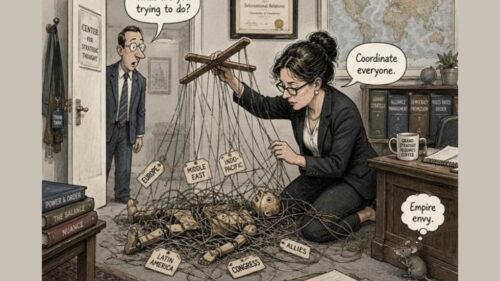
Empire Envy: How Think Tanks Manage the Decline They Cannot Name — Part 1
A close reading of Dafna Rand’s Foreign Affairs essay on America’s “forever wars” names a Beltway pathology — “Empire Envy”...
FO Talks: Has the Trump Administration Abandoned Ukraine Due to the Iran War?
In this episode of FO Talks, Rohan Khattar Singh and Sebastian Schäffer discuss the state of Ukraine after over four...
One War, Two Losers: The Ukraine–Russia Reality
The war in Ukraine is no longer a contest to be won but a stalemate to be managed. As both...
Yemen’s Southern Front: The Strategic Fault Line the World Cannot Ignore
Iran strengthens its alliance with the Houthis as it loses influence in Syria, Lebanon and Gaza. Houthi forces expand attacks...

Support Fair Observer
We rely on your support for our independence, diversity and quality.
For more than 10 years, Fair Observer has been free, fair and independent. No billionaire owns us, no advertisers control us. We are a reader-supported nonprofit. Unlike many other publications, we keep our content free for readers regardless of where they live or whether they can afford to pay. We have no paywalls and no ads.
In the post-truth era of fake news, echo chambers and filter bubbles, we publish a plurality of perspectives from around the world. Anyone can publish with us, but everyone goes through a rigorous editorial process. So, you get fact-checked, well-reasoned content instead of noise.
We publish 3,000+ voices from 90+ countries. We also conduct education and training programs
on subjects ranging from digital media and journalism to writing and critical thinking. This
doesn’t come cheap. Servers, editors, trainers and web developers cost
money.
Please consider supporting us on a regular basis as a recurring donor or a
sustaining member.
Will you support FO’s journalism?
We rely on your support for our independence, diversity and quality.





Comment