





[This is the second part of a five-part series adapted from Dr. Noa Gafni’s report, The New Five Forces: A Blueprint for Business in an Uncertain World. To read more, see Part 1 here.]
In the first installment of this series on the New Five Forces, we examined how technological disruption is reshaping industries with unprecedented speed. But Technology is just one of the forces transforming the business environment. The New Five Forces framework argues that organizations must navigate the convergence of Technology, Geopolitics, Society, Environment and Economy, all of which increasingly exert pressure from outside traditional industry boundaries.
We now turn to Geopolitics.
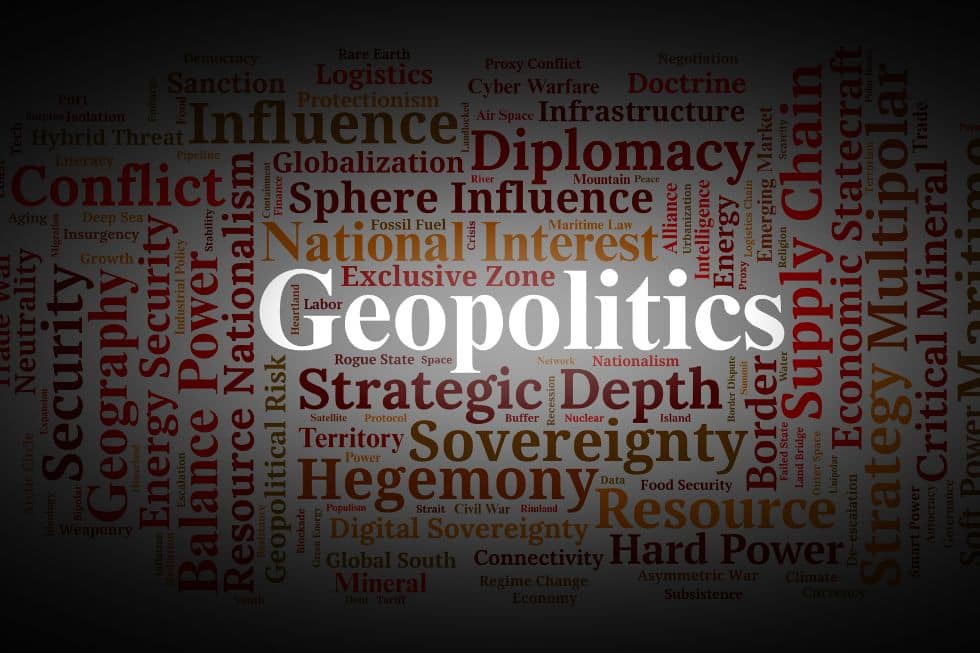
The second force: Geopolitics
For most of the post-Cold War period, geopolitics created corporate tailwinds. Globalization opened markets, lowered trade barriers and created the conditions for supply chains optimized entirely around efficiency rather than resilience. The assumption was that political stability and open trade were permanent features of the operating environment. The integration of China, the expansion of the European single market and the proliferation of free trade agreements created a world where geography was central to commerce. Executives could build global operations without taking into account political considerations.
Between 2016 and 2022, the reemergence of nationalism, weaponization of supply chains and acceleration of great power competition between the United States and China have now made geopolitics material to strategy. For many executives trained in the 1990s and 2000s, the speed of this reversal has been disorienting and disturbing. The analytical tools of geopolitics, from the assessment of state interests to the modeling of conflict scenarios, require specialized knowledge that many organizations have historically not had.
Geopolitics also demands the structural flexibility to proactively engage before disruption occurs, rather than respond to a crisis. This requires companies to have a fundamentally different relationship with governments. The lobbying model of the past, where companies worked with intermediaries to protect their industry’s interests, is insufficient. The organizations navigating the Geopolitics force most effectively have learned to engage governments directly, building ongoing relationships, sharing information and making themselves useful to national interests in order to build goodwill.
The semiconductor chess game
Nowhere is the geopolitical chess game playing out more clearly than in the semiconductor industry. Taiwan Semiconductor Manufacturing Company (TSMC) produces approximately 90% of the world’s advanced chips. It is also at the center of a geopolitical competition to win the AI race.
TSMC was so central to geopolitics that it was called a “Silicon Shield” for Taiwan. The US, China, Europe, Japan and South Korea each have stakes in the continued operations of TSMC. But their interests are mutually incompatible as the race to “win” in an AI future is leading both the US and China to react. The US CHIPS and Science Act of 2022, which committed over $50 billion to domestic semiconductor manufacturing, was in part a direct response to TSMC. The CHIPS Act created incentives for TSMC to build plants in Arizona, which TSMC did in order to manage geopolitical risk.
The TSMC case illustrates what happens when the private sector becomes enmeshed in national security interests. For most companies, the TSMC scenario is extreme, but the underlying dynamic is not. Companies in the US with significant China operations create decoupling scenarios. European executives navigate a regulatory environment that is diverging from the American one.
The implication is that every organization with global operations now carries geopolitical exposure. These must be mapped, stress-tested and actively managed. And it requires leaders who understand political relationships and are building those relationships before they are needed, not after they have failed. The Geopolitics force only grows more complex as the global order continues to shift.
Key takeaways
- Geopolitical exposure must be mapped and stress-tested. All corporations with global operations have geopolitical exposure. They must scenario-plan accordingly.
- The lobbying model is obsolete. Companies need direct government relationships, not intermediaries, especially in sectors touching national security, supply chains or critical infrastructure.
- Supply chains must be built with redundancy in mind. The TSMC case shows that cost-optimized global supply chains can become geopolitically untenable almost overnight. An overly efficient supply chain is more prone to geopolitical chess games.
- Proactive engagement is a must. Companies must build political relationships before they are needed. CEOs are now joining US President Donald Trump on trips to China, for example. Other companies and countries are similarly enmeshing business with politics.
- Great power competition creates forced choices. Companies with significant US and China operations should be prepared for a number of decoupling scenarios. The tenuous relationship between the US and Europe should be followed closely as well.
TikTok: surviving a geopolitical storm
TikTok’s rise represents one of the most consequential convergences of the Technology and Society forces in recent business history. Its algorithmic recommendation engine proved capable of delivering relevant content to users.
TikTok identified and served an unmet social need: the desire for unpolished content from ordinary people rather than the aspirational content from influencers that dominated Instagram. That insight, combined with the recommendation algorithm’s ability to surface relevant content regardless of follower count, captured attention in a new way. Creators without large existing audiences could achieve significant reach.
The Geopolitics force defined TikTok’s constraints as sharply as the Technology and Society forces defined its growth. Its ownership by a Chinese company placed TikTok at the center of US–China technology competition and generated sustained regulatory pressure in the US, Europe and India. This led to a restructuring of its US business, which is now majority-owned by American investors. That TikTok still exists in the US shows its deft ability to manage geopolitical exposure as well.
TikTok is particularly salient because its product success was in sharp contrast with geopolitical headwinds. TikTok created a new social media platform with exceptional skill. What it underestimated was the degree to which geopolitical exposure could override its product excellence. The lesson is that no force can be safely ignored. All organizations navigating the Technology–Society intersection must build geopolitical fluency into their strategy proactively.
Beyond Geopolitics
The lesson extends beyond semiconductors and international trade. Organizations that once viewed geopolitics as a distant concern must now account for it as a core strategic variable. Political relationships, government priorities and shifting alliances increasingly shape where companies invest, manufacture and grow.
Yet geopolitical realities are only part of the challenge. Organizations must also navigate changing expectations from consumers, employees and communities, all of whom are exerting new forms of influence on corporate decision-making.
The next entry in this series will examine the force of Society.
[Lee Thompson-Kolar edited this piece.]
The views expressed in this article are the author’s own and do not necessarily reflect Fair Observer’s editorial policy.
FO Talks: The Iran War Could Crash the Global Economy, Here’s How
In this episode of FO Talks, Atul Singh and Manu Sharma examine how the Iran war is triggering a global...
The Emergence of the New World Order and the Decline of the US
The current world order is undergoing several geopolitical upheavals that are reshaping world politics to carve out a new order...
Tariffs and Tech: How Geopolitics Is Changing Venture Capital
US President Donald Trump launched a package of tariffs on April 2, 2025, aiming to reset global trade in favor...
The New Cold War: How Polycrises Threaten Every Business
The global landscape is shifting from a unipolar order to a multipolar "Axis of Disorder," characterized by rising geopolitical tensions...
The New World Order Is Disorder
US power is declining and an Axis of Disorder is rising to take its place. The world order is becoming...

Support Fair Observer
We rely on your support for our independence, diversity and quality.
For more than 10 years, Fair Observer has been free, fair and independent. No billionaire owns us, no advertisers control us. We are a reader-supported nonprofit. Unlike many other publications, we keep our content free for readers regardless of where they live or whether they can afford to pay. We have no paywalls and no ads.
In the post-truth era of fake news, echo chambers and filter bubbles, we publish a plurality of perspectives from around the world. Anyone can publish with us, but everyone goes through a rigorous editorial process. So, you get fact-checked, well-reasoned content instead of noise.
We publish 3,000+ voices from 90+ countries. We also conduct education and training programs
on subjects ranging from digital media and journalism to writing and critical thinking. This
doesn’t come cheap. Servers, editors, trainers and web developers cost
money.
Please consider supporting us on a regular basis as a recurring donor or a
sustaining member.
Will you support FO’s journalism?
We rely on your support for our independence, diversity and quality.





Comment