


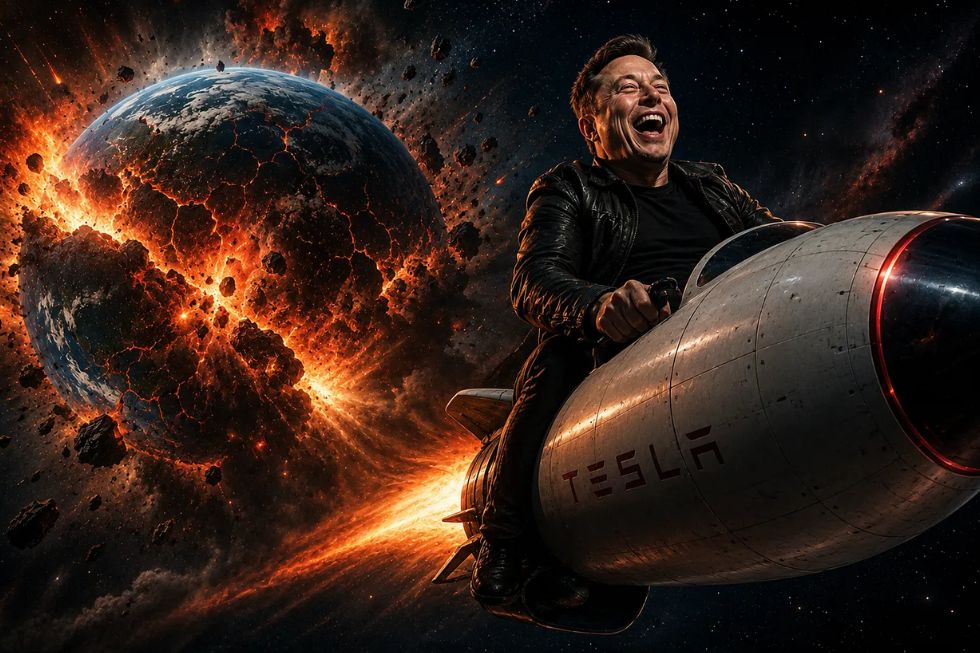



Let’s begin with the concession, because it is real and because skipping it is how you lose the argument. SpaceX landed an orbital rocket upright when the entire industry called it fantasy, then did it more than five hundred times until the cost of reaching space collapsed. It strung the largest satellite constellation in history across the sky and sold broadband to the places fiber will never reach. Starlink booked $11.4 billion last year and $4.4 billion in operating income: a magnificent business, maybe the best of its decade.
Musk did not invent the rocket or the phased-array antenna or the language model; he is not Nikola Tesla, conjuring from first principles. He is something rarer in practice: an assembler who bolts existing technologies together at a pace and scale almost no one alive can match, aimed at needs the market hadn’t yet thought to name. Grant him every bit of it.
Now open the prospectus, and watch the achievement turn into the alibi.
SpaceX is eating itself — so why is it still leading?
Past the fourteen opening pages of rocket photography, past the sentence — verbatim — “We do not want humans to have the same fate as dinosaurs,” sits the arithmetic. SpaceX lost $4.94 billion in 2025, the year it filed to go public, after earning $791 million the year before. It lost another $4.28 billion in the first quarter of 2026. The company seeking the richest valuation in the history of markets got dramatically poorer on its way to the altar.
The wound is self-inflicted and named xAI, the AI business folded in months before the offering: $3.2 billion of revenue against a $6.4 billion operating loss, and $12.7 billion of capital expenditure, more than the company spent on rockets and satellites combined. Strip the story to its mechanics, and it is simple. Starlink is a great business being bled to feed a furnace strapped to its hull.
So what are investors paying for? At the offering’s $1.75 trillion floor, roughly 94 times trailing revenue. The most expensive stock in the S&P 500, Palantir, trades at 67 times sales. Meta went public, growing 88% a year at 28 times revenue; Google, growing 240%, went out at 10. Value SpaceX’s three segments at twice what their public rivals command — a deliberately “soft ball” exercise — and you reach about $1 trillion. The remaining three-quarters of a trillion dollars rests on one device: a “total addressable market” (TAM) of $28.5 trillion, nearly the size of the entire US economy, of which $22.7 trillion is filed under “enterprise AI,” about thirty times the size of the enterprise software market that actually exists.
Name the trick precisely, because precision is what makes it land. The TAM is not a lie. It is hedged, sourced to consultants, stamped as an estimate that “may prove to be inaccurate.” It is something more corrosive than a lie: a number engineered to be unfalsifiable, swapped in for the discounted cash flows a normal company would have to show. You cannot disprove a claim on thirty times a market that does not yet exist. That is the entire purpose of building one that size. The bet was never that the numbers add up. The bet is that they will never have to.
And they will never have to, because every mechanism that normally forces the reckoning is being disabled — one institution at a time, in public, on his behalf.
Elon Musk doesn’t have to go to Mars for his money
Start with Musk’s pay, the single cleanest specimen of the whole enterprise. The board granted Musk one billion restricted Class B shares. On paper, the conditions are science fiction. They do not vest until SpaceX is worth $7.5 trillion and he has planted a permanent colony of at least one million people on Mars. A package you can wave at the public as proof that he only wins if humanity wins.
But if you read the stock-award agreement attached to the filing, the trick falls out. He can vote those billion shares now — before a single one vests, before the first Martian draws breath — so the grant swells the voting lock he already holds. He can pledge them now as collateral for loans, converting paper he has not earned into cash he can spend. And because the law does not treat unvested shares as income, he owes no tax on them until they vest, which, given the Mars condition, may be never. Vote them, borrow against them, defer the tax forever: he extracts the power and the liquidity of ownership while accepting none of its obligations. The milestones aren’t targets. They’re set dressing — there so he can say he is paid in Mars while he is, in fact, paid now. (The board approved this, the pension funds note, with no independent compensation committee in the room. A second tranche of 60.4 million more super-voting shares rides on building data centers in space.)
That is the man. Here is the machine being rebuilt around him.
Musk draws the lines now
You may end up owning this company whether you assess it or not. Effective May 1, Nasdaq rewrote its own rulebook, cutting the “seasoning” period before a new company can enter the Nasdaq-100 from three months to fifteen trading days, and waiving the minimum-float requirement that has stood for decades. Seasoning exists for one reason: to let a volatile new stock find an honest price before the index funds — the passive vehicles inside your 401(k), buying mechanically, without judgment, in proportion to weight — are forced to swallow it.
Goldman Sachs estimates the change could compel up to $60 billion in Nasdaq-100 buying alone. FTSE Russell has loosened its float rule; S&P is consulting on halving its seasoning window and waiving the profitability test outright. The rule that kept Tesla out of the index until 2020, long after it was one of the most valuable companies on Earth, is being broken on purpose for the largest and greenest issue ever floated. You needn’t take my word that this is improper. A portfolio manager at Acadian wrote that the proposal “stinks.” The Wall Street Journal’s Jason Zweig called it “arbitrary, unfair and potentially risky.” A market technician named Ian McMillan said it plainly on X: “They are openly looting the coffers.”
Now, let’s turn to the governance, where the design stops pretending. Through ten-vote super-voting stock, Musk will command somewhere between 79% and 85% of the vote — the range itself a function of how you count that unvested billion-share grant — while owning roughly 42% of the equity. He is chairman, chief executive and chief technology officer at once. He can be removed only by a vote of the share class he himself controls: unfireable, as a matter of arithmetic, without his own consent. Shareholder claims are forced out of open court into private arbitration. Under SpaceX’s new Texas incorporation, filing a derivative suit demands a 3% stake — billions of dollars of stock — a bar that at this valuation essentially only Musk could clear. None of this is my framing. It is the substance of a May letter from the comptrollers of New York State and New York City and the chief executive of CalPERS (California Public Employees’ Retirement System) — fiduciaries for more than a trillion dollars of teachers’ and firefighters’ savings, who will be forced by index inclusion to hold this stock, and who wanted their objection on the record.
The Harvard scholar Lucian Bebchuk and Tel Aviv’s Kobi Kastiel supply the part the filing will not say aloud: The structure is built so Musk can eventually become a small-minority controller, diversifying his stake down toward 9%, lower still through nonvoting shares, without ever loosening his grip. The math of that arrangement is merciless. A controller who owns a sliver pockets the full value of every self-dealing decision while bearing only his fraction of the cost, which means the incentive to extract grows precisely as his stake shrinks. The related-party plumbing is already running — Tesla’s $2 billion poured into SpaceX, the all-stock swallowing of xAI, the Terafab chip venture, the option over Cursor — every transaction consummated before a single public shareholder held a vote.
Systems are eroding to benefit the few
Step back far enough, and the separate outrages resolve into one shape. A compensation plan that hands him ownership’s spoils and none of its duties. Three index providers suspending the rules that protect ordinary savers, so his stock can be bought without being judged. A charter that makes him unremovable and his decisions unchallengeable in any court that publishes its reasoning.
Each was granted by people who knew better and did it anyway — bankers chasing the fee, exchanges chasing the listing, a board chasing his favor. That is the actual story, and it is bigger than one inflated valuation. The systems were built so that no individual, however rich, could stand above the price discovery and the legal accountability the rest of us are bound by. One by one, for one man, those systems are being quietly reengineered to make an exception. A bubble pops and the foolish lose money. This is different. This is the slow conversion of public markets — the commons where a teacher’s pension and a billionaire’s fortune were supposed to obey the same rules — into something closer to a private domain, where the lord sets the terms and the rest of us are simply made, by the mechanics of our own index funds, to hold his paper and call it ownership.
And do not mistake this for one man’s singular brazenness. SpaceX is only the most naked instance of a structure already in place across the platform economy — the same proportional rent Apple extracts from every developer, the same dependency Amazon enforces on every seller, the same private control of public infrastructure that let Musk throttle Starlink over Ukraine and Zuckerberg arbitrate the speech of three billion people. What is new is not the appetite; it is the scale at which a handful of owners now sit astride the rails that nations, markets, and citizens are obliged to run on.
The last time private commercial entities accumulated this kind of sovereign reach — the East India Company minting money and raising armies, governing a subcontinent for the better part of three centuries — the state eventually clawed control back, but only after generations of extraction. The SpaceX prospectus is a preview of what that clawing-back will have to overcome, written in the language of a company that has decided the rules are for other people.
The rocket is real. The reckoning is what’s being engineered away. And the most dangerous thing Musk has ever built is not his pitiful X-persona. It is the precedent the prospectus sets: The rules bend if you are large enough to make bending them profitable for everyone whose job was to hold the line.
[Cheyenne Torres edited this piece.]
The views expressed in this article are the author’s own and do not necessarily reflect Fair Observer’s editorial policy.
A Trillion Reasons Democracy Is Doomed
Two new “trillionaires” — the US military and Elon Musk — now occupy the headlines. Both represent a dangerous concentration...
Beyond the Breach: Safeguarding the Integrity of Private Banking
In private banking, the digitization of judgment creates a dangerous paradox as systems can remain technologically resilient while becoming substantively...

Private Credit Turned Out to Be an Illusion. What’s Next?
The global financial system faces stress as private credit funds struggle with investor withdrawals. BlackRock froze redemptions after massive requests,...

The Evolution of Capitalism: Why Markets Defy Feudal Aristocracy
Some argue that growth is reliant on the wealthy’s spending, but modern capitalism relies on freedom and mass participation. Wealth...
Support Fair Observer
We rely on your support for our independence, diversity and quality.
For more than 10 years, Fair Observer has been free, fair and independent. No billionaire owns us, no advertisers control us. We are a reader-supported nonprofit. Unlike many other publications, we keep our content free for readers regardless of where they live or whether they can afford to pay. We have no paywalls and no ads.
In the post-truth era of fake news, echo chambers and filter bubbles, we publish a plurality of perspectives from around the world. Anyone can publish with us, but everyone goes through a rigorous editorial process. So, you get fact-checked, well-reasoned content instead of noise.
We publish 3,000+ voices from 90+ countries. We also conduct education and training programs
on subjects ranging from digital media and journalism to writing and critical thinking. This
doesn’t come cheap. Servers, editors, trainers and web developers cost
money.
Please consider supporting us on a regular basis as a recurring donor or a
sustaining member.
Will you support FO’s journalism?
We rely on your support for our independence, diversity and quality.





Comment