


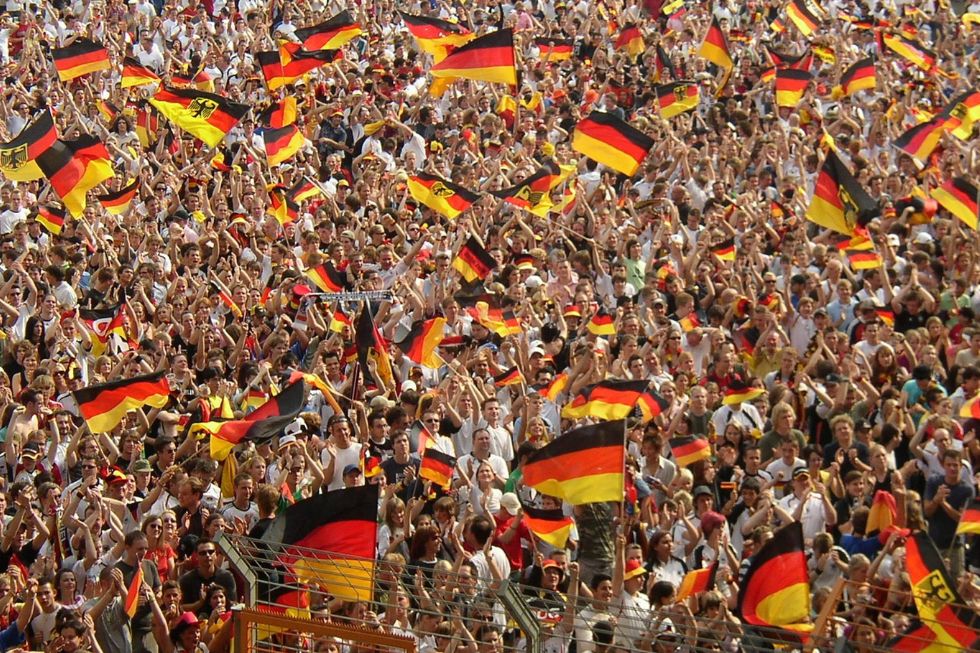



“From the football pitch to politics to the economy, Germany has become Europe’s most powerful country,” The Economist wrote in 2013.
Today, Germany has been shaken by a series of political and economic crises — from the Covid-19 pandemic to war in Europe — fueling nostalgia for a more optimistic and ostensibly uncomplicated past. In that search, attention often turns to the early years of Angela Merkel’s chancellorship — and to the 2006 World Cup, the subject of a recent three-part German documentary series.
That nostalgia is easy to understand. In 2006, Germany welcomed the footballing world under the slogan “A time to make friends.” Flags covered balconies and cars; public screenings of matches turned into festivals. German footballer Philipp Lahm opened the tournament with a curling shot into the top right corner against Costa Rica, and Germany’s run to the semifinals helped shape the tournament into what many remember as weeks of seemingly carefree celebration. The German news magazine Der Spiegel headlined: “A happy nation — Germany, a summer fairy tale — the World Cup becomes a national Love Parade,” referencing the country’s once famous techno parade to evoke mass celebration. The magazine suggested that Germany had begun to “settle into its own history.” In a country long defined by its struggle with the Nazi past, this was a loaded idea.
For many, the tournament symbolized a newfound ease with national identity. Then-UN Secretary-General Kofi Annan remarked, “Here you see a united and happy German people … No one sees the spirit of today’s Berlin or of the Germans as being in any way connected to the past.”
The narrative of a carefree summer — one in which Germany supposedly showed what it is really like — has become something of a national myth. Questioning it is often seen as needlessly negative. For many, it feels like a spoilsport attack on the “summer of their lives.” Not even later corruption allegations surrounding Germany’s successful bid to host the 2006 World Cup sufficed to fundamentally shake this collective memory.
In light of growing far-right and exclusionary views — and rising support for authoritarian and anti-immigration positions — an uncomfortable question must be asked: How harmless was the “summer fairy tale” really? What kind of impact do large-scale sporting events have? And how do they shape and intensify national sentiment?
Sporting events and national identity
Major sporting events like the FIFA World Cup have become central moments of collective communication in modern societies. They are mass media events with enormous reach and a powerful capacity to mobilize emotions and participation. These events are far from politically neutral. They function as global stages where political, social and economic interests are expressed and advanced.
Studies show that such events can affect how strongly people identify with their nation. A key factor is the degree of emotional and practical engagement: The more people feel involved — through shared experiences, celebrations and media consumption — the stronger their sense of belonging becomes.
Through their narratives, symbols and rituals, sports and media mega-events make the host nation emotionally tangible. In Irish-American political scientist Benedict Anderson’s sense, the “imagined community” of the nation becomes something people can actually feel. In Germany, football-driven patriotism has thus become a mass phenomenon deeply rooted in the social mainstream.
At the same time, research points to double-edged effects. A German study found that pride in national sporting success is positively correlated with nationalism and xenophobia, raising doubts about whether sports can foster patriotic attachment without simultaneously reinforcing exclusionary attitudes.
Surveys conducted by the University of Marburg suggest more strongly that the 2006 World Cup contributed to an increased acceptance of nationalist views: “Individuals surveyed after the World Cup expressed more nationalist and less purely patriotic attitudes than those surveyed before the tournament.”
The myth of the “summer fairy tale”
These studies challenge the dominant images of 2006 that continue to shape Germany’s collective memory. German writer Max Czollek reflected in 2018:
In 2006, people behaved as if they were shaking off a heavy burden they had carried for a long time … Germans experienced the World Cup as a collective sense of relief that it was finally acceptable to wave the national flag again, like in the past.
The sociologist Wilhelm Heitmeyer had already dismissed the image of a peaceful, open-minded patriotism in 2006 as “dangerous nonsense.” His warnings about the risks of so-called “party patriotism” were often seen as overly pessimistic. In hindsight, however, they appear strikingly prescient.
As of 2026, the far-right Alternative für Deutschland (AfD), which is monitored by Germany’s domestic intelligence agency, has become the largest opposition party and leads national polling in some surveys. Although it has never been part of the federal government, it has shaped political discourse for over a decade. It has steadily pushed the boundaries of what is considered acceptable further to the right. Its growing strength has raised concerns about democratic stability. Reflecting this, voices within the governing coalition led by incumbent Chancellor Friedrich Merz have described the current government’s success or failure as a make-or-break moment for German democracy.
Exploiting patriotism politically
The 2006 World Cup can be read as a highly visible moment in the broader normalization of national pride — and as a symbolic loosening of what some had long described as an excessive or “misplaced” sense of historical guilt. It helped make a vocabulary of national identification more socially acceptable, creating an emotional and symbolic terrain that far-right actors later found easier to appropriate. The AfD did not invent these sentiments; it sought to capitalize on them.
If this link seems far-fetched, consider Götz Kubitschek, a key figure in Germany’s far-right intellectual scene, who describes the AfD’s strategy as “normalization patriotism” — a deliberately low-threshold, broadly appealing and seemingly harmless form of national identification designed to serve as a common point of reference.
In a 2025 special issue titled “Football: The National Sport – The Heartbeat of a German Passion,” the far-right magazine Compact claimed that patriotism “releases feel-good hormones.” After Germany’s early exit from the World Cup in Qatar, the right-wing conservative weekly Junge Freiheit struck a nostalgic tone, recalling the 2006 “summer fairy tale” as “collective loosening-up toward a more relaxed, unselfconscious patriotism.”
The AfD itself openly recognizes the political and identity-building power of sport. In its 2025 policy guidelines on sports, the party emphasizes that sporting success fosters “positive identification with one’s own nation,” explicitly citing the 2006 World Cup as a key example.
This strategy fits into a broader modernization of right-wing extremism. It marks a departure from the more overt neo-Nazi subcultures that were still prevalent in 2006, and that had dismissed the World Cup’s mainstream, apolitical enthusiasm as a shallow, system-conforming display.
Patriotism as a vehicle for historical revisionism
The normalization of patriotism as part of the AfD’s broader identity is closely linked with its ethnonationalist and revisionist approach to history — one that seeks to downplay or reframe the memory of Nazi crimes and their victims. In its 2016 party manifesto, the AfD called for an end to what it described as the “narrowing” of German historical memory to the period of National Socialism, advocating instead for a more “balanced view” that emphasizes supposedly positive and identity-forming aspects of German history.
Leading figures within the party have made this position explicit. Alexander Gauland, the party’s honorary chairman, notoriously referred to the Nazi era as “a speck of bird droppings in over a thousand years of successful German history.” Björn Höcke, one of its most influential and controversial extremist figures, demanded a “180-degree turn” in the country’s politics of remembrance.
Similarly, party chairwoman Alice Weidel has rejected the widely accepted German framing of May 8, 1945 — the day of Nazi Germany’s surrender — as a “day of liberation,” arguing that it is inappropriate to celebrate what she describes as the defeat of one’s own country. Against this backdrop, her call for Germany to “be proud of itself again” becomes part of a broader political project — one that links national self-affirmation to a redefinition of how history is remembered and interpreted.
For actors seeking to promote a more affirmative national narrative, the 2006 “summer fairy tale” can function as a useful point of reference within a broader national narrative: one in which the Nazi past serves primarily as a negative backdrop to a supposedly renewed, democratic present. This framing can obscure deeper continuities and mask broader social tensions.
Distraction in the euphoria of sport
Moments of national self-celebration and patriotic euphoria can create societal blind spots, masking those tensions. Even as Germany celebrated its “summer fairy tale” in 2006, the country was already experiencing a wave of far-right violence. Between 2000 and 2007, the neo-Nazi terrorist group National Socialist Underground (NSU) murdered ten people, most of them of Turkish descent.
Victims’ families held demonstrations during the World Cup. Yet for years, investigations wrongly focused on the victims’ social circles — shaped in part by racist stereotypes. The NSU’s responsibility for the murders, as well as the extent of failures within Germany’s security agencies, only came to light in 2011. The contrast is striking: While the country celebrated itself as open and welcoming, the most serious far-right murder series in postwar Germany remained largely unrecognized at the time.
A more nuanced patriotism
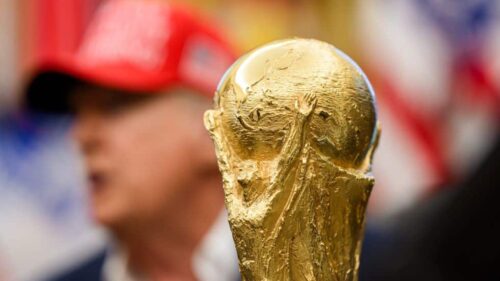
As the next World Cup approaches in the US, similar dynamics may come into view. The Trump administration is likely to use the tournament to project belief in American exceptionalism (“America First”) through highly visible, “performative patriotism.” A form of patriotism long rooted in an “idol worship of America-branded totems, like flags and statues” — a tradition amplified and radicalized by President Donald Trump’s Make America Great Again movement.
But does patriotism inevitably have to lead to self-aggrandizement and political instrumentalization? Or are there other ways to express a sense of national belonging?
Attachment to one’s country can also be self-critical and nuanced. The German-Iranian writer Navid Kermani articulated this in a 2014 speech in the German Bundestag marking the 65th anniversary of Germany’s Basic Law. Rejecting the idea of a “normal” and “unstrained” relationship with the nation, he argued: “There never was such a normal and unstrained relationship — not even before National Socialism.” Instead, German history has always contained both “an excessive, aggressive nationalism” and “a strong tradition of self-criticism, a commitment to Europe, and a turn toward cosmopolitanism.”
Echoing a sentiment by former Chancellor and winner of the Nobel Peace Prize Willy Brandt, Kermani concluded: “A good German cannot be a nationalist.”
And yet, Kermani expressed pride in a different Germany: “Not a boastful one, not the swaggering one … a country that has matured through its own failures and no longer needs grand displays … This is the Germany I love.”
[Kaitlyn Diana edited this piece.]
The views expressed in this article are the author’s own and do not necessarily reflect Fair Observer’s editorial policy.
Will Trump Turn the World Cup into a MAGA Triumph?
The FIFA World Cup kicks off on June 11, and America is hosting several matches. But does US President Donald...
The Returning Nightmare: Europe’s Far Right and the Fading of Democratic Memory
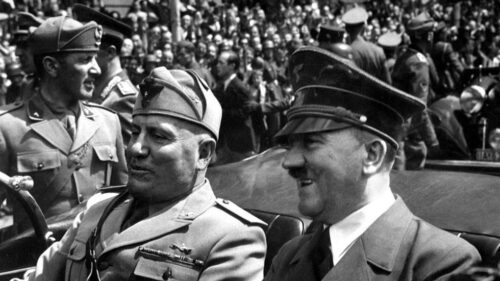
The resurgence of far-right movements throughout Europe is a result of several converging issues: a decline in historical awareness, unchecked...
How the Far-Right is rewriting Germany’s 2015 “Refugee Summer”
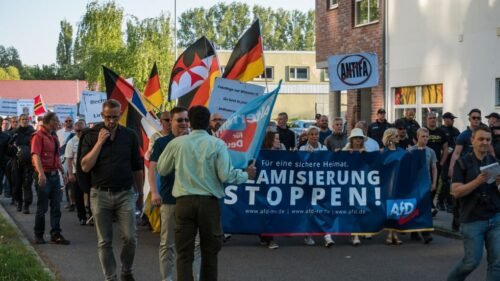
Ten years after Germany accepted nearly 900,000 refugees, politicians have rewritten the story of the 2015 “refugee summer” as a...
Support Fair Observer
We rely on your support for our independence, diversity and quality.
For more than 10 years, Fair Observer has been free, fair and independent. No billionaire owns us, no advertisers control us. We are a reader-supported nonprofit. Unlike many other publications, we keep our content free for readers regardless of where they live or whether they can afford to pay. We have no paywalls and no ads.
In the post-truth era of fake news, echo chambers and filter bubbles, we publish a plurality of perspectives from around the world. Anyone can publish with us, but everyone goes through a rigorous editorial process. So, you get fact-checked, well-reasoned content instead of noise.
We publish 3,000+ voices from 90+ countries. We also conduct education and training programs
on subjects ranging from digital media and journalism to writing and critical thinking. This
doesn’t come cheap. Servers, editors, trainers and web developers cost
money.
Please consider supporting us on a regular basis as a recurring donor or a
sustaining member.
Will you support FO’s journalism?
We rely on your support for our independence, diversity and quality.





Comment