






 | ||
| ||
| ||
Dear FO° Reader, Greetings once again from the United States, where we bring you yet another follow-up article on a previous topic: elections. A few weeks ago, we discussed the Supreme Court striking down key provisions of the landmark 1965 Voting Rights Act, which is already redrawing congressional maps to favor incumbents, mostly Republicans. However, in the wake of this backsliding of democratic ideals, one state has passed an important measure that fights back against another of the Supreme Court’s regressive decisions: Hawaii has passed a measure that will disallow corporations from spending money on elections. This has sent some tremors across the US political landscape, even if it was quickly paved over by other, louder news. But if this law continues forward, it could have a major positive impact on the United States in a time when it seems like only terrible things are happening.
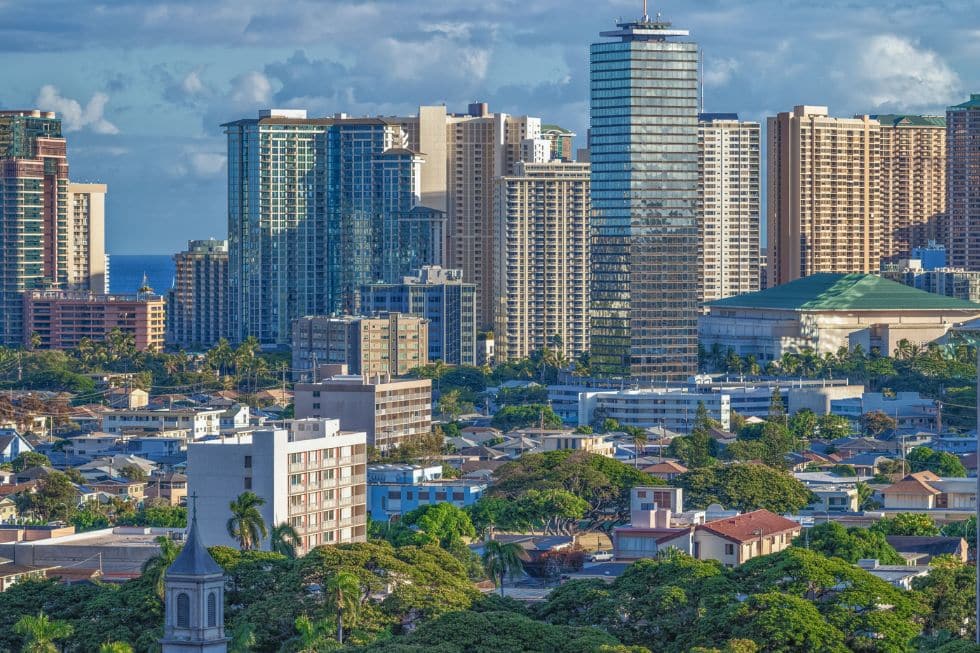
Center of Honolulu, Capital of Hawaii, via Shutterstock Citizens United: corporations are people, my friend In 2010, the US Supreme Court under Chief Justice John Roberts, who is still serving today, decided the landmark Citizens United v. Federal Election Commission case. In the ruling, the court’s Republican-appointed majority decided that laws preventing corporations or other legal bodies from spending money on political advertising went against the First Amendment, which guarantees freedom of expression to all US citizens. This immediately altered how American politics works on a fundamental level, with corporations pumping billions into Political Action Committees (PACs), to the point where they are called super PACs. These organizations wield enormous amounts of cash to buy airtime and other advertisements for their chosen candidate, which also effectively made donations extremely difficult to track. These donations are dubbed “dark money.” Predictably, this had a thousand knock-on effects and immediate criticism from many people in many positions of power, from local journalists and activists to then-President Barack Obama openly denouncing the decision in his State of the Union address a week after the verdict. Democratic lawmakers tried to write bills to overturn the decision, but they died in Congress. Money instantly started flowing into American politics, with estimates of super PAC spending in 2010 rising as high as $62.6 million. In 2024, these organizations’ budgets had ballooned to over $4.1 billion. Polls have shown the decision to be extremely unpopular with the American public, with one conducted in 2025 having 79% of respondents across all political parties saying that super PACs appear as political corruption. Sources: Citizens United v. Federal Election Commission | Britannica Citizens United v. FEC | Wikipedia Super PAC | Wikipedia New polling illuminates how the Supreme Court got Citizens United wrong and shows bipartisan momentum for money-in-politics reforms, including proposed Montana ballot measure | Issue One By the Numbers: 15 Years of Citizens United | OpenSecrets The Hawaiian solution For years, some states and advocacy groups have tried to find ways to undo Citizens United. In 2024, the state of Maine overwhelmingly passed a ballot measure limiting super PAC contributions, but it was immediately challenged in court by conservative groups. Results are pending. Hawaii is currently the only state to have passed state legislation against the ruling, which passed both the Hawaiian House of Representatives and Senate with only a single opposition vote in either body. It should be noted that while Hawaii is a heavily Democrat-leaning state, nearly all Republicans also voted for the bill. Instead of directly challenging the Supreme Court’s ruling, Hawaiian lawmakers have gone after the corporations instead. The bill operates under the logic that corporate powers are only granted by the state, and the state can therefore strip corporations of the power to spend in the state’s politics. The bill’s defenders are quick to say that this does not strip a corporation’s right to speech or purchase power, but does strip them of this very specific spending power. They say that the bill does not violate the Citizens United ruling, which only struck down acts that prohibited a corporation that always had the right to spend on elections from spending on elections. Sources: Hawaii Governor Signs First-of-Its-Kind Legislation to Circumvent Citizens United; Legal Challenges Expected | Holtzman Vogel New Hawaii law targets corporate influence in politics after Citizens United ruling | AP News Hawaii Legislature passes first-in-nation bill targeting Citizens United ruling | Courthouse News Service A major US court case could help fix the ills of Citizens United | The Guardian Reactions during a backslide
Hawaii’s bill will almost certainly be challenged just like Maine’s ballot initiative, but there are signs of other states following suit. Montana, a rural Republican state, is adding a similar measure to their 2026 ballot. If any of the three measures survive the lawsuits, it will likely signal a number of copycat bills in other states around the country. This is important not just for each individual state, but for the nation as a whole. As we mentioned in our previous newsletter, American democracy is on a backslide, with lawmakers choosing their own voters after the repeal of landmark civil rights legislation. If some states can prevail against a decision that arguably started this era of politics, they may also be able to prevail against further blackslide and their own impulses to restore a level of democracy to the nation that set the world back towards the practice after 1800 years of empires. Sources: Casey Herrmann Assistant Editor | ||
We are an independent nonprofit organization. We do not have a paywall or ads. We believe news
must
be free for everyone from Detroit to Dakar. Yet servers, images, newsletters, web developers and
editors cost money.
So, please become a recurring donor to keep Fair Observer free, fair and independent. 
| ||
| ||
| About Publish with FO° FAQ Privacy Policy Terms of Use Contact |





Explore More FO° Spotlight
Support Fair Observer
We rely on your support for our independence, diversity and quality.
For more than 10 years, Fair Observer has been free, fair and independent. No billionaire owns us, no advertisers control us. We are a reader-supported nonprofit. Unlike many other publications, we keep our content free for readers regardless of where they live or whether they can afford to pay. We have no paywalls and no ads.
In the post-truth era of fake news, echo chambers and filter bubbles, we publish a plurality of perspectives from around the world. Anyone can publish with us, but everyone goes through a rigorous editorial process. So, you get fact-checked, well-reasoned content instead of noise.
We publish 3,000+ voices from 90+ countries. We also conduct education and training programs
on subjects ranging from digital media and journalism to writing and critical thinking. This
doesn’t come cheap. Servers, editors, trainers and web developers cost
money.
Please consider supporting us on a regular basis as a recurring donor or a
sustaining member.
Will you support FO’s journalism?
We rely on your support for our independence, diversity and quality.





Comment