


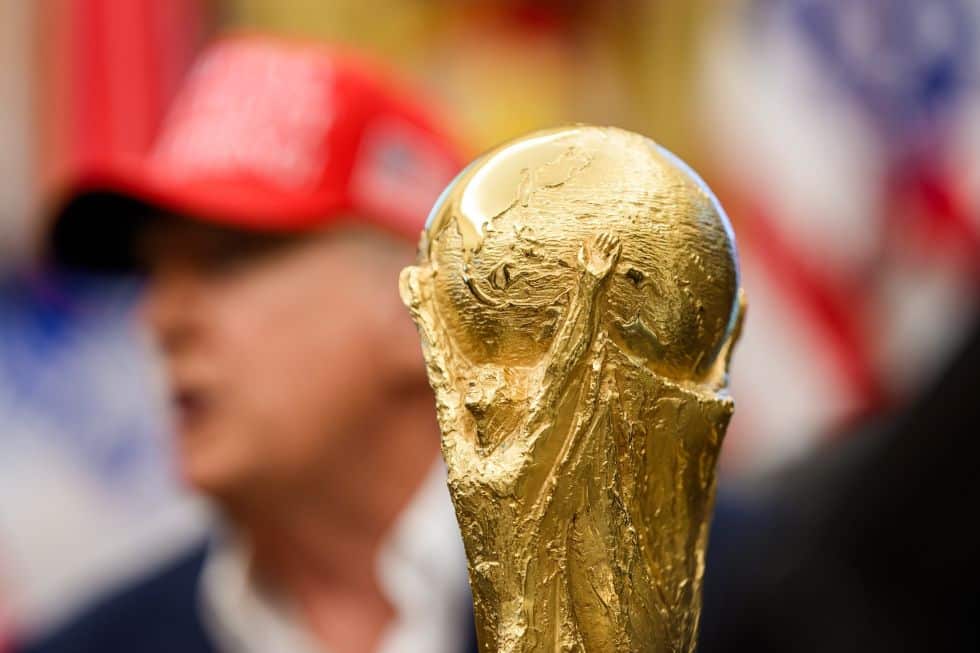


If any President of the United States deserves to be the first recipient of FIFA’s Peace Prize, an annual award established by association football’s governing body in 2025, it is Donald Trump. The award is presented to individuals who have “helped to unite people all over the world in peace.” Shortly after accepting the inaugural presentation in December 2025, Trump initiated military strikes on Iran, prompting retaliation and hostilities that have since escalated. Trump believes in peace, so long as it doesn’t interfere with his broader project: Making America Great Again, usually abbreviated to MAGA.
I’ve got them
We must understand his fulsome endorsement of FIFA’s World Cup tournament and his friendship with FIFA President Gianni Infantino in this context. The quadrennial competition to determine the world’s best national football team is due to kick off in June; most matches will take place in the United States, with others staged in Canada and Mexico. Trump has already spoken of the tournament almost possessively. In a speech celebrating America’s hosting rights for both the World Cup and the 2028 Olympics, he declared: “I didn’t think I’d be the president when this happened … but strange things took place, and now I’ve got them.”
I’ve got them. That giveaway says much about Trump’s political imagination. His sudden enthusiasm for the world’s game is not sporting conversion. It’s hardnosed political recognition.
Sport has long served as a uniquely effective political vehicle. Since at least the Berlin Olympics of 1936, governments have understood international sports tournaments as instruments of prestige, legitimacy and symbolic projection. Adolf Hitler’s Nazi regime used the Berlin Games to advertise Germany’s resurgence and organizational power before a global audience. During the Cold War, Olympic medal tables became proxies for ideological superiority. Argentina’s military junta exploited the 1978 World Cup to project domestic stability. More recently, Russia, Qatar and Saudi Arabia have all used sport to enhance international standing and reshape global perceptions.
All these cases demonstrated what political scientists call “soft power:” the ability of nations to generate influence through attraction, image and cultural kudos rather than military force or economic coercion. Association football has become perhaps the most effective soft-power instrument in existence because, unlike baseball or American football, it’s played and watched almost everywhere on earth. It’s one of the few truly universal cultural languages. Trump appears to get this.
America and the world’s game
For decades, the US treated football as a vaguely foreign pastime, linguistically quarantining it behind the term “soccer,” as if reluctant to grant it parity with America’s own sporting traditions. The NFL remained the country’s dominant spectacle, baseball its source of mythology and basketball its most successful cultural export. Soccer existed somewhere at the margins: suburban, imported, faintly European. (The term soccer originated in Britain as a colloquial shortening of “association football.”)
That changed gradually, at first after a false start, the North American Soccer League (NASL) folding after 16 years in 1985 and later with the more successful Major League Soccer (MLS), abetted by the growth of Latin audiences and the astonishing success of the US women’s national team, which transformed football into a platform for progressive politics, gender equality and LGBTQ+ advocacy. Yet even now, football occupies a peculiar place in American culture. It is hugely popular with women, commercially expanding and globally connected, but still lacks the emotional appeal enjoyed by the NFL or college football.
Trump doesn’t need Americans to love football in the traditional sense. He only needs to know that the 2022 World Cup reached billions of viewers across television and digital platforms, with individual matches drawing audiences on a scale unmatched by any domestic American sport. An estimated five billion people engaged with World Cup media in some way. The average global live audience of FIFA World Cup Qatar 2022 was 175 million viewers.
This means the World Cup offers something no domestic American sport provides: planetary presence. It allows an American president to stand symbolically at the center of a global ritual involving flags, anthems, borders and national competition. The tournament may market itself as universal and inclusive, but its engine remains insular rivalry, national attachment and collective identity. Fans don’t root for humanity, planetary salvation or peace on earth: They support Argentina, Brazil, England, Nigeria or the US. Or Iran.
This is where Trump’s opportunism becomes especially significant. His relationship with FIFA appears fundamentally transactional — a term frequently used loosely, but which here refers to a style of leadership based less on shared values than on reciprocal usefulness and strategic advantage. FIFA gains proximity to American political power and the commercial benefits of staging the tournament in the world’s largest media market. Trump gains association with the largest sporting spectacle on earth.
Infantino himself seems eager to encourage the relationship. After awarding Trump the FIFA Peace Prize, he insisted: “Objectively, he deserves it.” The remark sounded almost self-parodic, though perhaps unintentionally so. But modern political spectacle often hovers somewhere between sincerity and parody. Trump is very familiar with this liminal space. He also appears to understand something many critics of globalization still miss: Globalization did not erase nationalism; it simply provided a world stage.
Globalization’s greatest product
Globalization is commonly understood as the growing integration of economies, cultures, media systems and populations across national borders. Its critics often imagine it dissolving traditional national identities into a borderless cosmopolitan culture. Yet the World Cup demonstrates the opposite. It’s one of globalization’s greatest products, bringing together dozens of nations in a single media spectacle. But, instead of weakening nationalism, it intensifies it. Flags multiply. Anthems become louder. National identity becomes passionately concentrated.
Trump’s genius, for chronic want of a better word, lies in recognizing that nationalism no longer has to resist globalization. It can operate through it. MAGA rhetoric frequently attacks “globalists,” international institutions and transnational elites. Yet Trump simultaneously exploits global media systems, international branding and worldwide spectacle more effectively than most conventional politicians. MAGA acolytes no doubt argue that this makes Trump the most original and provocative president, probably ever. From the transactional perspective, sport is less a medium for competition than the forum for a kind of never-ending dialogue between the present day and the cultural, political and philosophical treasure-house of America’s past.
So, the World Cup presents him with an extraordinary opportunity: to transform a global event into an advertisement for American pre-eminence. One might even ask whether this represents a distinctly 21st-century form of imperialism; less territorial than emblematic, less concerned with conquest than with visibility, dominance and narrative control.
Even Trump’s language hints at this logic. When he described the tournament as “an opportunity to showcase the nation’s pride and hospitality,” he was invoking more than just tourism. He was describing political theater. He sees the World Cup as a demonstration that the US remains the indispensable stage on which the world performs, with Mexico and Canada playing supporting hosting roles. The final game to determine the world champions is scheduled to be played at MetLife Stadium, East Rutherford, New Jersey, on July 19, 2026.
Long shadows
Yet this spectacle unfolds against a wildly unstable geopolitical background. Conflicts involving Iran, Gaza and broader tensions across the Middle East cast long shadows over the tournament. Several participating nations come from predominantly Muslim societies whose relationships with the US remain politically sensitive. Questions about visas, security, protest and diplomatic symbolism will inevitably accompany the football itself. (Iran is still scheduled to appear.)
FIFA, like other sports, traditionally insists that sport and politics are formally separate. This has always been wishful thinking. Football doesn’t exist outside politics if only because nothing so globally pervasive can remain politically neutral. International sport has never been outside politics; it has repeatedly acted as a crucible in which different forms of power — fascist, military, authoritarian and democratic — are staged, tested and made plain to see. It concentrates political emotion into flags, anthems, rivalries and televised images capable of mobilizing billions simultaneously.
Trump appears unusually and unexpectedly comfortable with this reality. He doesn’t treat political controversy as contamination. On the contrary, conflict often heightens his sense of opportunity. Instability sharpens the value of American control, American security and American presence. Hosting the world during a moment of global anxiety allows the US to project itself not merely as a nation but as the central nervous system of global spectacle.
Whether the tournament succeeds commercially is secondary. The NFL, NBA and Major League Baseball will continue to dominate American sporting culture long after the World Cup circus leaves town. It appears Trump’s objective is larger and more immediate: that he wants to absorb and channel the energy of the tournament into the broader MAGA credo of restored American greatness.
The irony is difficult to miss. A movement frequently portrayed as anti-globalist may ultimately reveal itself to be highly adept at using globalization for nationalist ends. The World Cup doesn’t resolve that contradiction. It dramatizes it before billions of viewers.
Trump doesn’t understand football. He doesn’t need to. He needs only to understand power, spectacle and the value of attention in the 21st century. On that score, he may understand the World Cup better than anyone.
[Ellis Cashmore is the author of Celebrity Culture.]
[Lee Thompson-Kolar edited this piece.]
The views expressed in this article are the author’s own and do not necessarily reflect Fair Observer’s editorial policy.
Is Trump Just Pretending to Be Mad?
Is Donald Trump mad… or is it an elaborate act designed to keep political rivals — and allies — wrongfooted?...
TRUMP vs. the BBC
US President Donald Trump’s lawsuit against the BBC is scheduled to see trial in February 2027. Trump is suing Britain’s...
Why Do Americans Want To Buy Premier League Football Clubs?
On October 15, 2010, the Fenway Sports Group acquired Liverpool Football Club for £300 million ($410 million), allowing the club...
Ten Reasons Saudi Arabia Should Host the 2034 FIFA World Cup Finals
Although the idea has scandalized many Western observers, Saudi Arabia should host the 2034 FIFA World Cup. FIFA could promote...
The Tale of the Boy Who Cried “Racism!”
After a Copa América win, footballer Enzo Fernández shared a highly controversial video of himself and other Argentinian players singing...
Support Fair Observer
We rely on your support for our independence, diversity and quality.
For more than 10 years, Fair Observer has been free, fair and independent. No billionaire owns us, no advertisers control us. We are a reader-supported nonprofit. Unlike many other publications, we keep our content free for readers regardless of where they live or whether they can afford to pay. We have no paywalls and no ads.
In the post-truth era of fake news, echo chambers and filter bubbles, we publish a plurality of perspectives from around the world. Anyone can publish with us, but everyone goes through a rigorous editorial process. So, you get fact-checked, well-reasoned content instead of noise.
We publish 3,000+ voices from 90+ countries. We also conduct education and training programs
on subjects ranging from digital media and journalism to writing and critical thinking. This
doesn’t come cheap. Servers, editors, trainers and web developers cost
money.
Please consider supporting us on a regular basis as a recurring donor or a
sustaining member.
Will you support FO’s journalism?
We rely on your support for our independence, diversity and quality.
250 Years of American Scripture
On America’s 250th anniversary, it may be time to think about how the Founders were mythologized into secular saints, embodying...
FO° Talks: An Indian Military Mind on Ukraine’s Remarkable Kursk Invasion
In this episode of FO° Talks, Fair Observer Chief Strategy Officer Peter Isackson and retired Indian General AK Singh hold...

America Is Confused Over What It Means to Be Exceptional
President Biden’s failure to address the conflict in the Middle East reveals the crisis of American exceptionalism.





Comment