


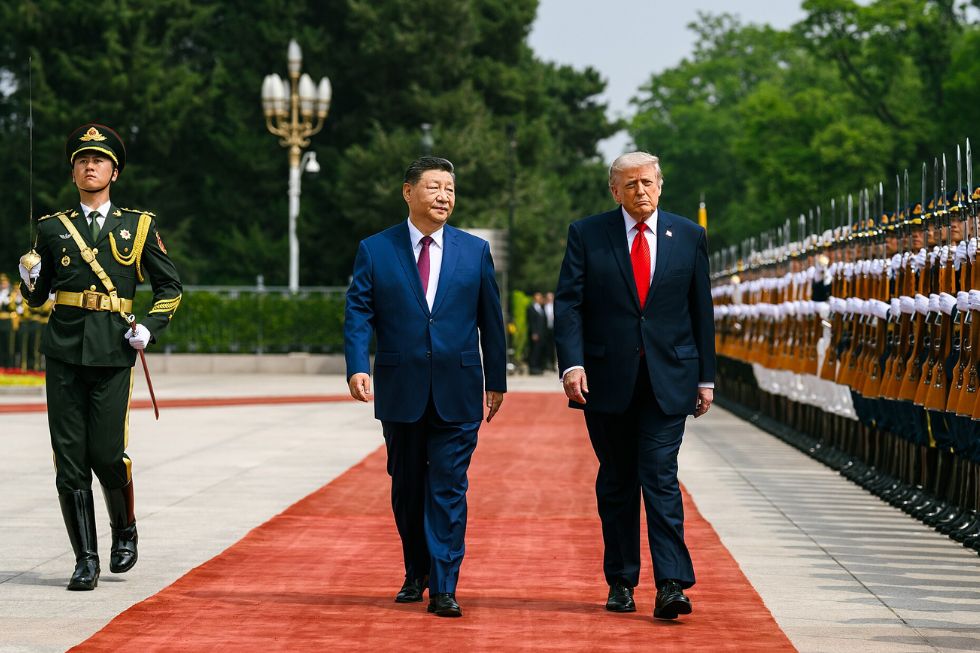



Washington spent decades portraying China as a “near-peer” competitor, implying that American primacy remained intact. That was true for a while, but it is now officially obsolete, for China competes effectively with America in almost every metric. For example, in purchasing power terms, China’s economy has already surpassed America’s, and its shipbuilding capacity has been assessed at up to 230 times that of the US. It has built dominance in the critical mineral supply chains that underpin modern manufacturing, defense and the energy transition. China has proven that, as America’s only peer, it has the scale, resilience, resources and countermeasures to absorb punishment and return it in kind.
The more profound issue is that peer-level rivalry cannot be managed through the tools designed for lesser powers. A country that lacks the power to withstand the pressure can be successfully sanctioned and isolated. The same cannot be said of the world’s second-largest economy, the factory of the world and the near-monopoly supplier of materials that America’s military and industrial base cannot function without. Every instrument US President Donald Trump has sought to deploy against China has hit this ceiling. That is the primary reason Trump deployed his charm offensive in Beijing.
The limits of tariffs and economic pressure
Trump’s theory was simple: Escalate tariffs until Beijing folds, but China did not fold. Instead, it retaliated methodically — with countertariffs on American agricultural exports that squeezed Trump’s rural base and rare earth export licensing restrictions that briefly threatened to halt American auto and defense manufacturing.
China controls roughly 90% of the global supply of permanent magnets made from rare earth elements. When Beijing almost immediately activated that lever, Washington insiders reported that Trump reversed course within a single afternoon, acknowledging the extent of China’s leverage. Companies trying to diversify away from China find that diversification almost always involves Chinese companies, which dominate manufacturing investment across Southeast Asia. China is not a node in the global supply chain; in many sectors, it is the chain.
When, earlier this year, the US Supreme Court struck down Trump’s emergency tariff authority as unconstitutional, the instrument he had used to impose sweeping, flexible pressure across virtually every American trading partner had evaporated. Trump arrived in Beijing not as the man who had broken China’s economy, but as the man whose primary legal weapon his own Supreme Court had made irrelevant.
The Iran War and the erosion of US influence
If the tariff debacle reduced Trump’s leverage, the Iran War is eviscerating any remaining aura of dominance. Iran has not capitulated. The strait has not reopened. The ongoing conflict has left the US weaker, more distracted and more resource-constrained than it might otherwise have been in Chinese eyes.
Trump arrived in Beijing clearly needing President Xi Jinping’s help on Iran, as well as his forbearance on trade. In short, Trump has put himself in an impossible box, and only Xi can dig him out of the hole he has dug for himself. But Trump left without a rare-earth agreement, a tariff resolution or any hint of Iranian cooperation. Instead, he got (rehashed) soybean commitments, a long-term apparent commitment to purchase Boeing aircraft and a photo at the Temple of Heaven.
All of this points toward a conclusion that neither side can make politically, but that facts compel: The US and China have no realistic alternative to functional coexistence. Climate, AI, food security and financial stability are some of the domains in which both countries remain indispensable. Genuine decoupling — the kind that ends China’s structural leverage — would require rebuilding global manufacturing and critical resource supply chains from the ground up, over decades. That is simply not going to happen. While America and the world were sleeping, Beijing secured critical mineral supplies worldwide. The world made China the epicenter of global manufacturing, and that is where it will remain for the foreseeable future.
The inevitability of coexistence
When the US and China collide, the shockwaves travel through every supply chain, energy market and financial system simultaneously. Competitive coexistence, in which China and the US maximize their comparative advantages while maintaining the economic interdependence that neither can afford to sever, appears to be the only viable path forward.
Trump’s deference toward Xi is not simply a sign of weakness; it is an encounter with structural reality — the undeniable fact that China has built leverage, across rare earths, manufacturing, trade and now Iran, that no tariff can neutralize and no Supreme Court ruling can restore. Attempting to manage a true peer requires something Trump has resisted throughout his presidency: a strategy designed not for domination, but for coexistence. The Beijing summit was evidence that he is beginning, reluctantly and without admitting it, to learn that lesson.
[Daniel Wagner is CEO of Country Risk Solutions and author of 5 books on China.]
[Kaitlyn Diana edited this piece.]
The views expressed in this article are the author’s own and do not necessarily reflect Fair Observer’s editorial policy.
Xi-Trump Summit in Beijing Was Great Theater, Little Substance
The recent US–China summit in Beijing, though symbolically significant as the first meeting between the two leaders on Chinese soil...
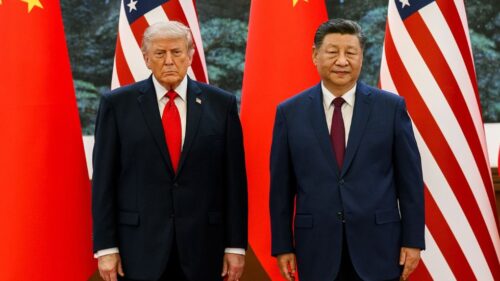
China Watch: The Rise of a New Global Order Amidst the Persian Gulf War
China’s strategic restraint in the recent war in Iran contrasts with US aggression, positioning it as a stabilizing global force...
FO Talks: Is America Building a $1.5 Trillion War Machine to Fight China?
In this episode of FO Talks, Atul Singh and Ben Freeman examine US President Donald Trump’s proposed $1.5 trillion defense...
Support Fair Observer
We rely on your support for our independence, diversity and quality.
For more than 10 years, Fair Observer has been free, fair and independent. No billionaire owns us, no advertisers control us. We are a reader-supported nonprofit. Unlike many other publications, we keep our content free for readers regardless of where they live or whether they can afford to pay. We have no paywalls and no ads.
In the post-truth era of fake news, echo chambers and filter bubbles, we publish a plurality of perspectives from around the world. Anyone can publish with us, but everyone goes through a rigorous editorial process. So, you get fact-checked, well-reasoned content instead of noise.
We publish 3,000+ voices from 90+ countries. We also conduct education and training programs
on subjects ranging from digital media and journalism to writing and critical thinking. This
doesn’t come cheap. Servers, editors, trainers and web developers cost
money.
Please consider supporting us on a regular basis as a recurring donor or a
sustaining member.
Will you support FO’s journalism?
We rely on your support for our independence, diversity and quality.





Comment