


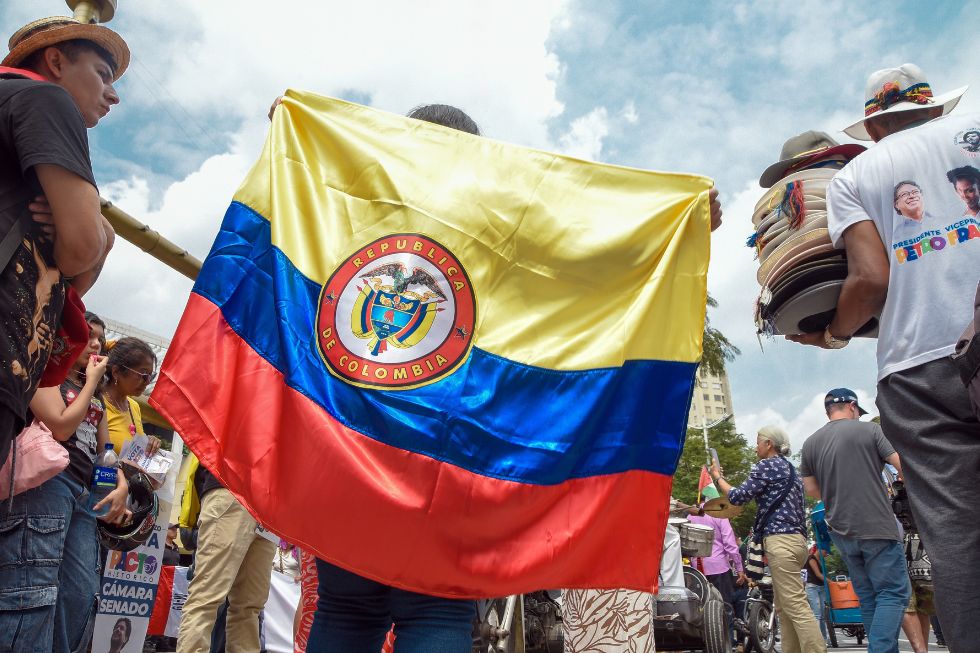




As the turbulent term of President Gustavo Petro comes to an end, Colombia’s political landscape has undoubtedly changed. However, it’s not a given that the optimism across the country’s indigenous and marginalized social movements will actually materialize into policy continuity.
Formerly a member of the M-19 guerrilla and then mayor of Bogotá, Petro has been an icon of Colombia’s political left for decades. Against the odds, Petro succeeded in getting elected president in 2022 by building a broad center-left coalition alongside old political foxes. Despite initial optimism surrounding Colombia’s first left-leaning government in decades, Petro’s administration has been lackluster over the last four years. Bogged down by corruption scandals, the hodgepodge congressional coalition that led to many of those very scandals, and a president whose signature is indiscipline and untimeliness, Petro has not delivered significantly on his promises of peace with non-state actors in peripheral parts of the country or of national prosperity.
President Petro has been undoubtedly successful, though, in one of his stated goals. He has normalized the left as a political protagonist, awakened a committed electoral base, and broken a decades-old monopoly of center-right and right-wing political parties over national politics. He has moved the national discourse toward one of class struggle.
Today, Colombia’s presidential campaign is in full swing ahead of the first round of voting on May 31. In a crowded field of approximately a dozen candidates, the three leading figures stand out — both for what their leadership in the polls tells us about Colombia’s electoral landscape in 2026 and for what a potential administration under each of these would mean for the country and the region.
A tale of two senators and an outsider
For the last several weeks, national polling has consistently placed Senator Iván Cepeda ahead of the pack in the first round of voting, with support from over a third of likely voters. Seen by most as Petro’s political successor, Cepeda has been a senator since 2010 and is the son of a high-profile communist leader who was murdered in 1994. Like Petro, Cepeda is a hardened left-wing ideologue — educated on the eastern side of the Iron Curtain in places like Czechoslovakia, Bulgaria and Cuba. Unlike Petro, however, Cepeda is disciplined, methodical, and regarded by both detractors and supporters as a more efficient political operative.
Cepeda was catapulted to the top of the polls, both nationally and within the country’s left-wing coalition primary, by his marked antagonism with former President Álvaro Uribe. For years, Cepeda and Uribe were engaged in a high-stakes judicial battle, which resulted in a symbolic victory by Cepeda over Colombia’s most important and influential right-wing political figure of the 21st century — Uribe himself.
Since rising to the forefront of the presidential race, Cepeda has awakened optimism among the electoral base of the left-wing and incumbent Pacto Histórico, as well as strong rejection among Colombia’s broad right-wing electorate. This electorate has unearthed Cepeda’s past sympathies and closeness with the guerrilla, including leaders who betrayed the 2016 Peace Accords by returning to armed resistance.
In a country that has traditionally voted right-of-center, the most striking characteristic of Cepeda’s presidential candidacy is his strong polling and his campaign’s seeming confidence that he might be capable of winning outright during the first electoral round, without the need for a run-off.
Cepeda’s campaign rhetoric, affirming that he will grow favorably and broaden his base to secure a first-round victory, underscores two realities. First, that Cepeda’s best shot at winning is indeed ahead of a potential run-off. Second, the campaign’s expectation that mobilizing the national government’s political machinery will indeed yield a better-than-expected showing for the administration’s candidate.
Cepeda is polarizing, as are other political leaders in Colombia and throughout the region. His detractors label him a communist, a guerrilla sympathizer, and even a closet or urban guerrilla member himself. Moreover, his political trajectory, achievements and agenda are indeed markedly aligned with Colombia’s left, such as legitimizing the struggles of the Revolutionary Armed Forces of Colombia (FARC) by bringing it into the political fold as part of the 2016 Peace Process or highlighting the vindications of indigenous communities and politically persecuted social leaders.
Fair or exaggerated, Cepeda’s labels and trajectory would have been politically unsustainable for anyone eyeing national office in Colombia 20 years ago, even ten years ago.
The left in a broadened political spectrum
Back when the wounds of cartel, paramilitary and guerrilla violence were still fresh in Colombia, during the 80s, 90s and early 2000s, marked guerrilla and left-wing sympathies were politically radioactive. This reality led, in large part, to the election and re-election of former President Alvaro Uribe as well as to his lasting political influence nearly a quarter of a century later.
Yet, Colombia has changed. Through President Uribe’s frontal confrontation with armed guerrillas between 2002 and 2010, his demobilization of right-wing paramilitary groups and the subsequent Peace Process led by friend-turned-foe President Juan Manuel Santos, Colombia has gained a broader political spectrum in which a candidacy like Cepeda’s is viable.
Cepeda’s candidacy is viable, or plausible rather. However, despite his leadership in recent polls, Senator Cepeda does have an electoral ceiling, and he could lose in a potential run-off. Previewing the candidacy of Senator Paloma Valencia, her metamorphosis into a center-right candidacy under a coalition ticket that ranges from the center to the far-right is fueled in large part by the rejection of Cepeda and the fear that his platform of continuity instills across center-right and right-wing electors.
On the other hand, if Cepeda were to run off against the outsider Abelardo de la Espriella, the outcome is more uncertain. Where exactly Colombia’s centrists would split, and who would ultimately benefit the most from these independent voters — whether Cepeda, de la Espriella or merely abstention — is hard to predict. Yet in this scenario, Senator Cepeda would presumably have a greater chance of courting centrist voters, for reasons we will discuss when we dive into candidate Abelardo de la Espriella.
This refashioned political landscape might well be President Petro’s most lasting legacy, a broadening of Colombia’s political spectrum — though his legacy also includes a more polarized country, driven in part by populist yet divisive decisions such as a significant minimum wage increase. Not only does the minimum wage hike epitomize his populist policies, but his presidency has also been marked by unpopular decisions like appointing highly questionable friends, political allies and former M-19 guerrilla colleagues into high-level positions — whether as ministers, ambassadors or heads of administrative entities.
In this process, Petro has prioritized proximity to his ideology over experience and capacity to handle gubernatorial matters. One clear example has been the government’s failed Paz Total or Total Peace effort, which aimed to consolidate the advances of the 2016 Peace Process as well as demobilize other major guerrilla groups, such as the National Liberation Army (ELN). If Cepeda does indeed win, he will owe it to Petro; even if Cepeda loses in the run-off, he will owe his political future as a leader of the opposition to President Petro.
An increasingly centrist Centro Democrático
Senator Valencia is officially the candidate of the powerful and flagship right-wing party, Centro Democrático, which was founded by former President Uribe in 2013.
In any election over the last 13 years, the Centro Democrático’s candidate would have been and has been the candidate to the farthest right end of Colombia’s political spectrum. However, that is not the case in 2026, and it is largely explained by two dynamics. First, President Petro’s successful expansion of the political spectrum, and second, the presence of the “outsider” hard-right candidate de la Espriella.
Now, in practical terms, the uniqueness of the 2026 landscape has led Senator Valencia to position herself as a center-right candidate by first participating in an inter-party primary and selecting the runner-up from that process, who happens to be an openly gay technocrat, as her running mate.
Senator Valencia, the Centro Democrático and former President Uribe, in the background, are betting on broadening their electoral base by winning over centrists and independents to whom the figure of Cepeda and the continuity that he represents is unpalatable. This strategy, however, is not without risks.
By casting her candidacy as center-right, Valencia has alienated numerous Centro Democrático hardliners, like fellow Senator Maria Fernanda Cabal and former Minister Fernando Londoño. Valencia’s gamble is that her credentials with the Centro Democrático will ultimately yield a strong right-wing electoral base, while her appeal as a woman and that of her running mate will win over urban and centrist voters to form a broad center-right coalition.
Within Colombia’s two-round presidential election structure, if Senators Valencia and Cepeda were to ultimately face off in a run-off, Valencia’s broad base center-right strategy would pay off because her ticket can be palatable to centrists, right-wing hardliners and almost anyone who opposes the Petro-Cepeda line. And yet, Senator Valencia’s true challenge is going to be making it from the first round of voting into the run-off.
“Friendly fire” from an eccentric right-wing “outsider” could prove a handicap for Senator Valencia and the Centro Democrático during the first round of presidential voting, while inadvertently boosting Cepeda’s chances in the run-off. Enter de la Espriella.
Can Bukele’s model win in Colombia?
Born in Bogotá, de la Espriella is a lawyer who grew up in the northern city of Montería, close to Colombia’s Caribbean coast. A successful entrepreneur with his own law firm based in Florida, de la Espriella embarked on his political adventure as an independent in 2025 by collecting over four million signatures, one of the mechanisms available in Colombia to launch a presidential candidacy. He ended up as the candidate who collected the highest number of signatures during this presidential cycle, using that milestone to position himself as an alternative with real citizen backing.
This is the second consecutive presidential election in which someone without any political experience or notable affiliation with or proximity to traditional political parties runs with serious chances of being elected. The rise of de la Espriella as a political figure has been defined by that outsider profile, shaped by his background as a private-sector professional with no debts or ties to major, traditional political structures. However, in his career as a lawyer, de la Espriella did defend high-profile figures, such as members of paramilitary groups and figures closely affiliated with Venezuelan strongman Nicolás Maduro.
Before entering the electoral arena, de la Espriella built his reputation in the private sector as a high-profile criminal attorney and entrepreneur both in Colombia and the US. That background let him present himself to voters as someone outside traditional politics, with a message focused on law and order, at times at odds with sectors of the political class and bringing a business mindset to “clean house” — politically speaking. His political capital and appeal come precisely from that distance to the establishment — though de la Espriella has also been described as former president Uribe’s “Plan B” or “Trojan Horse.” Ultimately, de la Espriella brands himself as a businessman who enters politics, not as a career politician. Sound familiar?
Inspired by figures like President Nayib Bukele of El Salvador, de la Espriella’s status as a private entrepreneur has shaped both his narrative and his platform. De la Espriella appeals to private-sector logic — order, authority, legal certainty and defense of private property — to connect not only with sectors disillusioned by traditional parties, but also with detractors of Petro and with people who voted for Petro yet are now disappointed by the current government’s improvisation and lack of delivery.
De la Espriella’s blunt, media-savvy style reinforces the image of someone who owes no favors to the system, rocks the boat and can speak without filters. Even though his businesses have been successful, his reputation has been questioned for defending shady individuals, such as money launderer David Murcia and Maduro’s frontman, Alex Saab. De la Espriella’s political appeal is currently best explained by the populist right-wing wave that capitalizes on public discontent, using his business experience as proof of executive ability and his outsider role as a credential for independence.
De la Espriella openly courts former President Uribe’s supporters, aligning himself with a segment of the electorate that values security and institutional order above all else. While also not being “Uribe’s candidate” — at least not officially. Lastly, de la Espriella’s choice for a running mate adds formality and technocratic depth to the ticket. The figure of former minister José Manuel Restrepo, a respected (and even boring) economist with solid academic credentials and an overall positive reputation, tames de la Espriella’s campaign, which has earned him the nickname of el tigre (the tiger) of this election.
Restrepo’s credentials as minister during Iván Duque’s presidency and his experience as rector of a prominent university in Colombia aim to add electors from the right-wing establishment of the Centro Democrático, which would defect from Valencia’s candidacy and campaign. This aim to expand the ticket’s appeal toward more “moderate” sectors is similar to Valencia’s approach with her own vice-presidential pick, Juan Daniel Oviedo, who also happens to have been a high-profile appointee of former President Duque.
Nevertheless, De la Espriella’s growth in the polls and popularity among certain sectors are yet to be proven as an authentic electoral wave. During Colombia’s legislative elections in March, the outsider candidate threw his weight behind the small Christian party supporting his candidacy, Salvación Nacional, which secured only five seats in Congress for the upcoming legislative term. The party barely reached the vote threshold needed in Colombia to avoid losing its legal status, which would represent a challenge for an eventual de la Espriella government.
By comparison, the left-wing Pacto Histórico and the right-wing Centro Democrático recorded gains in their total number of seats (respectively) across both the Senate and the House of Representatives. As of now, de la Espriella would likely struggle to build a legislative coalition, which could lead to bureaucratic delays and tie his hands on policy achievements beyond the reach of executive orders.
[Kaitlyn Diana edited this piece.]
The views expressed in this article are the author’s own and do not necessarily reflect Fair Observer’s editorial policy.
FO° Talks: Bolivia Turns Right — How Rodrigo Paz Ended 20 Years of Left-Wing Rule
In this episode of FO° Talks, Rohan Khattar Singh and Erik Geurts discuss Bolivian President Rodrigo Paz Pereira’s unexpected rise...

The New Shift from Pink to Green in Latin America
This Global South is deep in debt, desperate, and facing climate horrors almost beyond imagining. Remarkably, Latin America is turning...
Latin America’s ‘New’ New Left
The recent election in Colombia has produced new hope for the country--and for the whole region.

Support Fair Observer
We rely on your support for our independence, diversity and quality.
For more than 10 years, Fair Observer has been free, fair and independent. No billionaire owns us, no advertisers control us. We are a reader-supported nonprofit. Unlike many other publications, we keep our content free for readers regardless of where they live or whether they can afford to pay. We have no paywalls and no ads.
In the post-truth era of fake news, echo chambers and filter bubbles, we publish a plurality of perspectives from around the world. Anyone can publish with us, but everyone goes through a rigorous editorial process. So, you get fact-checked, well-reasoned content instead of noise.
We publish 3,000+ voices from 90+ countries. We also conduct education and training programs
on subjects ranging from digital media and journalism to writing and critical thinking. This
doesn’t come cheap. Servers, editors, trainers and web developers cost
money.
Please consider supporting us on a regular basis as a recurring donor or a
sustaining member.
Will you support FO’s journalism?
We rely on your support for our independence, diversity and quality.





Comment