



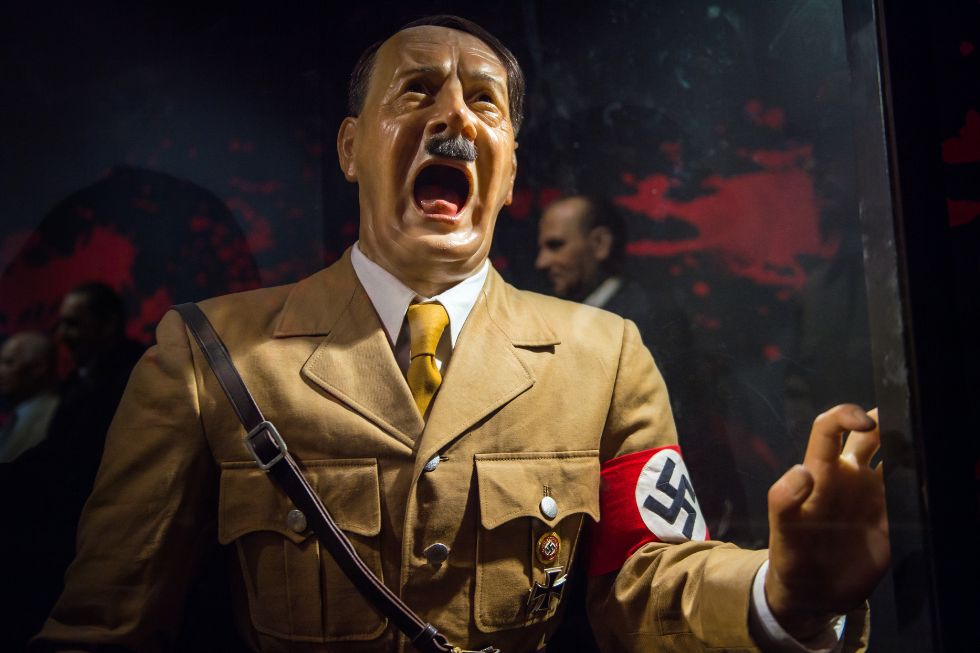



The 20th century left a lot of bad memories for a lot of people. The first half of it was dominated by three unequivocally evil events on a global scale: two world wars and the Great Depression. The second half of the century had its moments of calm and leisurely enjoyment, as the consumer society emerged to produce in the West a culture deemed by many to be the fulfillment of Thomas Jefferson’s vision in 1776, promising to protect the “pursuit of happiness.” It’s not clear what that phrase meant to Jefferson, but 20th-century Americans, egged on by Madison Avenue, adapted it to the reality of their expanding postwar economy. Jefferson had framed it as a fundamental human right, alongside life and liberty, but he was simply glossing John Locke’s formula of “life, liberty and property.” The author of the Declaration of Independence had no idea he was launching the consumer society.
With the defeat first of Germany and then of Japan, citizens of the Western world began the task of putting behind them the horrors of the disastrous three-decade stretch that began in 1914, dominated by wars and economic collapse before being drawn to a close by the ominous spectacle of two atomic bombs launched on urban populations from the air. Once those horrors were behind us, a new phase of history could begin. And it was impressive. The French still refer to it as “les trentes glorieuses” — “The Thirty Glorious [Years]” — between 1945 and 1975 in which Western nations became convinced that the economy and global culture were on an upswing that might indeed go on forever.
This feeling of unbridled optimism grew and expanded in a reassuringly measured way for the first half of the “glorious thirty,” despite the rapid emergence and persistence of a Cold War replacing the hot one that ended in 1945. This psychological war between opposing economic theories and political ideologies provided the equivalent of the kind of ominous background musical score Hollywood used to maintain suspense. But no one was eager to see the finishing credits. It had the effect of installing deeply within everyone’s psyche a lingering fear of an imminent nuclear confrontation. Those who lived through that period will recall that the tranquillity induced by the superficial but very real prosperity of the new consumerist culture was regularly punctuated by moments of “duck and cover.” Prosperous consumers began asking themselves the annoying question: “When, thanks to our trend of upward mobility, will I be able to afford an individual bomb shelter?”
There was a real frightening moment in October 1962: the Cuban missile crisis. But Americans who lived through that period remember the decade of the 1950s, dominated by the paternal presidency of Dwight D. Eisenhower, as an era of voluntary conformity. These were good times. No reason to rock the boat. Everyone who was white — as well as a select few among the racial minorities — was encouraged to get a degree, secure a job, obtain a mortgage and, more generally, fall into line. “Falling in” nevertheless meant dealing with the perspective of “fallout,” nuclear fallout.
The price of happiness
The 1960s began quietly on a note of continuing consumer confidence. All that was thrown off kilter in November 1963 with the assassination of a president. America’s youth turned away from the prevailing trend of the ‘50s to fall in line and march towards success. They replaced it by a new trend of falling out of line. Apart from political protests and the refusal to accept assassination as a tool of governance, falling out of line included engaging in widely shared licit and illicit pleasures (notably drugs and sexual liberation thanks to a new reading of Jefferson’s “pursuit”). It was a new twist on the consumer society and the pursuit of happiness.
The developing disaster of the war in Vietnam began to undo the trente glorieuses, even if the idea of unlimited prosperity remained the accepted norm, the dominant idea driving the civilization forward. The carefully designed configuration of the pieces on the postwar chessboard — the United Nations, the International Monetary Fund, the World Bank, the General Agreement on Tariffs and Trade that would evolve into the World Trade Organization — had produced the image of a largely stable “rules-based” international order. It malfunctioned from time to time, like any complex system. Before the end of the century, only a few realized that it was rapidly losing its coherence.
The first sign of structural damage became apparent in 1971 when US President Richard Nixon decoupled the US dollar from gold, dismantling the hitherto brilliantly successful monetary order crafted at Bretton Woods in 1944. As chess logic goes, it was equivalent to a black pawn taking the white team’s queen. Nixon subsequently resigned and the US effectuated a humiliating retreat from Vietnam. The petroleum shock following the Yom Kippur war in 1973 provoked a pattern of increasingly confused defensive moves by the principal chess player. The petrodollar had taken over the role of gold, without actually replacing it. Although it held off the checkmate, it created a permanent state of instability of West Asia, transformed into an increasingly exposed powder keg.
The fall of Saigon in 1975 temporarily cured the US of its military adventurism. Once bitten, twice shy. But contrary to the proverbial logic, the trauma of Vietnam would return with the dawn of the 21st century. In the meantime, the collapse of the Soviet Union provided a new glimmer of hope for a remake of the trente glorieuses. Historian Francis Fukuyama announced the end of history. The US model, driven by the peaceful operations of Starbucks and McDonalds, was set to refashion global culture. The European nations believed they could provide a sophisticated variation by adopting a “supporting role” in the screenplay provided by Hollywood. The European nations united (but failed to unify) as they conjoined their economic forces in a glorious European Union endowed with its own rival, but non-threatening currency, the euro.
For nearly a decade, a new order seemed to have prevailed. But then came the true but unexpected Y2K bug. The 20th century and its largely reassuring second half ended not with a whimper, but a bang, on the morning of September 11, 2001. That iconic moment cast a shadow on everything that appeared positive about the expiring century and the triumph of the consumer society.
Looking back at it today, we are only beginning to see that from start to finish, the historical logic wasn’t about constructing peace and prosperity. The system depended at its core on strategizing war, conducting ruthless competition and deploying skulduggery, aggressivity, manipulation. Everything we felt we had discarded in 1945 now appeared to be present at the core of the system. It wasn’t Adolf Hitler or Joseph Stalin, but whatever it was, it revealed a growing taste for domination and, along the way, provided multiple examples of a continued taste for genocide. The illusion that order had been definitively restored following World War II was precisely that: an illusion.
German novelist Thomas Mann was a prophet in our midst. No one took him seriously when, in his 1945 essay titled, “Germany and the Germans” (Deutschland und die Deutschen), he presented the chilling argument that Hitlerism — as a psychological and political phenomenon — had successfully infected the world, potentially outlasting the Third Reich itself. Two years later, US President Harry Truman passed the National Security Act and created the CIA, without realizing that it would consciously or unconsciously derive inspiration from the science of Hitler’s Gestapo.
Evil had not disappeared, but simply gone into hiding
One way of characterizing how people now think of the 20th century is that the first half of it saw the Devil unleashed, especially in Germany and the Soviet Union. Those two nations produced the century’s iconic demons: Hitler and Stalin. In the second half of the century, everyone not named Thomas Mann felt comforted by the idea the Devil had been exorcised. The wisdom and hard work of a new class of disciplined leaders who believed in their class’s commitment to virtue accomplished this noble task.
When Satan seemed to peer at us again from behind the backdrop — for example, when charismatic leaders were assassinated — we were regularly told it was the work of a lone gunman. There was no reason to suspect diabolical machinations. By the final decade of the century, all was on track for Fukuyama’s end of history.
We could feel it during the wonderful decade of the 1980s. It was “morning in America.” A new start to a golden age began under the benign English-speaking leadership of US President Ronald Reagan and British Prime Minister Margaret Thatcher. The culture of individual success had begun replacing the culture of shared prosperity. And, almost on cue, the dreadful Soviet Union that had spawned Stalin, had the courtesy to collapse and usher in a peaceful, unipolar world, from which all devils would be permanently banished.
Everything changed in September 2001. The devils had returned. They were spreading a new plague, with a new name: Global Terror. They were out there somewhere, in faraway lands that nevertheless threatened the livelihood of those of us who were committed to cultivating our gentle prosperity. The fact that our prosperity depended on access to resources from those faraway lands meant that we had good reason to fear the troublemakers, especially those who were far away.
That mentality led to a series of increasingly futile 21st century “forever wars,” the latest of which began only a few months ago. Spreading havoc abroad has become more than a habit. It was clearly an addiction. All in the name of protecting the precious way of life, the fruit of our pursuit of happiness, which we also believe is the key to everyone’s prosperity… so long as they fall in line. But it’s that same mentality that has destabilized the institutions and ultimately undermined the productive capacity of the very civilization we’re now striving desperately to defend.
In short, far from being exorcised, the Devil is back on his throne and he is amongst us. We simply refuse to acknowledge his presence. We continue to believe he has been permanently exiled without realizing that we’ve been hosting him in our midst all this time. How else can we explain the fact that the US Department of Defense has now been not just renamed, but restructured as the Department of War? Back in the chaotic 20th century, we had two principal enemies: Germany and Japan. We could focus our hatred on them in times of war. Now the enemies are everywhere. Even allies are enemies. They all deserve our hate. So it appears in Donald Trump’s America.
What about Europe?
The EU is not only fraying at the seams, it is lost in the woods of its mindless bureaucracy. These two images conjure up King Lear’s “loop’d and window’d raggedness.” Europe produced maximum horror in the first half of the 20th century. The scenario of chaos may be reemerging today. World War I became possible thanks to the convergence of an industrial revolution and intense competition between competing European colonial powers. The combination of industrial efficiency and unlimited extraction allowed them to build their own military-industrial complexes that inevitably produced the monumental clash of 1914, when they began seriously testing their prowess against one another.
The sense of civilizational unity in the West — notably between the US and Europe, but also among European nations — remains today, but only at the formal level. The thread that holds it together is weakening as we watch the tension grow. It can only thrive by believing there are enemies out there that will unite us in a common effort. But it’s becoming more and more difficult even to name those enemies and be certain of their evil intentions.
Is Russia really an enemy of Europe? That appears to be a matter of belief, but there are no concrete facts to back it up. And China? The US has obvious reasons to see it as a rival, but does that make it an enemy of Europe? Apparently, if Washington sees China as its principal enemy, Europe has no choice but to follow suit.
Is Iran a terrorist state threatening the West? Europe didn’t think so when it signed the JCPOA in 2015 and remained in it even after Trump withdrew. Where’s the threat to our civilization? It only exists if Israel, which isn’t in the West, is deemed to symbolize the West. That symbiotic connection seems to work for the US, but does it make sense for Europe?
In contrast, we may be seeing a return to a state we claim to have cast off in 1945, in which the enemies of European nations are other European nations. To some extent, that is already the case when we consider the case of Russia, a nation that, at least since Peter the Great, has always been European. Ever since the collapse of the Soviet Union, its leaders have sought to integrate Europe. And it’s always been Washington that refused.
This is truly a turning point, but not exactly the Zeitenwende former German Chancellor Olaf Sholz referred to. We may be witnessing a return to the nightmare scenario of both 20th-century world wars.
What’s surprising is that few people seem to notice. Germany’s current chancellor, Friedrich Merz has announced its ambition to rearm and become Europe’s dominant military power. Doesn’t that ring any bells? Shouldn’t we look back and remind ourselves that many people in the US and the UK, prior to the outbreak of World War II, regarded Hitler with sympathy, admiring his ability to establish order? American financial and industrial interests made the buildup of Nazi Germany’s economy possible. It was only when he invaded Poland that they woke up in surprise.
Angels to the rescue?
Are any of Europe’s current leaders concerned by Germany’s newfound ambition to become the continent’s new military powerhouse? Have European media begun to raise the alarm? So far, only a few public thinkers have allowed themselves even to evoke the danger.
Italian geopolitical analyst Thomas Fazi and French historian and political scientist Emmanuel Todd are outliers. Both of them see the risk and offer contrasting but ultimately complementary analyses. Todd fears that France will be a likely future victim of any policy that encourages German rearmament. “For Germany, only hierarchical relationships are conceivable,” he tells us. “The Germans want to dominate Europe because it suits their temperament.”
Fazi wouldn’t disagree, but he makes a complementary point. “This is not nationalism, military or otherwise, but its opposite: the undermining of German and European core interests at the hands of a transnationalised globalist elite — Merz is, after all, a former BlackRock executive — that views permanent war and militarisation as a way to entrench its wealth and power at the expense of European prosperity and security.”
The debate will undoubtedly continue. For our own safety and well-being, we should hope that it will amplify, but the consequences are in all cases unpredictable. The big question for Europe is twofold:
- Is it poised, despite its best intentions, to return to the logic that prevailed during the first half of the 20th century? (Todd’s concern)
- Is it destined to consolidate its identity as an obedient but permanently humiliated vassal of the US military-industrial complex? (Fazi’s focus)
The devils are loose and, similar to a century ago, Europe is their playground. Are there any European leaders capable of summoning up Abraham Lincoln’s “better angels of our nature” to rein them in again?
*[The Devil’s Advocate pursues the tradition Fair Observer began in 2017 with the launch of our “Devil’s Dictionary.” It does so with a slight change of focus, moving from language itself — political and journalistic rhetoric — to the substantial issues in the news. Read more of the Fair Observer Devil’s Dictionary. The news we consume deserves to be seen from an outsider’s point of view. And who could be more outside official discourse than Old Nick himself?]
[Lee Thompson-Kolar edited this piece.]
The views expressed in this article are the author’s own and do not necessarily reflect Fair Observer’s editorial policy.
A Taste for Genocide: Why the West Can’t Shake Its Most Violent Habits
From the scorched earth of the Thirty Years’ War to the “Strait of Hormuz Apocalypse,” the West’s history of professionalized...

Is Europe a Possessed Continent?
Europe’s crisis runs deeper than economics or politics — it’s both an identity crisis and a spiritual collapse. Its leaders...

The Devil’s Advocate in a World Without Saints
Modern society has abandoned its search for saints, both religious and political. Since the Vatican eliminated the Devil’s Advocate role...
Europe’s Scripted March to War
From Washington’s cherry tree to today’s war rooms, lying about what you did became democracy’s unforgivable sin while the deeds...

The Devil’s Advocate: Europe’s Accelerating Descent into Hell
When we learned of “the end of history,” a little over three decades ago, our geopolitical meteorologists forecasted sunny skies...
Support Fair Observer
We rely on your support for our independence, diversity and quality.
For more than 10 years, Fair Observer has been free, fair and independent. No billionaire owns us, no advertisers control us. We are a reader-supported nonprofit. Unlike many other publications, we keep our content free for readers regardless of where they live or whether they can afford to pay. We have no paywalls and no ads.
In the post-truth era of fake news, echo chambers and filter bubbles, we publish a plurality of perspectives from around the world. Anyone can publish with us, but everyone goes through a rigorous editorial process. So, you get fact-checked, well-reasoned content instead of noise.
We publish 3,000+ voices from 90+ countries. We also conduct education and training programs
on subjects ranging from digital media and journalism to writing and critical thinking. This
doesn’t come cheap. Servers, editors, trainers and web developers cost
money.
Please consider supporting us on a regular basis as a recurring donor or a
sustaining member.
Will you support FO’s journalism?
We rely on your support for our independence, diversity and quality.





Comment