





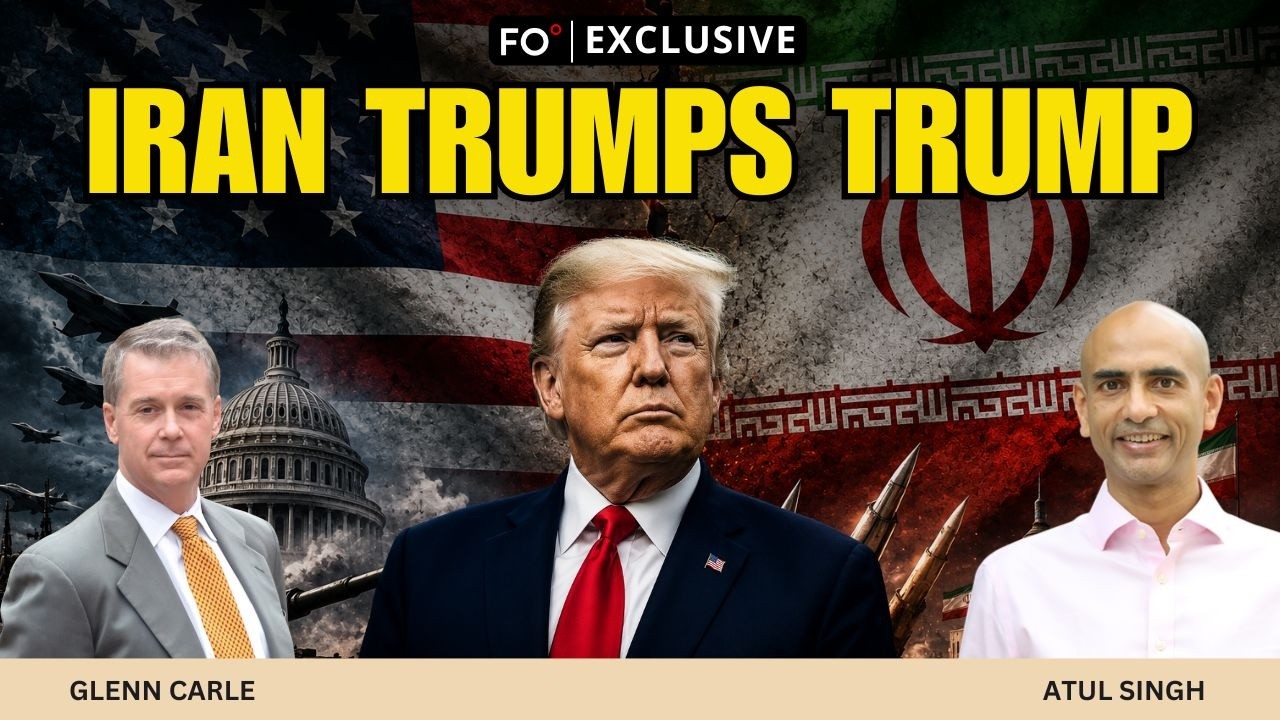
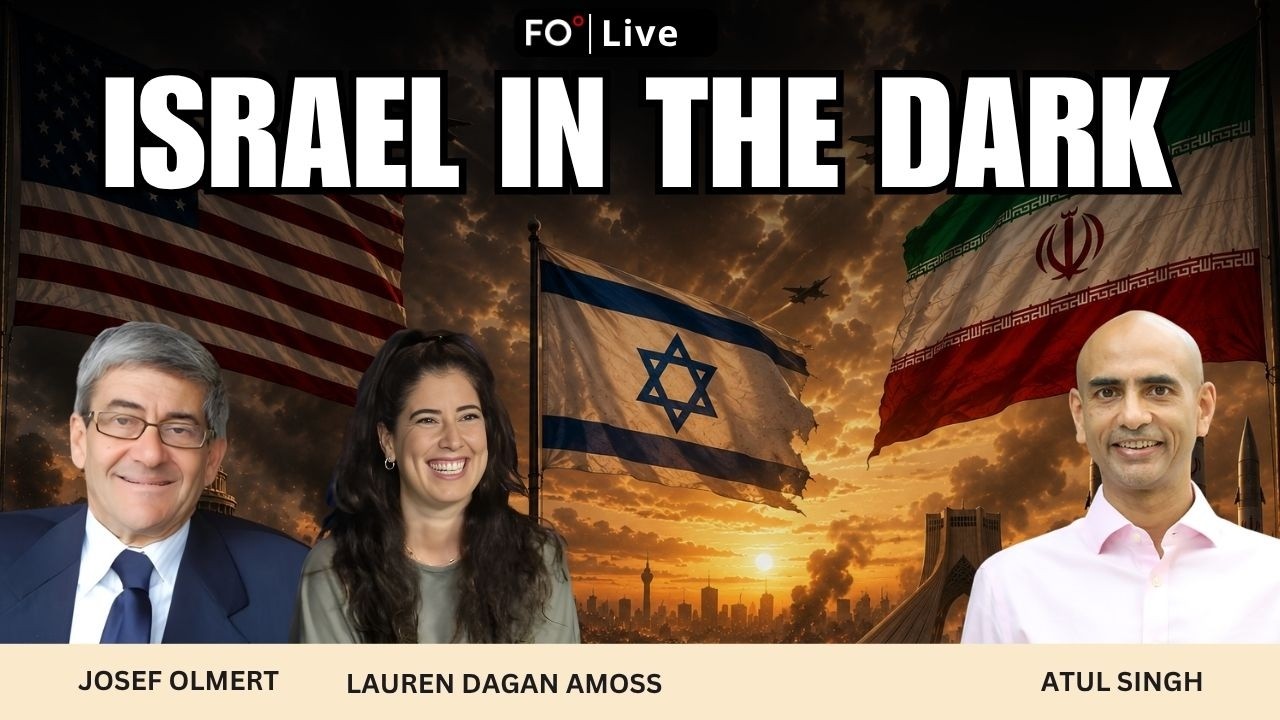
Editor-in-Chief Atul Singh and Evan Munsing, candidate for Colorado’s competitive 8th Congressional District, Marine Corps veteran and entrepreneur, examine the United States’s sudden entry into war with Iran under President Donald Trump. Contradictorily, a president who campaigned on avoiding foreign entanglements has launched a new conflict in the Middle East. As Singh and Munsing explore the implications, they situate the war within a broader pattern of strategic ambiguity, institutional decline and growing public distrust. The result is not just a geopolitical crisis, but a test of American democracy itself.
Shock, contradiction and shifting goals
Munsing describes a political landscape caught off guard. Across party lines, Americans are struggling to reconcile Trump’s long-standing “America First” rhetoric with a decision to initiate war. Drawing on conversations from the campaign trail, he notes that voters are not only surprised but deeply confused about the rationale behind the conflict. “I think the first thing is just shock across the political spectrum,” he observes.
The absence of clear objectives compounds that confusion. Singh presses Munsing on what the administration is trying to achieve, and the answer remains elusive. From regime change to nuclear containment to vague notions of victory, the stated goals appear to shift constantly. Munsing points to statements from the White House suggesting that Trump alone will determine when Iran has “unconditionally surrendered,” dismissing the idea as “ridiculous.” Without a stable definition of success, the war risks replicating the strategic drift seen in Afghanistan and Iraq, where the endgame remained perpetually undefined.
Miscalculation and the risk of escalation
The discussion then turns to how the conflict began. Munsing argues that Trump’s decision-making reflects a pattern of boundary-testing behavior. Early military successes, particularly a high-risk operation in Venezuela, may have created a false sense of confidence. According to this view, the administration expected a rapid, decisive outcome in Iran — perhaps even regime collapse — without fully accounting for the complexity of the region.
This miscalculation now presents a dangerous dilemma. If the US withdraws quickly, it risks signaling failure. If it escalates, it may become trapped in a prolonged and costly conflict. Singh raises the possibility of deploying ground troops, a scenario that would dramatically raise the stakes. Munsing considers such a move unlikely but politically catastrophic, arguing that it would face overwhelming public opposition and significantly increase casualties and financial costs.
The broader concern is that the administration lacks a coherent strategy. Without clear objectives or limits, the conflict could expand in unpredictable ways, drawing the US deeper into a region already defined by volatility and competing interests.
Domestic repercussions and the terrorism calculus
Beyond the battlefield, Singh and Munsing examine how the war could reshape domestic politics. Recent lone-wolf attacks in the US complicate public sentiment. While such incidents may initially push Americans toward disengagement, a confirmed state-sponsored attack linked to Iran could have the opposite effect.
Munsing explains that a direct threat to the homeland would likely trigger a “rally around the flag” response, increasing support for the war despite broader skepticism. This distinction underscores how fragile public opinion remains. Americans may oppose the conflict in principle, but their stance could shift rapidly under the pressure of perceived national danger.
Simultaneously, the lack of a clear initial justification for the war weakens the administration’s position. Without a compelling narrative, it becomes harder to sustain public support over time, especially if the conflict drags on or casualties mount.
Congress, executive power and institutional decline
Singh highlights the constitutional role of Congress in declaring war. Munsing argues that lawmakers have increasingly ceded this power to the executive branch. “It certainly feels like we’re moving to a Cesarean presidency,” he says, pointing to a long-term trend that has accelerated in recent years.
This shift reflects deeper institutional problems. Congress, once protective of its prerogatives, now appears reluctant to assert itself. Munsing criticizes a culture of performative politics in which legislators prioritize media presence over substantive lawmaking. With approval ratings hovering around 17%, public confidence in the institution has reached strikingly low levels.
The Iran war exposes these weaknesses. Despite the absence of formal authorization, Congress has struggled to respond decisively. For Munsing, this moment represents both a failure and an opportunity: a failure to uphold constitutional responsibilities, but also a chance to reassert them, if lawmakers choose to act.
Distrust, disillusionment and fragile hope
Singh and Munsing close with a broader reflection on declining trust in American institutions. From prolonged wars in Afghanistan and Iraq to economic crises and elite scandals, many citizens now see a system that operates by different rules for the powerful and the public. Some have even labeled the conflict the “Epstein war,” viewing it as a distraction from unresolved controversies involving political and economic elites.
Munsing warns that this perception could lead to two dangerous outcomes: widespread disengagement from civic life or a turn toward more extreme political solutions. Both, he suggests, would undermine the foundations of American democracy.
Yet he also identifies tentative signs of renewal. Public frustration is driving greater political engagement, from town hall participation to grassroots campaigning. On the campaign trail, he finds that a majority of voters are willing to engage seriously, even across party lines. This rising involvement, combined with pressure on elected officials, could create an opening for institutional reform.
Whether those “green shoots” take root will depend on whether political leaders respond to public demand for accountability and clarity. As Singh and Munsing make clear, the stakes extend far beyond the Iran war itself, touching on the future of American governance in an increasingly unstable world.
[Lee Thompson-Kolar edited this piece.]
The views expressed in this article/video are the author’s own and do not necessarily reflect Fair Observer’s editorial policy.




















Comment