





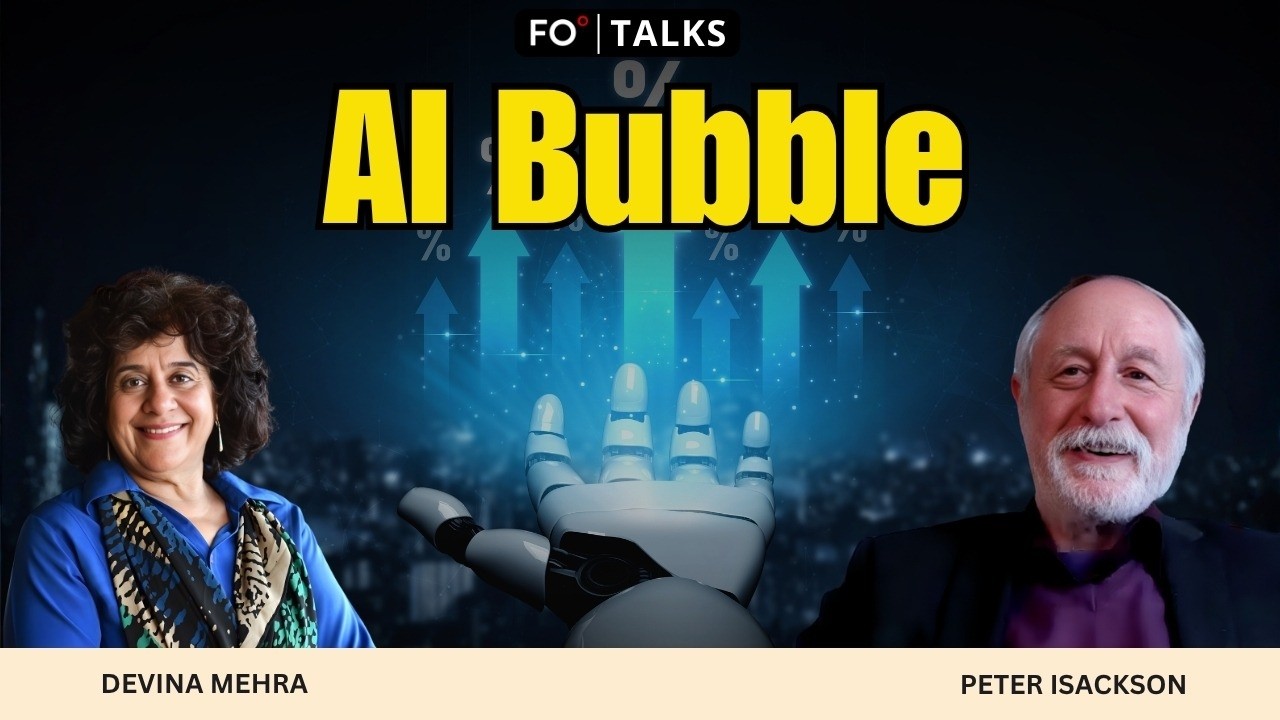
Fair Observer’s Video Producer Rohan Khattar Singh speaks with Devina Mehra, Founder and Chairperson of First Global, about the forces shaping global markets in 2026. After a volatile 2025 marked by wars, inflation and US President Donald Trump’s disruptive economic policies, how should investors make sense of an increasingly fragmented world? Mehra’s answer is strikingly unsentimental: geopolitics matters, but markets operate on their own logic.
Markets, Trump and the limits of geopolitics
Mehra identifies Trump as the common thread running through much of the recent turbulence. In her words, he is “dismantling the old order without your knowing what comes next.” Yet she draws a clear distinction between macro-level disruption and market behavior.
Looking at 50 years of data, from the Gulf Wars to September 11 and the US invasion of Afghanistan, she argues that stock markets tend to recover from geopolitical shocks within six to 12 months. Unless a country is directly involved in conflict, markets historically “shrug it off.” The notable exception is when major commodity producers are involved, as in the Russia–Ukraine war, where energy and commodity prices experience sustained impact.
In 2025, another dynamic was at play: extreme market concentration. The so-called Magnificent Seven US tech stocks once again drove the bulk of S&P 500 gains. In 2025, roughly 43% of the index’s performance came from this narrow group, down from more than 60% in 2023 and 2024 — but still highly concentrated. Even within that group, only three or four stocks accounted for most of the gains. The average stock, Mehra cautions, has underperformed.
The AI boom and the profitability question
Much of the recent market enthusiasm centers on artificial intelligence. Mehra remains cautious. History, she argues, shows that transformative technologies do not automatically translate into investor profits.
Automobiles and aviation reshaped the 20th century but were “a graveyard of companies” from an investor’s standpoint. The early Internet era followed a similar pattern. Infrastructure firms such as Global Crossing laid undersea cables that still carry global data traffic today — yet the company itself went bankrupt.
Mehra’s concern with AI is less about its transformative potential and more about capital intensity and monetization. Massive data centers, rapidly depreciating hardware and soaring talent costs create enormous upfront investment. Meanwhile, she points to data suggesting that usage of some AI platforms fell 60–70% during school holidays. This implies that student adoption, not high-margin enterprise demand, drives a significant portion of current traffic.
Even more worrying, she notes, is financial engineering. Some large technology firms avoid placing AI-related debt directly on their balance sheets by routing it through smaller entities that build and finance infrastructure separately. The result is systemic leverage that may be underappreciated.
India’s growth versus market reality
Turning to India, Khattar Singh challenges the dominant narrative that India is rising while the West stagnates. Mehra acknowledges that India’s headline GDP growth remains among the highest globally. Yet the composition of that growth raises questions.
Manufacturing as a share of GDP has fallen to roughly 12–13.5%, near its lowest level since the 1960s. Tourism has not yet surpassed pre-pandemic levels. Foreign direct investment and foreign institutional flows have slowed, and India recently recorded a capital account deficit for the first time in two decades.
Most importantly, Mehra stresses that macroeconomic growth does not guarantee market performance. China offers a stark example: Between 2007 and 2023, Chinese GDP expanded more than sixfold, yet its equity market only recently surpassed its 2007 peak. High growth does not automatically translate into shareholder returns or sufficient job creation.
Dedollarization, crypto and the myth of safe havens
On dedollarization, Mehra has revised her earlier skepticism. While reserve currencies rarely change quickly, she believes the pace of diversification has accelerated as confidence in US institutions comes “under question.” Even so, she doubts that China’s renminbi will replace the dollar outright. Instead, she anticipates gradual diversification toward a basket of currencies — euro, Swiss franc, Japanese yen — alongside gold.
Cryptocurrencies, in her view, are legitimate assets but not true currencies. Extreme volatility makes them impractical for pricing goods or serving as stable stores of value. With drawdowns of 70–85% occurring multiple times, she recommends limited exposure — 2% to 5% of a portfolio at most.
Gold fares no better under scrutiny. Over a 50-year period, gold has been more volatile than equities. After peaking in 1980, it took 27 years to reclaim that high. Its steady rise in Indian rupee terms, she explains, reflects currency depreciation rather than intrinsic stability.
Machines, bias and the discipline of data
At First Global, Mehra has adapted to what she sees as a structural shift in markets. In the 1990s, the edge lay in privileged information. Today, regulation ensures simultaneous disclosure. The advantage now lies in analysis.
Her firm uses machine learning systems to screen more than 20,000 securities globally, examining numerous factors without human emotional bias. Machines reduce randomness and cognitive error — insights drawn in part from behavioral economist Daniel Kahneman’s work on decision-making. Yet she insists on a “human overlay” to design models and interpret outputs. Technology is a tool, not an oracle.
Mehra will not speculate on what single trend could make or break markets in 2026. “Risk is always something you didn’t see coming,” she says, recalling how The Economist failed to flag Russia–Ukraine as a major geopolitical risk just weeks before war erupted in 2022. For her, disciplined data checks matter more than bold predictions. In an age of narrative excess, humility may be the most valuable asset of all.
[Lee Thompson-Kolar edited this piece.]
The views expressed in this article/video are the author’s own and do not necessarily reflect Fair Observer’s editorial policy.































Comment