







 | ||||||||
| ||||||||
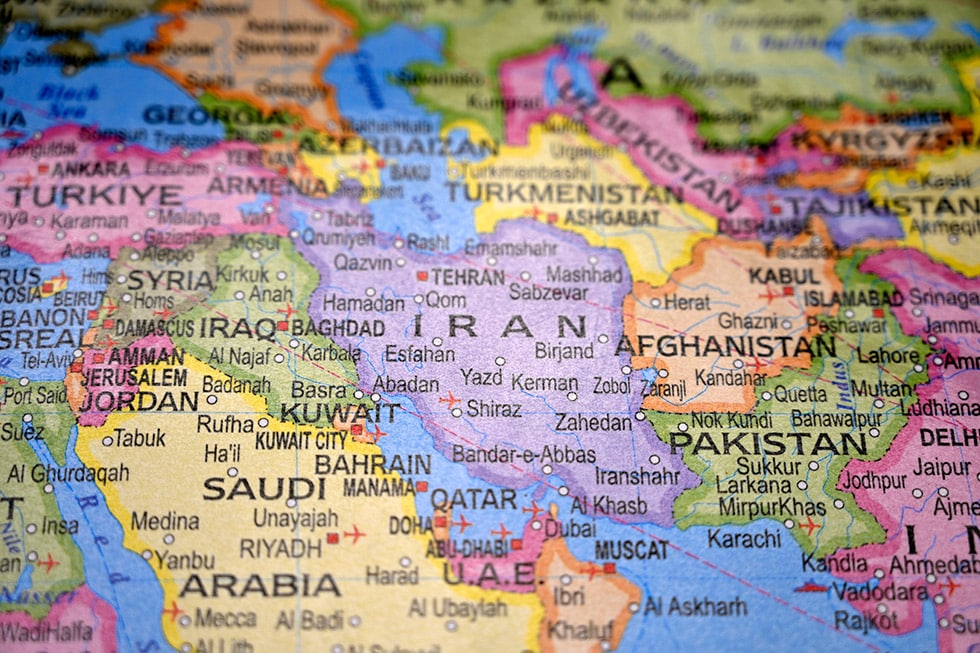
Dear FO° Reader, We once again find ourselves in a tumultuous week. This time, Iran has been bombed in a joint Israeli–US operation. President Trump has said that the goal of the attacks is to prevent Iran from obtaining nuclear weapons. The joint strike is responsible for killing many of Iran’s senior leaders, including the Ayatollah, Ali Khamenei, who has led Iran since 1989, leaving Iran in limbo in deciding its next leader. These attacks have struck the country in the wake of an already-explosive round of protests within Iran itself, with thousands of civilians killed by the Iranian government in a violent crackdown.
via Shutterstock To say tensions and tempers are running high would be a laughable understatement. The story is rapidly developing around the world in shows of solidarity, counterprotests and oil prices. Here at Fair Observer, we have decided to try and give you a snapshot of how we got here, what exactly the world’s reaction has been so far and what some of the reasons Israel and the US chose to start this war. Source: More than 7,000 dead in Iran’s crackdown on protests, activists say | PBS News The US balances between criticism and praise The US has had a mixed response. Democrats have decried the attack. While Republicans mostly support it, there is some noticeable criticism among US President Trump’s usual diehard base. Trump had campaigned on the platform of no new foreign wars in 2024. Now that Trump has backflipped on this promise, some notable pundits and former allies are expressing outrage. This has not, however, made much of a difference in practical reality. The Senate voted almost exactly along party lines, 47–53, against putting any limits on the administration in terms of future military actions in the region. This comes despite Congress, not the President, having the power to declare war, power that comes from the US Constitution. The Trump administration informed Congress of the attack on Iran for “collective self-defense” in accordance with US law, something that has underscored every military conflict in US history after World War II, including (initially) supported wars like Vietnam and Afghanistan. This has caused the administration to insist this conflict is not a war, despite US bombing of Iran’s capital and the killing of a number of the nation’s leaders in targeted strikes. Observant readers might notice similarities to Venezuelan President Nicolas Maduro’s abduction in early January. This represents something of a pattern for Trump, whose critics say is growing more authoritarian. Others allege that Trump is trying to distract from the Epstein files scandal, in which Trump has been mentioned multiple times. Sources: Trump promised the MAGA base no new wars. Then he went to war with Iran | NPR Senators vote down legislation to halt Iran war | AP News Why doesn’t Congress declare war anymore? | CNN Politics Nicolás Maduro Capture and Indictment | Britannica The DOJ has been taking down Epstein files. Here’s what remains. | CBS Israel joins the US in strikes against Iran Support for the strikes among Jewish Israelis has been near-unanimous — polls put it anywhere between 82% and 93% depending on when and who you ask. The dominant framing is existential: Iran’s nuclear ambitions were a ticking clock, and the strikes are widely seen not as an act of aggression but as a long-overdue act of self-preservation. Netanyahu has been quick to claim the operation as a historic security achievement, and for once, much of the country seems inclined to agree with him. The Air Force and Mossad are riding a wave of public trust rarely seen in Israeli politics. Arab Israelis, however, are living in an almost parallel reality. Somewhere between 65% and 88% oppose the attacks, are far more likely to see Netanyahu’s motives as political rather than strategic, and express deep fear about where this escalation leads. It is a stark reminder that “Israeli public opinion” is never a single thing. Even within the Jewish majority, anxiety quietly runs alongside the triumphalism — roughly half of supporters admit the government has no clear exit strategy. The celebration, it seems, comes with an asterisk. Sources: The Israeli Public and the Campaign Against Iran: Survey Results – June 2025 | INSS Jewish-Israelis support Iran war, Arab-Israelis skeptical | The Jerusalem Post Vast majority of Israelis support the war against Iran, polls find Russia remains on the sidelines Russia has reacted to the attacks with condemnation. President Vladimir Putin gave his condolences after Khamenei’s assassination. He also alluded that the strikes were done on false pretenses — rather than destroying Iran’s nuclear capabilities, the Kremlin alleged, the strikes were meant to overthrow the Iranian regime. Russia’s Foreign Ministry spokeswoman, Maria Zakharova, has said that the West’s calls for Iranians to seize power are “cynical” and “inhumane.” However, despite both countries’ close ties, Russia has not made any definitive moves in support of the regime. In January 2025, Russia and Iran signed a joint strategic treaty, but that treaty does not compel Russia to intervene militarily on behalf of Iran. Some analysts speculate that the attack caught Moscow off guard. At the moment, it seems Russia’s chief concern is financial. Given the country’s economic crisis and the sanctions on its oil exports, rising oil prices as a result of the strikes will only damage Russia’s economy further. And, as they are still locked in a long, bitter war with Ukraine, the nation may not have the resources necessary to assist Iran militarily. Sources: Russia says US attacked Iran on false pretext, condemns call for Iranians to seize power | Reuters Russia Struggles to Find a Response to U.S.–Israel Attack on Iran | Jamestown China takes a similar stance Like Russia, China is keeping a close watch on oil prices even though, according to data analysts, the state has a little more maneuverability than Russia when it comes to oil. And, like Russia, China has similar strategic ties to Iran. Beijing’s official response has been loud and unambiguous: the strikes are illegal, unacceptable and a violation of the UN Charter. Foreign Minister Wang Yi called for an immediate ceasefire and a return to dialogue, while state media outlets — such as Xinhua and China Daily — went further, framing the entire episode as proof that US diplomacy was never genuine. The nuclear talks, in their telling, were not a peace process but a calculated pause before military action. What Beijing says and what Beijing does, however, are increasingly two different things. Despite the fiery rhetoric, China has made no concrete moves in Iran’s defense — and analysts are not surprised. A Trump-Xi summit is on the horizon, and China’s trade relationship with Washington dwarfs its ties with Tehran. There is also a colder calculation at play: a US bogged down in a Middle Eastern war is a US distracted from the Indo-Pacific. China is watching carefully, condemning loudly and doing very little. Sources: Foreign Ministry Spokesperson Mao Ning’s Regular Press Conference on March 3, 2026 Ending war immediate global concern: China Daily editorial – Chinadaily.com.cn China set to suffer from turmoil in the Middle East, but it stands to benefit long term What China’s response to the US attack on Iran says about its foreign policy – ABC News Southeast Asia’s loud outcry In South and Southeast Asia, reactions have been heated. In Pakistan, violence erupted during a pro-Iran protest near the US embassy. Ten people were killed and over 60 were injured. In total, there have been 24 deaths related to pro-Iran protests. Protesters have even set fire to a UN office. Pakistan ordered a three-day curfew and deployed troops to the northern Gilgit-Baltistan region. Protests erupted across India against Israel and the US after Khamenei’s killing. Thousands reportedly took to the streets, chanting anti-US and anti-Israel slogans. The largest demonstration took place in Lucknow, Uttar Pradesh, where they waved black flags in mourning. Similar protests were held in Bangladesh’s capital, where the far-right political group Jamaat-e-Islami, the largest Islamist party in Bangladesh, staged a rally. South Asia’s politicians have been far more conservative in their responses. Indian Prime Minister Modi has called for peace, even as an Iranian warship was sunk near Sri Lanka. Meanwhile, Indonesia’s foreign minister, Sugiono, announced that talks with Trump’s “Board of Peace” were on hold. Trump had proposed the Board of Peace as a plan to end the Israel–Hamas war. Sources: Pakistan calls troops, orders 3-day curfew as 24 killed in pro-Iran rallies | Al Jazeera Protests across India against Khamenei’s killing | Al Jazeera Jamaat holds rally in Dhaka protesting attack on Iran | Dhaka Tribune An Islamist party becomes Bangladesh’s main opposition for the first time | NPR Protest in Lucknow over Ayatollah Ali Khamenei’s killing in Iran | Hindustan Times Discussions with Board of Peace ‘on hold’ due to Iran war, Indonesia says | Reuters Reactions from Europe These attacks have elicited mixed reactions from European leaders. While many condemn Iran’s retaliatory strikes, few have neither condemned nor applauded the attacks in Iran by the US and Israel. Other viewpoints from across Europe have condemned Iranian attacks on neighboring Gulf states. The Baltic states — Latvia, Lithuania and Estonia — welcomed the death of the Ayatollah, also noting that it is a significant setback for Iran and provides the Iranian people an opportunity to shape their future. Spain has been the only EU state to condemn the US and Israel strikes in Iran openly. Spain has also refused to allow the US to use its bases to strike Iran, which has resulted in Trump issuing threats to sever trade with Spain. Sources: Iran Conflict: Will Europe Remain a Bystander? — Kyiv Post Spain’s Pedro Sánchez hits back at Trump threat to sever trade saying ‘no to war’ — BBC News Iran’s response: retaliatory strikes around the Gulf and Shia protests Iran’s retaliatory strikes in neighboring Gulf states earlier this week have many scrambling to evacuate the region. Many airports in the region are closed or heavily restricting flights as governments assess security risks and clear airspace for military operations. Missiles struck Dubai International Airport this week, one of the world’s busiest transit hubs and a critical gateway linking Europe, Asia and Africa. The disruption has forced airlines to cancel routes or divert flights around the Gulf, stranding travelers and complicating evacuation efforts as tensions across the region continue to escalate. The UAE’s Ministry of Defence (MoD) announced that its defense systems had intercepted 11 ballistic missiles and 123 drones on Tuesday. The MoD reported that its systems detected a total of 812 Iranian drones and had intercepted 755 of them, resulting in three fatalities and 68 injuries, many being foreign nationals. The UAE has condemned Iran’s attacks and affirms that it has the right to respond, potentially expanding the scale of the conflict. Sources: Travellers stranded, airlines under pressure as Iran war escalates — Al Jazeera In addition to the retaliatory strikes, the death of Khamenei has sparked widespread protests among Shia communities across South Asia, particularly in Pakistan, which hosts one of the largest Shia populations outside Iran. Many demonstrators view Khamenei not only as a political leader but also as a key religious authority, making his killing a deeply symbolic loss for Shia identity. Protests across the Gulf region have included mass mourning marches, anti-US and anti-Israel demonstrations and violent clashes with security forces. The unrest highlights both the transnational influence of Iran within Shia communities and the precarious position of regional governments that must balance domestic sectarian tensions with strategic relationships with Western and Gulf partners. Sources: From Karachi to Beirut, Khamenei’s death sends shockwaves across the Shiite world — AP News Anger among Pakistan’s Shi’ites underlines its Iran-U.S. tightrope walk — Reuters The coming weeks will likely determine whether the latest escalation becomes a limited confrontation or a wider regional conflict. Iran now faces a leadership vacuum after the death of Khamenei, while governments across the Middle East weigh how forcefully to respond to Tehran’s retaliation. At the same time, divisions among European states and rising unrest within Shia communities abroad underscore how the crisis extends far beyond Iran’s borders. What began as a targeted military strike has quickly evolved into a moment of profound uncertainty for the region, raising questions about Iran’s future leadership, the stability of regional alliances and the risk of a broader war in the Middle East. Media Watch: Europe
Middle East/North Africa
Opinions on why this war is happening: Why did Trump and Netanyahu start this war? Liam, Casey and Roberta Assistant Editors and Communications Related readings
| ||||||||
We are an independent nonprofit organization. We do not have a paywall or ads. We believe news
must
be free for everyone from Detroit to Dakar. Yet servers, images, newsletters, web developers and
editors cost money.
So, please become a recurring donor to keep Fair Observer free, fair and independent. 
| ||||||||
| ||||||||
| About Publish with FO° FAQ Privacy Policy Terms of Use Contact |





Explore More FO° Spotlight

Support Fair Observer
We rely on your support for our independence, diversity and quality.
For more than 10 years, Fair Observer has been free, fair and independent. No billionaire owns us, no advertisers control us. We are a reader-supported nonprofit. Unlike many other publications, we keep our content free for readers regardless of where they live or whether they can afford to pay. We have no paywalls and no ads.
In the post-truth era of fake news, echo chambers and filter bubbles, we publish a plurality of perspectives from around the world. Anyone can publish with us, but everyone goes through a rigorous editorial process. So, you get fact-checked, well-reasoned content instead of noise.
We publish 3,000+ voices from 90+ countries. We also conduct education and training programs
on subjects ranging from digital media and journalism to writing and critical thinking. This
doesn’t come cheap. Servers, editors, trainers and web developers cost
money.
Please consider supporting us on a regular basis as a recurring donor or a
sustaining member.
Will you support FO’s journalism?
We rely on your support for our independence, diversity and quality.





Comment