


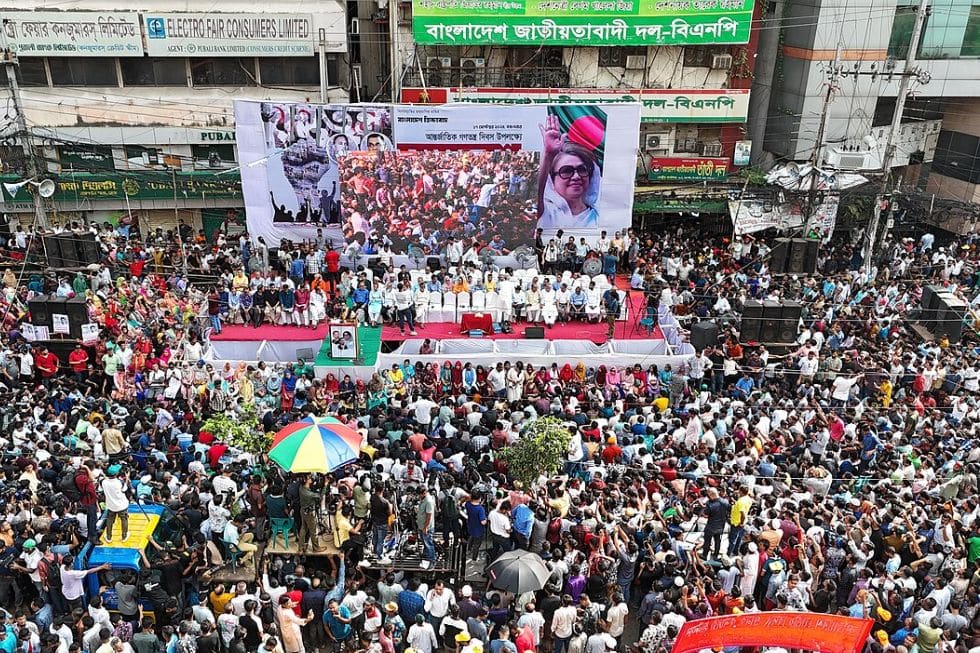



The recent parliamentary election in Bangladesh, which returned the Bangladesh Nationalist Party (BNP) to power with a two-thirds majority, marks a potential paradigm shift in the country’s foreign policy trajectory. With former Prime Minister Sheikh Hasina Wazed’s long political era coming to an end, the BNP, led by Tarique Rahman, is expected to recalibrate Dhaka’s relations with regional actors, including India, Pakistan and China.
In his post-election statements, Tarique Rahman espoused a “Bangladesh First” approach, asserting that the country’s foreign policy would henceforth be guided by national interest and the welfare of the people. However, uncertainty clouds the next administration. Will the incoming BNP government’s foreign policy mark a sharp departure from its predecessor, or will structural and regional constraints limit it to pragmatic adjustments?
India–Bangladesh relations at a crossroads
Bangladesh and India maintained a particularly strong bilateral relationship during the tenure of former Prime Minister Sheikh Hasina, which was largely shaped by New Delhi’s objective of maintaining political stability in Dhaka. Given Bangladesh’s strategic geographic location, India has consistently sought to ensure stable access to its northeastern provinces via the Siliguri Corridor through transit agreements with Bangladesh. At the same time, India was concerned about China’s growing presence in the Bay of Bengal, which influenced these ties. However, following the overthrow of Sheikh Hasina’s government in a mass uprising in 2024, relations between New Delhi and Dhaka worsened significantly.
The diplomatic fallout was marked by Indian accusations of religious minority repression in Bangladesh, misinformation campaigns and trade restrictions. Most significantly, India’s refusal to extradite Hasina, who fled to the country following her ousting, despite Bangladesh’s International Crimes Tribunal having sentenced her to death for her role in the 2024 protests, exacerbated the diplomatic tensions further.
Under the interim government led by Muhammad Yunus, anti-Indian narratives gained increased prominence among opposition groups and segments of the broader public in Bangladesh. Moreover, India’s continued support for the Awami League in recent elections contributed to rising public dissatisfaction in Bangladesh and heightened perceptions of Indian interference in the country’s internal politics. These developments have complicated bilateral relations and ignited domestic debates over issues of sovereignty and foreign policy autonomy in Bangladesh.
Nevertheless, India has started to adapt to the new political reality in post-Hasina Bangladesh. In February 2026, Indian Foreign Minister Subrahmanyam Jaishankar attended the funeral of former Prime Minister Khaleda Zia, whose son Rahman is poised to assume leadership. In addition, following the BNP’s victory, Indian Prime Minister Narendra Modi congratulated Rahman and reaffirmed his country’s support for a democratic and inclusive Bangladesh.
Informed observers predict that the BNP will adopt a pragmatic approach toward India, grounded in mutual benefit and strategic necessity. Given India’s status as Bangladesh’s closest neighbor, the new government has significant incentives to restore a productive working relationship with New Delhi, irrespective of whether the relationship reverts to the level of political intimacy seen during the Hasina administration. Therefore, Dhaka must adopt a cautious middle ground in its relationship with India.
For the BNP government, redefining relations with India will require recalibrating the country’s strategic cooperation with New Delhi while maintaining Bangladesh’s political autonomy and decision-making authority. Maintaining such a delicate diplomatic balance amid prevailing anti-India and anti-Bangladesh sentiments among certain groups in both countries will be challenging, especially given that such vitriol is often amplified by rumors, misinformation and political propaganda.
In this context, the BNP government may face domestic pressure to adopt a firmer rhetorical stance toward New Delhi, even though strategic interdependence and regional stability require continued engagement and cooperation with India.
A recalibrated engagement with China?
Relations with China are likely to pose the most consequential strategic challenge for the incoming BNP government. Under former Prime Minister Sheikh, Beijing expanded its influence in Bangladesh through infrastructure projects linked to its Belt and Road Initiative and closer defense cooperation with Dhaka. This trend continued after the political transition, with the interim government reportedly receiving over USD 2.1 billion in Chinese loans and grants, as well as diplomatic recognition, through high-level talks with Beijing.
In 2026, China is expected to remain Bangladesh’s largest trading partner and a core part of the country’s defense plans. This growing defense relationship is evident in the 2025 deal, under which China agreed to build a drone manufacturing plant in Bangladesh, as well as ongoing talks to acquire J-10CE fighter aircraft. China has successfully institutionalised its close relationship with Bangladesh, thereby narrowing the strategic choices for the next government. The BNP is therefore likely to continue economic engagement with Beijing, as protecting Chinese investments in the country aligns with Bangladesh’s national interests.
Although historically perceived as aligned with Beijing, the BNP’s diplomatic record reflects a pragmatic foreign policy strategy of alliance diversification. Under Ziaur Rahman’s administration (1977–1981), Bangladesh strengthened diplomatic and military ties with China to broaden external partnerships beyond India and the Soviet bloc. This hedging approach continued under Khaleda Zia, when military cooperation and economic engagement with China expanded through several agreements, including infrastructure, trade, and technical assistance.
However, Dhaka’s hedging strategy toward China will likely come under intense scrutiny from great-power players, pressuring the incoming government to navigate mounting hostility from India and the United States to China’s expanding regional influence. Questions about the sustainability of large-scale infrastructure financing and accusations of Chinese debt entrapment will further shape Dhaka’s approach toward Beijing. Consequently, BNP is likely to strike a balance between strategic prudence and economic collaboration in its engagement with China. It would be wise for the BNP to avoid placing Bangladesh at the center of the intensifying strategic competition between China, the United States and India.
Pakistan’s bid for re-engagement
During the Awami League government, Pakistan remained relatively distant from Bangladesh, largely due to Dhaka’s long-standing strategic alignment with New Delhi. Furthermore, unresolved historical grievances over Pakistan’s atrocities during the Bangladesh Liberation War continued to shape Dhaka’s diplomatic posture and constrained the prospect of closer bilateral engagements. However, this dynamic changed during Muhammad Yunus’ interim government, when Bangladesh and Pakistan took steps to restore ties. In an effort to rebuild mutual trust, the two countries resumed direct air links, increased civilian and military exchanges, and relaxed visa policies. Moreover, Islamabad explored renewed defence cooperation with Dhaka, including discussions on the potential sale of fighter aircraft.
Beyond official diplomatic channels, Pakistan has pursued soft-power outreach by engaging Bangladeshi cultural figures and media platforms, including the participation of Bangladeshi artists in Pakistan Idol. Amid persistent anti-India sentiment among segments of Bangladeshi youth, Pakistan appears to be leveraging cultural diplomacy and public engagement to shape public opinion in its favour and encourage closer ties with the new government in Dhaka.
Looking ahead: Bangladesh’s foreign policy choices
For Dhaka, diversifying external partnerships is an ideal strategy to reduce overdependence on any single regional actor. This approach involves balancing relations with both Islamabad and New Delhi and engaging with partners in the Middle East. Bangladesh will also need to maintain a transactional approach toward both India and Pakistan, ensuring that its engagement with both regional players remains transparent, structured and guided by clearly defined national interests rather than ideological alignment.
For the incoming administration to be successful, the BNP’s “Bangladesh First” policy must prioritize the country’s national interests, diversify external partnerships and address regional challenges, such as the Rohingya crisis. The incoming BNP government, therefore, should avoid entanglement in great-power rivalries between the US, India and China. Instead, the new administration’s diplomacy should be grounded in pragmatism and strategic calculation rather than rhetorical posturing.
[Omar Abdelrahman edited this piece.]
The views expressed in this article are the author’s own and do not necessarily reflect Fair Observer’s editorial policy.
Bangladesh Heads to the Polls as Minorities Face an Uncertain Future
Between December 2025 and January 2026, Bangladesh witnessed renewed violence targeting religious minorities, especially Hindus, amid political unrest following Prime...

FO° Podcasts: Myanmar Votes During a Civil War: Why This Election Could Tear the Country Apart
In this episode of FO° Podcasts, Rohan Khattar Singh and Asanga Abeyagoonasekera examine Myanmar’s December 28 elections against the backdrop...

Bangladesh Now Aligns With China, India Worries
China seeks to counter India’s rise by deepening its influence in South Asia and binding Bangladesh through trade, infrastructure and...
Support Fair Observer
We rely on your support for our independence, diversity and quality.
For more than 10 years, Fair Observer has been free, fair and independent. No billionaire owns us, no advertisers control us. We are a reader-supported nonprofit. Unlike many other publications, we keep our content free for readers regardless of where they live or whether they can afford to pay. We have no paywalls and no ads.
In the post-truth era of fake news, echo chambers and filter bubbles, we publish a plurality of perspectives from around the world. Anyone can publish with us, but everyone goes through a rigorous editorial process. So, you get fact-checked, well-reasoned content instead of noise.
We publish 3,000+ voices from 90+ countries. We also conduct education and training programs
on subjects ranging from digital media and journalism to writing and critical thinking. This
doesn’t come cheap. Servers, editors, trainers and web developers cost
money.
Please consider supporting us on a regular basis as a recurring donor or a
sustaining member.
Will you support FO’s journalism?
We rely on your support for our independence, diversity and quality.





Comment