






 | ||
| ||
| ||
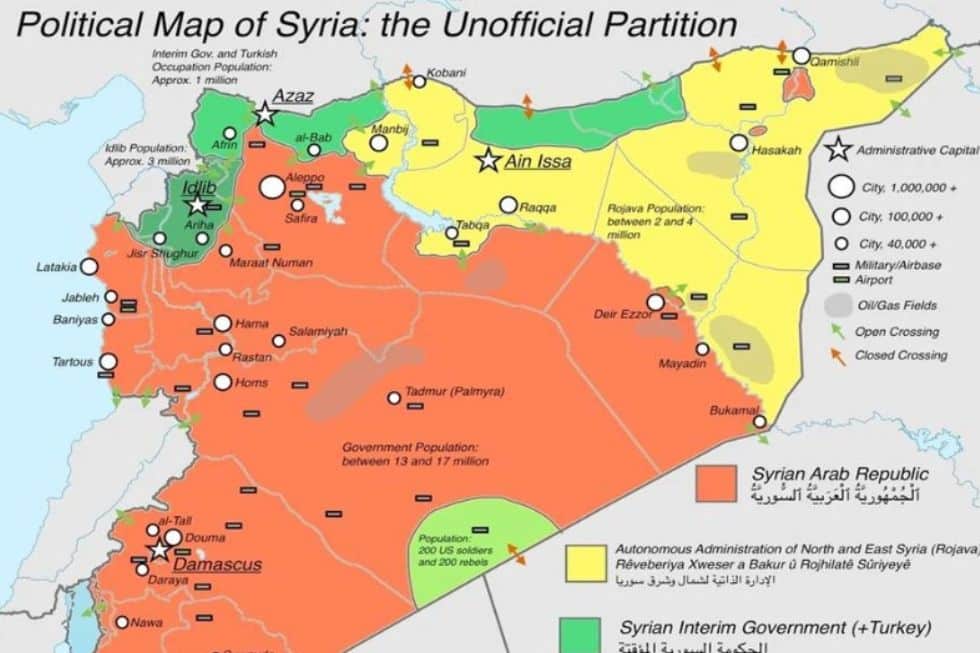
Dear FO° Reader, Greetings. I used to think that we might have more democracies in the future. But as it turns out, democracies are falling out of fashion. Right now, Syria is dealing with a similar crisis. In mid-January, Syrian government troops launched an offensive against the Kurdish-led Syrian Democratic Forces (SDF) after a ceasefire was announced on January 18. The SDF ruled northeastern Syria for over a decade, administering territory and maintaining relative stability. During the term of the previous Syrian president, Bashar al-Assad (who had been ousted in 2024), the SDF also served as Washington’s primary partner in the US’s fight against ISIS. However, their protection in the region came to a swift end when the Trump administration withdrew its support of the SDF in late January, 2026. Between the Syrian Army’s offensive and lack of US support, the SDF is exposed to regional pressure and military rollback, further threatening the already-uncertain existence of the Kurdish population in Syria. Sources: Syrian Offensive Against Kurdish-Led SDF Risks Escape of ISIS Prisoners US abandons Syria’s Kurds, risking regional turmoil and an IS resurgence Bashar al-Assad – Syrian Conflict, Dictatorship, Human Rights | Britannica The Kurdish Syrian population has put in the work US disengagement emphasizes Washington’s refusal to acknowledge the work the SDF put into revolutionizing the governance of Syria. In 2018, the Kurdish population of Syria established the Democratic Autonomous Administration of North and East Syria (DAANES) with pluralism as a foundational principle. This political project highlighted pluralism as a foundational principle. The 2023 Social Contract guaranteed political representation and cultural rights for Kurds, Arabs, Assyrians, Turkmen, and Yazidis, including the use of native languages within a shared political structure. Unlike the centralized authoritarian systems dominant in the region, DAANES stood as a rare beacon of pluralism, gender equality, and local democracy in a region defined by authoritarianism. Power flowed from the bottom up through a commune system. Local communes, typically composed of 30 to 400 households, managed everyday affairs such as public services and dispute resolution. These communes elected representatives to higher-level councils, linking local decision-making to regional governance. Sources: About – The Democratic Autonomous Administration of North and East Syria The Case for Decentralization in Syria | Middle East Forum DAANES also promoted Jineology, or the “science of women,” as a framework for challenging patriarchal norms. Gender parity was institutionalized through a co-chair system, under which every leadership position—from local councils to the executive—was jointly held by one man and one woman. This principle was non-negotiable and ensured women’s participation at every level of authority. Women’s autonomy extended to security, most notably through the YPJ (Women’s Protection Units), an all-female force that fought ISIS while defending women’s rights against extremist ideologies. Sources: Jineology | Wikipedia External geopolitical chess games threaten Kurdish democracy Clearly DAANES and the SDF are prepared to revolutionize the region. Yet external conflict complicates their fight. Despite serving as the US’s most reliable boots on the ground in the fight against the Islamic State, the Kurds found their political aspirations treated as expendable chips in a larger geopolitical game. DAANES is in a difficult position, unable to gain international recognition. Sources: Afrin: A Case Study in Turkish de-Kurdification Full article: The de facto Autonomous Governance and Stability in the Middle East: The Case of Kurds in Rojava The first significant rupture in the US–Kurdish partnership occurred in early 2018. The Trump administration effectively greenlit Turkey’s “Operation Olive Branch,” an invasion of the predominantly Kurdish enclave of Afrin. Ankara justified the assault by labeling the SDF an extension of the Kurdistan Workers’ Party (PKK), a designated terrorist organization. The human cost was staggering. According to Syrians for Truth and Justice (STJ), following the Turkish occupation and subsequent demographic engineering by pro-Turkish militias, the Kurdish population fell drastically. Displaced Kurds were replaced by Arab populations from other parts of Syria, establishing a clear precedent: Kurdish allies would be sacrificed whenever US relations with its NATO ally, Turkey, were at stake. Source: Turkey’s Demographic Engineering in Syria’s Afrin Region: A Closer Look | Middle East Forum A Field Report from Afrin: Assessing the Prospects for Return of Displaced Kurds – Middle East Forum Curricula in Afrin: Between “Turkification” and Restrictions on the Kurdish Language The geopolitical landscape shifted dramatically yet again in late 2024. Following the collapse of Bashar al-Assad’s regime on December 8, 2024, power was consolidated under Ahmad al-Sharaa (formerly Abu Mohammad al-Jolani). Sharaa, the former leader of Hayat Tahrir al-Sham (HTS) and an ex-al-Qaeda commander, rebranded himself as a pragmatist capable of unifying Syria and securing international recognition. Soon after the collapse of the al-Assad administration, the ideological gulf between the new order and the Kurdish project became increasingly apparent. Jihadist forces began asserting control across Syria, initially advancing into the south, where Druze and Christian minorities reside. These forces committed massacres and publicly humiliated elderly civilians, including shaving their beards and posting the footage online. The United States, which had backed the SDF since 2015, now appeared unwilling to intervene. Sources: One year since the fall of Bashar al-Assad: A timeline | Conflict News Syria: New investigation reveals evidence government and affiliated forces extrajudicially executed dozens of Druze people in Suwayda Syrian peace or conflict? The future of HTS-SDF relations after al-Assad The 2025 Paris Summit brought unprecedented normalization On January 4, 2025, negotiations between the SDF and the new Damascus government over political integration abruptly stalled. The US only hardened its position on maintaining its geopolitical footing rather than supporting the Kurds. The following day, US-brokered talks in Paris involving Israeli and Syrian officials further marginalized Kurdish interests. In a historic shift, the Sharaa government moved toward normalization with Israel. For the first time since Israel’s establishment — and after decades of open hostility and war — Damascus and Jerusalem entered formal diplomatic engagement. Under a US-brokered “joint fusion mechanism,” the two sides agreed to intelligence sharing and prospective economic cooperation. A central component of this realignment was the recognition of southern Syria as an Israeli sphere of influence. While this arrangement aimed to protect minorities such as the Druze in Sweida and limit Iranian influence, it came at a price. Israel, previously viewed as a quiet counterweight supporting Kurdish autonomy, withdrew its political backing of the SDF to facilitate a unified Syrian state under Sharaa. Sources: Turkey-Israel Rivalry in the New Syria | Stimson Center Prospects for Syria-Israel Relations | The Washington Institute 2026 has seen the end of Kurdish autonomy As expected, the late-2025 talks dissolved and clashes broke out between the Syrian government and the SDF. On January 13, 2026, the Syrian government launched an offensive in order to take control of areas held by the SDF in Aleppo. The SDF rapidly lost control of the Arab-majority cities of Raqqa and Deir al-Zor, and soon after, SDF commander Mazloum Abdi withdrew forces from Aleppo under an official agreement. By January 18, 2026, mounting pressure culminated in a “Ceasefire and Full Integration Agreement.” Al-Sharaa reportedly gave the Kurds only four days to implement the terms. These included a withdrawal of the SDF from Rojava and integration of its forces into the Syrian Army. Damascus regained control of Syria’s largest oil field, the al-Omar oil field, which had been a vital economic lifeline for the Kurdish administration. Sources: Syria updates: Clashes as army advances after taking towns held by SDF | Al Jazeera Syria government, Kurdish forces agree sweeping integration to end clashes | Reuters Syrian Government Offensive Forces SDF to Capitulate | ISW  Political map of Syria before the end of the SDF. Credits to The_Mathmatician_UK on Reddit. Source: Who controls what in Syria? As part of the agreement, al-Sharaa issued a decree making the Kurdish language a national language. The decree also restored citizenship to all Kurdish Syrians. This is the first time that Kurdish Syrians have been granted full recognition of the Kurdish identity as well as rights such as a ban on ethnic and linguistic discrimination. However, on January 30, an agreement between Kurdish forces and Damascus effectively ended Kurdish autonomy in northeastern Syria. Remaining SDF units were ordered to reintegrate into a Syrian Army composed largely of former jihadist factions. All-female Kurdish armed units, in particular, faced profound challenges integrating into a force that does not recognize women’s equality in law or practice. Sources: Syrian President Makes Kurdish A ‘National Language’ | Barron’s Syrian government reaches deal with Kurdish forces | BBC Kurdish-led Syrian Democratic Forces withdraw from Aleppo province after clashes with Syrian government The strategic logic of betrayal has precedence Where was the US in all of this? Despite being closely aligned with the SDF in its fight against the IS, Washington encouraged ceasefire and integration. This abandonment of the Syrian Kurds followed a cold strategic logic. First of all, the US prioritized NATO cohesion and its relations with Turkey. Turkey views Kurdish autonomy as an existential threat, and US backing of Kurdish groups would undoubtedly sour US–Turkey relations. Second, the US is betting on regional stability through the normalization of Israel–Syria ties, hoping it will sever Syria’s ties to Iran. Finally — and arguably the most important — the US no longer views the SDF as its primary ally in the fight against the IS. Washington is trying to reduce US military exposure by outsourcing regional security to the reconstituted central government in Damascus. It is also important to note that, during his first term, President Donald Trump withdrew from Syria to allow Turkey to launch a military operation against the SDF. So, US withdrawal has a precedent. Sources: How Syria’s Sharaa captured Kurdish-held areas while keeping the US onside | Reuters US envoy says SDF’s role in Syria has ‘largely expired’ after ISIL | Al Jazeera Trump’s Decision on Northeastern Syria Still Reverberates Washington has eventually found an ally in Damascus, which had been ruled by leaders antagonistic to Washington for decades. The irony is profound. Ahmad al-Sharaa — an al-Qaeda member who later split from the group and once carried a $10 million U.S. bounty — was welcomed into diplomatic legitimacy. Meanwhile, Kurdish leaders who fought and died alongside American forces were left isolated and ultimately compelled to dismantle their democratic experiment. Syria’s Kurds carry the cost of instrumental alliances
Today, Syria is a mosaic of external spheres of influence: Turkey in the north and Israel in the south. While this arrangement has offered localized stability for some, it has come at the expense of the Kurds, whose autonomous project was dismantled with the tacit approval of the very allies who once deemed them indispensable.
The Kurdish experience in Syria underscores a recurring lesson in US foreign policy: Alliances that are rooted in utility rather than principle are inherently fragile. DAANES was not merely a military partner in the war against the IS; it was a functioning alternative to both jihadism and authoritarianism. Its dismantling signals to non-state allies worldwide that democratic governance and battlefield sacrifice offer no guarantee of political protection. In choosing strategic realignment over moral consistency, Washington may have secured short-term stability. But it has also eroded its credibility among those most willing to fight for the values the United States claims to uphold. For the Syrian Kurds, the betrayal was not sudden, but rather systematic, predictable and ultimately decisive. Wishing you a thoughtful week, Farhang Faraydoon Namdar Assistant Editor | ||
We are an independent nonprofit organization. We do not have a paywall or ads. We believe news
must
be free for everyone from Detroit to Dakar. Yet servers, images, newsletters, web developers and
editors cost money.
So, please become a recurring donor to keep Fair Observer free, fair and independent. 
| ||
| ||
| About Publish with FO° FAQ Privacy Policy Terms of Use Contact |





Explore More FO° Spotlight

Support Fair Observer
We rely on your support for our independence, diversity and quality.
For more than 10 years, Fair Observer has been free, fair and independent. No billionaire owns us, no advertisers control us. We are a reader-supported nonprofit. Unlike many other publications, we keep our content free for readers regardless of where they live or whether they can afford to pay. We have no paywalls and no ads.
In the post-truth era of fake news, echo chambers and filter bubbles, we publish a plurality of perspectives from around the world. Anyone can publish with us, but everyone goes through a rigorous editorial process. So, you get fact-checked, well-reasoned content instead of noise.
We publish 3,000+ voices from 90+ countries. We also conduct education and training programs
on subjects ranging from digital media and journalism to writing and critical thinking. This
doesn’t come cheap. Servers, editors, trainers and web developers cost
money.
Please consider supporting us on a regular basis as a recurring donor or a
sustaining member.
Will you support FO’s journalism?
We rely on your support for our independence, diversity and quality.





Comment