





[On November 12, US President Donald Trump signed a funding bill, officially ending the US government shutdown.]
Fair Observer’s Video Producer Rohan Khattar Singh and political analyst Sam Raus discuss the historically long US government shutdown that began on October 1. Their conversation examines why Washington failed to keep the lights on, how the crisis threatened Supplemental Nutrition Assistance Program (SNAP) benefits for nearly 40 million Americans, and what the moment reveals about deeper structural problems — from wage stagnation to the widening economic divide. What emerges is a portrait of a country whose social safety net is straining under political dysfunction and economic pressure.
Shutdown explained
Khattar Singh begins by asking why the government once again ground to a halt. Raus explains that shutdowns have become almost routine because Congress repeatedly fails to pass a full budget and instead relies on temporary continuing resolutions to extend current spending levels. This year, that stopgap measure failed.
According to Raus, Democrats refused to back the Grand Old Party-drafted spending bills because they want the Trump administration’s healthcare reforms reversed and some Covid-era insurance subsidies extended. As a result, Congress deadlocked and federal funding lapsed on October 1.
At that time, the shutdown primarily hit federal workers and agencies. Museums, congressional offices and several government departments closed. Private donations even covered military paychecks — a striking reminder of how vulnerable federal operations become when political negotiations collapse.
What happened to SNAP benefits?
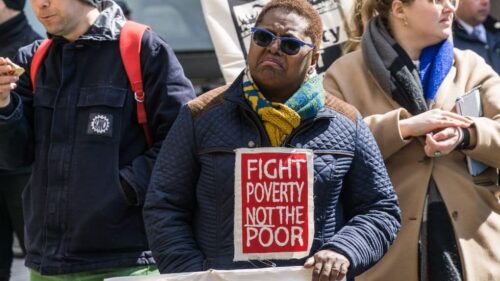
A major controversy of the shutdown came with the fate of the SNAP, a federal program that provides monthly benefits to low-income families to help them purchase food. Congress could not reopen the government or pass a standalone bill funding SNAP, so its clients ultimately saw their benefits disappear on November 1.
More than 40 million Americans rely on its monthly electronic benefit transfer disbursements to afford basic groceries. Roughly 12–13% of the US population depends on food stamps, and recipients are overwhelmingly concentrated in low-income communities: rural areas of the South, inner cities and regions where job growth and upward mobility have stalled.
SNAP serves many who work but remain trapped in unstable, low-wage jobs or the gig economy. For these families, the loss of benefits is an existential crisis. Raus notes that, unlike healthcare policy, the effects here are immediate: “People eat every single day and so they’re going to notice this in their pocketbooks really, really fast.”
Wage crisis in America
The dependence of so many working families on food stamps, Raus argues, points to a much deeper problem: the stagnation of working-class wages. While inflation has cooled slowly since the pandemic, prices remain far higher than pre-COVID-19 norms. Wage growth has not kept pace.
Most Americans do not experience economic health through the stock market or GDP figures. They experience it through the purchasing power of their paycheck. When grocery, energy and housing costs remain high, a barely-moving paycheck becomes a catastrophe. This is precisely why SNAP has become not just a poverty program but a working-class stabilizer.
The strain, he suggests, reveals “a crisis of government dependency” — not because people are lazy, but because the private-sector wage structure is failing to support basic needs.
Consequences of shutdown
The longer any government shutdown continues, the more economic and social instability it breeds. Raus expresses worry about civil unrest, noting that online threats of theft and break-ins reflect profound desperation. As he puts it, “We know hungry people … do rather irrational things.”
Beyond SNAP, layoffs across federal agencies accelerated as the Office of Management and Budget used the shutdown to downsize government workforces. Many who believed federal jobs were secure likely received a rude awakening. No job, public or private, is immune to sudden disruption.
Raus sees the lasting memory of this crisis reshaping political narratives. One side will demand more universal social programs, arguing that inconsistent funding makes selective benefits too vulnerable. The other side will call for a reduced federal role, insisting that an unreliable government should not be responsible for essential services in the first place.
Growing economic divide
Khattar Singh asks whether the shutdown will widen America’s economic inequality. Raus believes the divide stems from long-standing forces — wage stagnation, inflation, industry disruption — but says the shutdown intensifies the stress on communities already near the edge.
He expects different sectors and regions to recalibrate. Government-dependent industries will shrink. Families who relied on stable benefits will face new uncertainty. States, charities and local institutions may shoulder more responsibility as trust in federal institutions remains at historic lows.
In Raus’s view, this moment exposes the fragility of American safety nets. Social Security faces long-term shortfalls. Healthcare remains, in his words, “such a hot mess.” And the shutdown shows how easily even core programs can collapse when Congress cannot perform the basic function of funding the government.
This crisis may force the country to finally confront realities it has avoided for decades — that the systems meant to protect Americans are quite fragile, and deeply vulnerable to political paralysis.
[Lee Thompson-Kolar edited this piece.]
The views expressed in this article/video are the author’s own and do not necessarily reflect Fair Observer’s editorial policy.








































Comment