





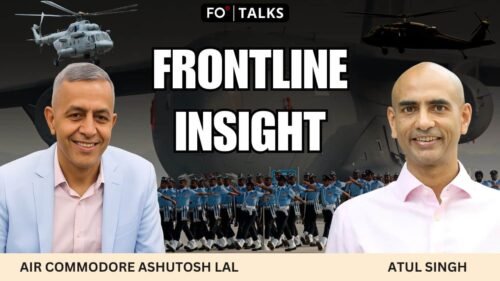
Fair Observer Founder, CEO & Editor-in-Chief Atul Singh and retired Indian Air Commodore Ashutosh Lal discuss Indian geopolitics. Lal brings more than three decades of helicopter flying experience, including over 8,700 hours, to argue a bold idea: The number and use of civilian helicopters can serve as a revealing index of a nation’s development.
Importance of helicopters
Singh begins by asking why helicopters, rather than jets or airports, should be considered a development metric. Lal explains that helicopters are not just elite toys for wealthy individuals or politicians. Instead, they act as a “great enabler,” connecting remote populations with modern medicine, education and economic opportunities.
In developed nations, whenever a single life is in danger, the state deploys helicopters as a matter of course. This, he says, reflects the true value placed on human life. For Lal, India’s helicopter sector is a test of whether the country is moving toward that standard.
Flying for Indian Air Force
Looking back, Lal recounts India’s early history with helicopters. The first Indian Air Force helicopter unit, the 104 Helicopter Unit, was raised on March 10, 1954. In its early years, the force flew Sikorsky S-55s and Bell 47G craft. India’s diverse terrain, comprising glaciers, jungles, deserts and seas, quickly made helicopters indispensable.
Lal remembers mentors like a pilot nicknamed “Cyclic,” who taught him to appreciate the unique demands of rotary flight. He also describes a deep admiration for naval aviators who land on ships during violent monsoons, a skill honed only through constant exposure. For him, these experiences build a culture of helicopter mastery that India can now bring into the civil domain.
India’s civil helicopter aviation
Singh then turns the conversation to the present state of civil aviation. Lal reports that India has only about 250 to 270 registered civil helicopters. By contrast, a single city like São Paulo, Brazil, has around 750.
Most Indian helicopters are used for offshore oil and gas operations, pilgrimages to inaccessible temples, business charters and political campaigning. Lal imagines a future where a passenger can land at a busy airport and immediately transfer to a helicopter, bypassing traffic altogether. A smaller market exists for pleasure trips, but the glaring gap is in public service operations.
Why India needs more helicopters
Lal underscores that India has almost no Helicopter Emergency Medical Services (HEMS). For a country with one of the highest road accident rates in the world, this absence is a tragedy. Natural disasters such as glacial lake bursts, Himalayan forest fires and train accidents all demand helicopter support, yet the National Disaster Relief Force cannot mobilize them quickly because helicopters do not have “organic availability.” This lack of readiness means lives, property and resources are lost unnecessarily.
Lal notes the irony of India building thousands of kilometers of highways without ensuring helipads for quick evacuation. In his view, “it is not too late,” but urgency is needed.
Helicopters for public service
Positive developments do exist. Singh points out the creation of a helicopter directorate within the Directorate General of Civil Aviation, which Lal praises as an important step. Industry bodies like the Federation of Indian Chambers of Commerce & Industry and the Confederation of Indian Industry are also pushing for reforms.
However, challenges are steep. No Indian airport allows “non-interfering simultaneous operations,” meaning helicopter traffic is delayed by fixed-wing flights. Regulations demand excessive paperwork for foreign pilots. Most significantly, India has no civil helicopter training schools, forcing civilians to study abroad at high cost. About 95% of pilots come from the armed forces, and even then, transitioning them smoothly into civilian roles remains a policy blind spot.
Lal stresses that studies already recommend at least 800 helicopters for India. Meeting this target would create a huge market and expand the nation’s ability to respond to emergencies. For him, helicopters should be treated as essential public-service infrastructure, not occasional luxuries.
Drones or helicopters?
Singh raises the issue of drones as a possible alternative. Lal responds that drones are useful supplements, but they cannot replace helicopters for critical tasks like mass evacuations, medical transport or disaster response. He urges policymakers to adopt a holistic approach that includes drones but builds a strong helicopter ecosystem as the backbone. Without this, India risks throttling its own growth and failing to achieve the vision of “Viksit Bharat” — a truly developed India.
Atul urges the Ministry of Civil Aviation, the Prime Minister’s Office and industry stakeholders in the audience to “get [their] act[s] together and create the architecture.” Helicopters are more than machines in the sky — they are lifelines that reveal whether a nation values every citizen and whether it has the will to act on that principle.
[Lee Thompson-Kolar edited this piece.]
The views expressed in this article/video are the author’s own and do not necessarily reflect Fair Observer’s editorial policy.










































Commenting Guidelines
Please read our commenting guidelines before commenting.
1. Be Respectful: Please be polite to the author. Avoid hostility. The whole point of Fair Observer is openness to different perspectives from perspectives from around the world.
2. Comment Thoughtfully: Please be relevant and constructive. We do not allow personal attacks, disinformation or trolling. We will remove hate speech or incitement.
3. Contribute Usefully: Add something of value — a point of view, an argument, a personal experience or a relevant link if you are citing statistics and key facts.
Please agree to the guidelines before proceeding.