



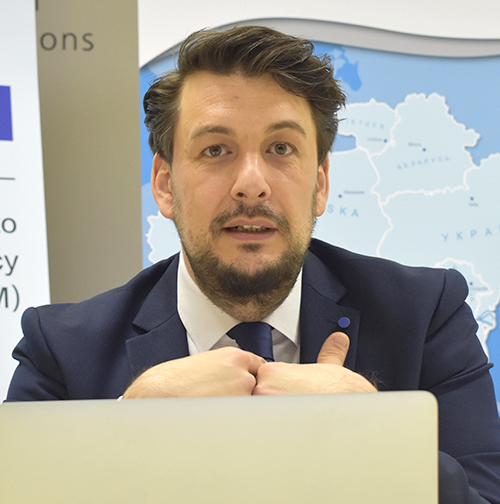


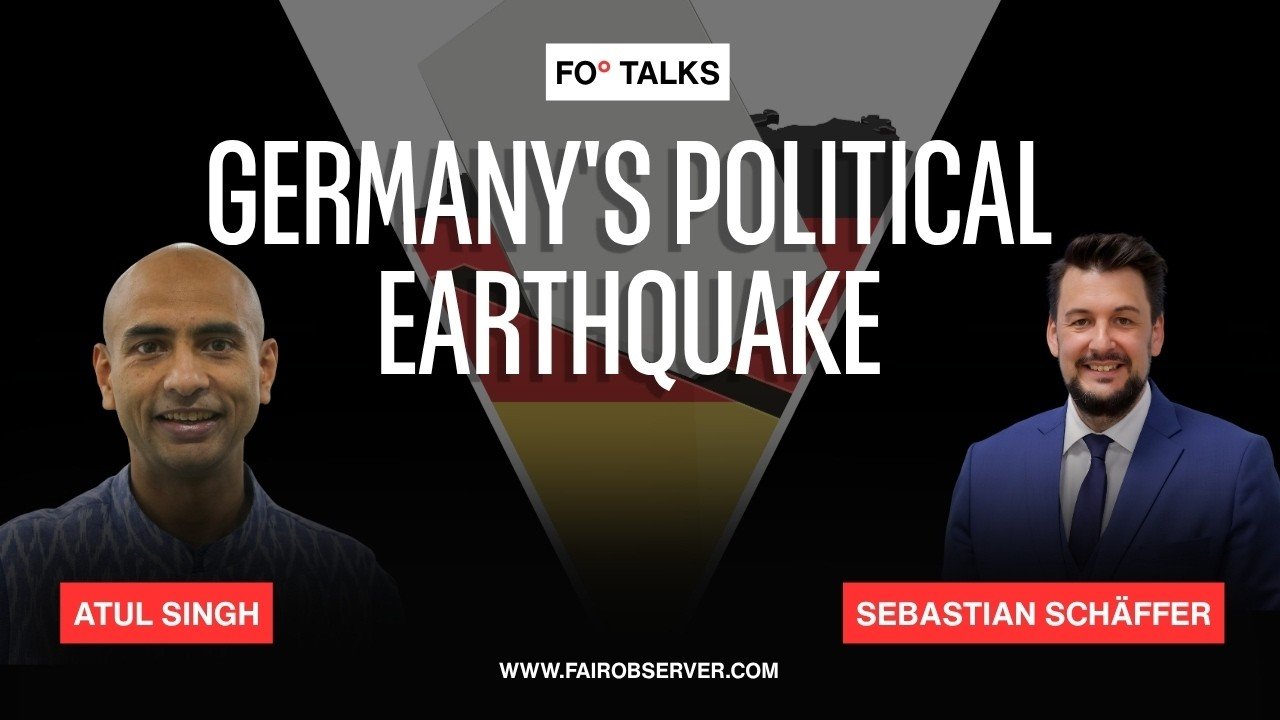
In this edition of FO° Talks, Peter Isackson, Fair Observer Chief Strategy Officer, discusses the 2024 European Union Parliament elections with Fair Observer Editor at Large Alex Gloy and Institute of the Danube and Central Europe Director Sebastian Schaffer.
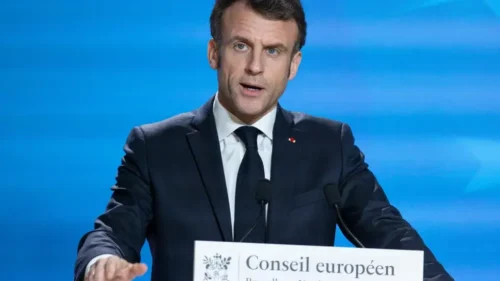
Politics in France have been coming to a boil. The past elections symbolize the lessons people have drawn from the fact that there is a more substantial influence of the extreme right, including Germany and Austria. French President Emmanuel Macron called for snap elections after the European Union Parliament elections. This move concerned many, seemed counterintuitive and provided further momentum toward the National Rally candidate, Marine Le Pen. On the other hand, there is hope that the next election will be different.
Surging right wing
Germany and Austria are other countries where the extreme right surged in the most recent European parliamentary election. Right now, the Group of the European People’s Party (Christian Democrats), a center-right political group, holds a majority of the seats with 188 out of 720 total seats. However, the far-right, represented in Germany by Alternative für Deutschland (AfD), has been on the rise. AfD is the strongest in East Germany and among new voters. It finished second, with 15.9% of the national vote, behind the Christian Democratic Union of Germany and the Christian Social Union of Bavaria (CDU/CSU).
In Austria, the Freedom Party has seen a similar rise in popularity. Austria will hold its regular parliamentary elections in September.
It is helpful, however, to take a step back and avoid drawing strict comparisons between different nations’ political situations. The media has been permanently interested in the far right challenging the center. This obscured the meaning of the center, with the media distorting perceptions of political alignment. If Le Pen were an American, she would be to the left of the democratic party. She advocates for social programs and supports the working class, something that no accepted party in the US is willing to do. Yet the media creates the perception that she is far-right and that the far right is therefore on the rise in France.
Since World War II, France has had a very solid right wing which consolidated around Charles de Gaulle. Francois Mitterand emerged after World War II and formed France’s left wing. Mitterand increased greatly in electoral appeal. He nationalized all big banks and major industries. Until 2017, France expected either the socialist party or a rightwing party more or less in the Gaullist tradition to rule, but that is when France started shifting to legitimizing the far right as an alternative to the two establishment wings of the ruling political spectrum: the socialists and the traditional post-Gaullist right.
How united is Europe?
The EU Parliament elections are not just a single election; they are 27 national parallel elections. A question that many may ask “Are people voting for the whole of Europe or just their country?” This is what makes elections so difficult on a European level. For example, people in Bratislava will not be interested in issues such as those of the Social Democratic Party in Austria. Voters will focus on the issues and problems of their own countries. This has created an identity problem in Europe. Europeans are more focused on their national identity and national issues rather than being united as Europeans with European problems.
The European project must move forward. Countries that trade with each other should not go to war. Europe has progressed in the past decades. When traveling in Europe, people once had to stop at border checkpoints, but now people can drive straight through. Europe also adopted the Euro in 1999, providing a universal currency for Europe. This has allowed for swift and easy transactions and removed the need to calculate exchange rates.
The gradual rise of far-right parties and the challenges to the political center have sparked intense debates about the nature of political alignment and the identity of the electorate. The issue of European unity remains a complex and pressing concern, as national interests often overshadow the broader European agenda. Despite the challenges, hope still exists for a more united and prosperous Europe.
[Liam Roman wrote this first draft of this piece.]
The views expressed in this article/video are the author’s own and do not necessarily reflect Fair Observer’s editorial policy.
























Comment