




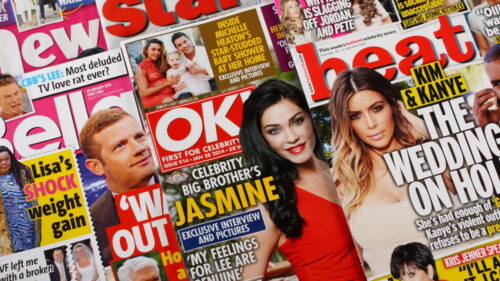
Ellis Cashmore, a professor of sociology, currently at Aston University is an expert when it comes to why we (the public) are so fascinated with celebrities. He has penned volumes with titles such as The Destruction and Creation of Michael Jackson, Elizabeth Taylor and Celebrity Culture.
Cashmore defines celebrity culture as “our tendency to have our values, practices and habits affected by figures who have risen to prominence (some would say undue prominence because it’s not proportionate to their accomplishments).” Notice that celebrities are referred to as figures and not people. Cashmore makes the distinction because celebrities are more products of our imagination than they are the flesh-and-blood person behind the fame. By existing in our imagination, they are independent of time and space and can be anything we want them to be.
But what separates a celebrity from an ordinary person?
When asked if an ordinary person could become a celebrity, Cahsmore replied, “Not without the help of a legion of followers.” Despite many, many people trying to grow a following online, the vast majority fail at becoming a true celebrity. Every so often someone does manage to pull it off by doing something crazy but this fame is often fleeting. Not many have the staying power within our imaginations.
The deciding factor of celebrity status is, ironically, we, the public. Anything can make someone a celebrity provided we find it interesting. Our perception of them makes them interesting. What makes a famous person a celebrity is the public: We turn them into celebrities.
A normal person can become a celebrity in a short amount of time provided they get national attention. They simply have to occupy people’s minds (for example, winning the lottery or a reality TV show).
Before the year 2000, movies and TV were the established methods of gaining fame, but now we all carry phones with us. We essentially carry celebrities with us and in a moment’s notice can summon them for our entertainment
Some people, like Paris Hilton and Kim Kardashian, caught onto this trend early. They realized that social media were not just a presence but a force. It doesn’t matter what you say or do as long as the media notice you. Paris Hilton was more than “famous for being famous”; she was famous for appearing. The media trailed her because we were interested in her.
Kim Kardashian saw this and realized she could make it better by using social media and she exploded in popularity. Kim started as an assistant for Paris, but eventually eclipsed her.
Nearly any kind of notoriety can transform into stardom. Oscar Pistorius, who was already famous to a degree as a paralympian, became infamous after shooting his girlfriend, Rea. This rocketed him from being known within the sports world to international stardom. Pistorius’s audience mushroomed because people who weren’t interested in running were intrigued by the murder trial. It’s a combination of our fascination with killing as well as how much we enjoy seeing the rise and fall of our celebrities.
Related Reading

Another key ingredient of being a celebrity is appearing to be relatable — this is key to the transformation into celebrity culture. It’s like “the larger-than-life characters have come down to earth,” Cashmore explains. Our affection for celebrities is rooted in our love of how ordinary they are.
How does celebrity culture affect us?
Celebrity culture is “inescapable” and “a defining aspect of culture today,” whether we like it or not. Cashmore clarifies, “The main way is that it affects the way we spend our money. We can’t untangle celebrity culture from consumer culture.”
Celebrity culture encourages us to buy things that we don’t need but things that we want. It exists not just to sell us specific products but instead to advertise a way of life in which we are rewarded for owning the commodities we see they have. While this encouragement may not be overt endorsements we do our best to mimic celebrities.
While Cashmore asserts that celebrity influence is often overestimated, there is a chance that this could change in the future.
We live in a time where people who are famous not for their leadership or anything related to politics, can still earn a reputation (think Arnold Schwarzenegger or Donald Trump). It seems like simply being known is half the battle in politics. As long as you can provoke strong emotion, you’re in business. The worst thing that can happen to a celebrity is that people stop caring.
Cashmore noted, “I wouldn’t put it past Kim Kardashian or Taylor Swift to someday make the transition to the political playing field.”
How long can we expect for Celebrity Culture to last? Cashmore reminds us that “a change is hardly visible on the horizon let alone an end. Celebrity culture is here to stay, it seems.”
[Beaudry Young wrote the first draft of this piece.]
The views expressed in this article/video are the author’s own and do not necessarily reflect Fair Observer’s editorial policy.





















Comment