


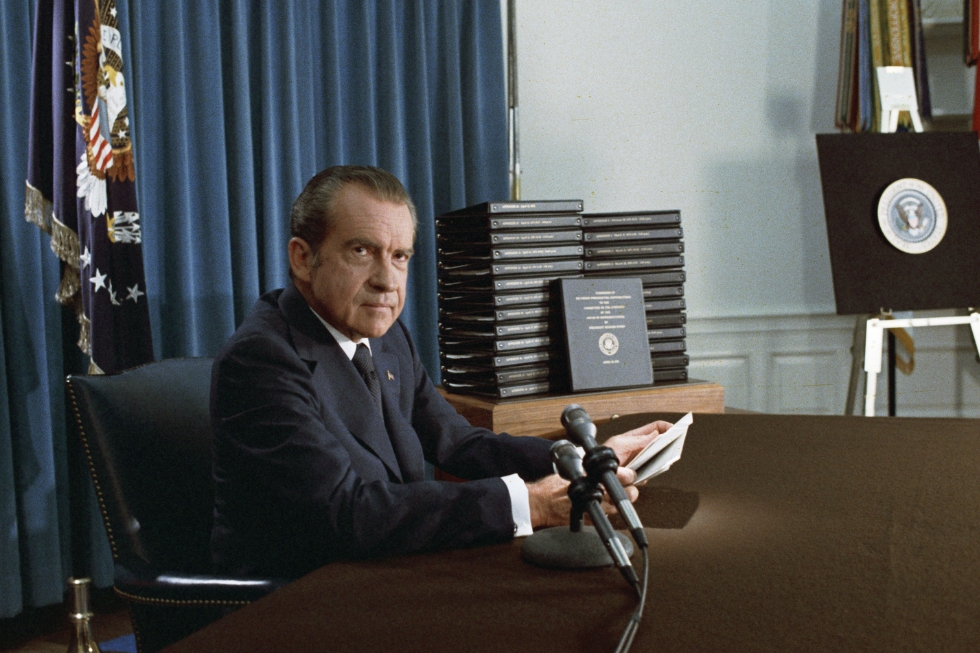


For over half a century, Richard M. Nixon has been the personification of a bad president and Watergate a byword for political corruption. In 1974, Nixon was forced into an ignominious resignation, forever becoming America’s political bête noire. His administration’s involvement in the break-in and wiretap at the Democratic National Committee headquarters in Washington’s Watergate complex — and the cover-up that followed — earned him a reputation that lasted until his death in 1994, and will probably endure indefinitely. But would the Watergate scandal be so terminal today?
Performative politics
Republican candidate Nixon was elected president in 1968 and much of his first term was overshadowed by the Vietnam War. Reelected in 1972 in a landslide, Nixon initially faced compromise after his campaign operatives broke into the Democratic National Committee headquarters to plant concealed listening devices. The subsequent cover-up implicated the White House itself. Nixon ceased to be merely a politician and became the enduring benchmark against which presidential misconduct would be judged.
Since Nixon’s time, politics have changed. They have become performative, characterized by dramatic features. Every word, act, mannerism or gesture is intended to project optics — the way an event will be seen by the public. For many detractors, politics is now as image-driven as the entertainment industry. An electorate schooled by decades of sex scandals, controversial wars, political conspiracy theories and media skepticism has become accustomed to transgression. And forgiveness.
Adultery in my heart
A foretaste arrived unexpectedly in 1976 when Democratic presidential nominee Jimmy Carter gave an interview to Playboy magazine. As a devout, born-again Christian who openly cited Jesus, prayed 34 times a day and taught Sunday School, Carter was a paradigm of moral uprightness. Yet, in the interview, he confessed: “I’ve looked on a lot of women with lust, I’ve committed adultery in my heart many times.”
Carter seemed to be portraying himself as a latterday Tantalus, the Greek mythological figure reaching for fruit that was always out-of-reach. Trapped in a state of perpetual temptation and self-imposed restraint, he endured the agony of desire in his “heart” while refraining from physical contact. No evidence of actual transgression ever emerged.
Carter may have assumed that voters badly wanted a return to Christian righteousness after Nixon’s impropriety. By admitting to temptation, he showed human fallibility but saintly self-denial. Though the confession caused a short-term drop in popularity, he secured a narrow 1976 election victory and served as president until 1981.
The brouhaha did no lasting damage to Carter, nor much good. But it was an engrossing diversion from everyday politics. And, crucially, it kept Carter’s name and image in the popular media. That was important because, as the 1980s passed, the media played an increasingly crucial role in politics. To succeed, politicians still needed to govern effectively, understand budgets and possess at least a working knowledge of foreign affairs. But before any of those qualities matter, they need something more fundamental: visibility.
Impermanent stain
Bill Clinton had plenty of it. Too much, perhaps. He came to power in 1993 as a charismatic figure, comfortable in the company of celebrities, even playing saxophone on television. Rumors of womanizing had followed him for years, but rather than damaging his reputation, they arguably enhanced it. There were so many women who claimed to have had relationships with Clinton that at times he seemed like a Lothario masquerading as a politician.
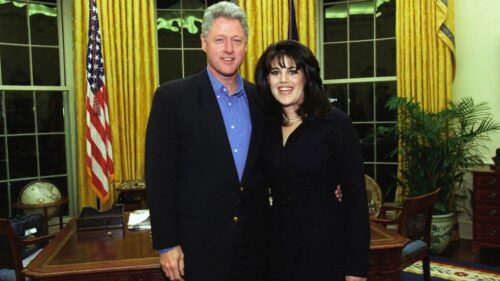
Yet the contradictions of being a married president with a conspicuous sexual appetite appeared to trouble neither Clinton nor much of the electorate. That could have changed when his political opponents seized on one of his amoureuses and transformed a secret affair into an international spectacle. Clinton initially denied the affair but eventually admitted to having had what became a near-legendary sexual liaison with Monica Lewinsky.
At the time, some assumed Clinton’s presidency would collapse under the weight of public humiliation. Instead, the opposite occurred. He remained politically buoyant, completed his second term and left office with approval ratings that many presidents would envy. The scandal might have affected him, but it didn’t define him.
This came in striking contrast to Nixon. “Watergate” might have been stuck on him with Krazy Glue: His name became inseparable from the scandal and all the negative associations it carried. Nixon was not merely the president who experienced Watergate; he was Watergate’s human incarnation. Clinton, by contrast, accessorized his public persona with the Lewinsky dalliance — a rosebud buttonhole rather than a permanent stain.
The affair became dubbed “Monicagate,” helping establish “-gate” as the suffix of choice for political scandal. These days, almost any civic wrongdoing is appended with it (Signalgate, 2025; Bridgegate, 2013; Sharpiegate, 2019).
You’re fired!
In the Watergate era, the idea that someone could become president of the United States without ever holding elected office or acquiring conventional political experience would have seemed almost unimaginable. Even Dwight Eisenhower, whom voters elected to the White House in 1952, brought with him a formidable public record as Supreme Commander of Allied Expeditionary Forces in Europe during World War II. He had commanded armies, negotiated with allies and possessed an authority rooted in institutional achievement.
Donald Trump’s credentials were entirely different. In fact, they can be summarized in a phrase: “You’re fired!” Trump demonstrated that politics were irrelevant to elections. At least, politics in the traditional sense of relating to governance of countries, areas or groups of people. But he had one attribute coveted by all politicians: Millions knew him, perhaps not as a legislator, diplomat or military commander, but as the host of the television show, The Apprentice. Before he entered politics, Trump had already acquired plenty of well-knowness, one of the most valuable currencies of the new political era.
Many assumed that the presidency itself would impose limits. Instead, Trump brought the logic of celebrity culture into the White House. His public image was inseparable from wealth, display and personal branding. His private Boeing 757 aircraft, fitted with luxury features; weekly visits to his Mar-a-Lago resort and proposals for an elaborate White House ballroom all became symbols of a presidency in which personal style and political power were twinned.
The controversies extended far beyond lifestyle. Peccadillos with women soon surfaced. Legal cases followed. Stormy Daniels, an “adult film” actor, claimed she’d been paid hush money to keep quiet about her relationship with Trump. E. Jean Carroll won a landmark 2023 federal civil trial in which a jury found Trump liable for sexual abuse and defamation. It related to an incident in a department store dressing room in the 1990s and resulted in millions of dollars in damages awarded to her. Trump was impeached twice, first over the Ukraine pressure campaign and later over his actions following the 2020 election. Yet impeachment itself no longer carried the same political force it once did.
Unlike Nixon, Trump never seems close to being crushed by scandal. Some might argue his miscreant behavior, even cumulatively, does not compare with Nixon’s grotesque subversion of the rule of law. Perhaps. But consider: his incitement of the Capitol riot to halt the peaceful transfer of power in 2021, his deliberate concealment and obstruction regarding classified national security documents and his felony conviction for falsifying business records to hide campaign hush money. There are, of course, other violations.
This reflects less on Trump or indeed Nixon and more on us, the public, the electorate or — let’s be accurate — the audience. We watch, listen, talk about and pronounce judgment in much the same way as we appreciate a film or a stage drama. Controversy is entertaining. It forces us to pay attention and make decisions, often on rightness and wrongness. There’s something satisfying in this.
We would still be horrified by the Watergate wiretap and subsequent cover-up. We would demonize Nixon, too. But for how long? Imagine if Nixon had some of Trump’s defiant brazenness and indifference to criticism. In the 1970s, he wasn’t able to tough it out. But today, he would stand a fighting chance.
[Ellis Cashmore is the author of Celebrity Culture.]
[Lee Thompson-Kolar edited this piece.]
The views expressed in this article are the author’s own and do not necessarily reflect Fair Observer’s editorial policy.
Bill Clinton, Monica Lewinsky and the Politics of Spectacle
US President Bill Clinton and his wife will soon give testimony as part of the investigation into the late sex...


Support Fair Observer
We rely on your support for our independence, diversity and quality.
For more than 10 years, Fair Observer has been free, fair and independent. No billionaire owns us, no advertisers control us. We are a reader-supported nonprofit. Unlike many other publications, we keep our content free for readers regardless of where they live or whether they can afford to pay. We have no paywalls and no ads.
In the post-truth era of fake news, echo chambers and filter bubbles, we publish a plurality of perspectives from around the world. Anyone can publish with us, but everyone goes through a rigorous editorial process. So, you get fact-checked, well-reasoned content instead of noise.
We publish 3,000+ voices from 90+ countries. We also conduct education and training programs
on subjects ranging from digital media and journalism to writing and critical thinking. This
doesn’t come cheap. Servers, editors, trainers and web developers cost
money.
Please consider supporting us on a regular basis as a recurring donor or a
sustaining member.
Will you support FO’s journalism?
We rely on your support for our independence, diversity and quality.





Comment