


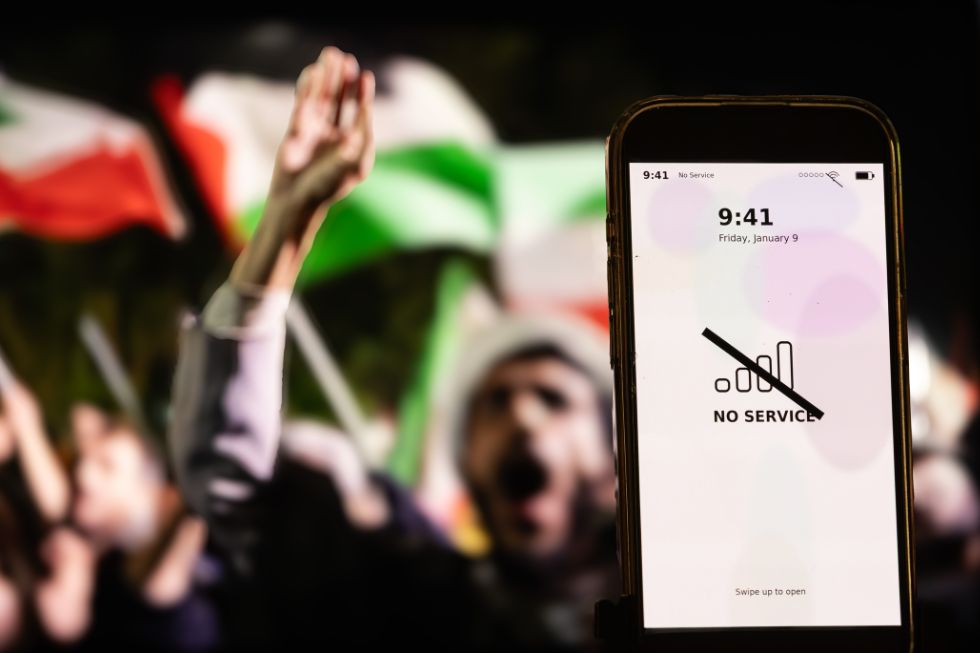



On January 8, 2026, at the height of its 2025–2026 protests, Iran imposed an 88-day internet blackout across the country. Millions of people were cut off from global connectivity, online commerce and family communication. There was a near-total collapse in access before the government began a gradual — but only partial — restoration.
As access slowly returned, much of the commentary focused on the immediate effects: lost revenue, daily disruption and the public’s inability to verify events independently. That is why the debate surrounding Iran’s recent internet shutdown has often been framed as a question of censorship, digital rights or technological control. While these dimensions are undoubtedly important, they do not fully explain what the episode reveals about the evolving relationship between the state’s political power and technology.
The internet is no longer treated only as a communications service or a technical infrastructure. It has become a strategic resource that the state can withdraw and ration in order to manage state security and political authority. The Iranian state cannot indefinitely separate itself from the digital systems upon which modern governance increasingly relies. Therefore, the most significant lesson of the shutdown and subsequent connectivity restoration is that it exposed how deeply digital connectivity has become integrated into the mechanisms of governance itself.
The rise of digital wartime governance
In modern warfare, military power alone no longer determines the outcome of conflicts. Controlling information flows has become an essential component of contemporary warfare. Narratives can affect morale, legitimacy, diplomatic support and public trust. Governments increasingly compete to shape perceptions, influence public understanding and control the interpretation of events. This objective reflects a longstanding concern about what officials frequently describe as “cognitive warfare,” “soft war” or “hybrid warfare.” Within this framework, information itself is viewed as a battlefield. If policymakers genuinely believe that information flows constitute a security threat, then controlling those flows becomes a logical component of wartime strategy.
Once citizens understand that connectivity can be suspended during periods of perceived instability, the internet acquires a new political meaning. It ceases to be an assumed public utility and becomes a conditional privilege whose availability depends, at least in part, on the state’s security calculations. This shift affects the relationship between citizens and the digital environment. It also affects the relationship between citizens and the state.
This dynamic matters because modern digital technologies have fundamentally altered the relationship between states and information. In effect, internet access begins to resemble a managed resource. Across the world, governments are increasingly concerned about what they perceive as vulnerabilities created by digital dependence. Cyberattacks, foreign influence campaigns, disinformation operations and information warfare have encouraged states to view digital infrastructure through a security lens.
Historically, governments exercised considerable influence over wartime narratives through state broadcasters, newspapers and official statements. Today, however, every smartphone owner possesses the potential to become a publisher. Images recorded by ordinary citizens can reach global audiences within minutes. Independent observers can challenge official accounts in real time. Events that once remained local can quickly become international stories. Images of damaged infrastructure, reports of military activity, public reactions, casualty information and unofficial narratives can all influence both domestic stability and international perception.
For governments seeking to manage crises, this creates a significant challenge. The internet reduces the state’s monopoly over information production. As a result, internet restrictions seek to reduce informational uncertainty by limiting the number of actors capable of generating competing narratives. That is why traditional discussions of internet freedom often focus on binary categories: access versus restriction, openness versus censorship, connection versus disconnection. These frameworks remain useful, but they no longer fully capture the realities of how many states interact with digital networks.
Rather than treating connectivity as either fully available or completely prohibited, governments increasingly seek to reduce, restore, filter, prioritize or geographically differentiate access according to political requirements. Connectivity becomes flexible rather than fixed. This represents a transition from censorship to governance. Under a censorship model, the objective is to suppress specific information. Under a governance model, the objective is to regulate the conditions under which information circulates.
Iran’s internet statecraft
Iran offers a particularly revealing case because of the interaction between security concerns, political control and economic constraints. The Islamic Republic has long viewed media and information management as central elements of state security. Since its founding, the political system has placed significant emphasis on controlling narratives surrounding both domestic developments and external threats. Wartime conditions intensify this tendency.
To understand why Iran repeatedly resorts to internet shutdowns during periods of crisis, it is necessary to understand how the Iranian state perceives the internet itself. In many democratic societies, digital connectivity is primarily viewed as an economic and social utility — a platform for communication, commerce and civic participation. In Iran, however, the internet increasingly occupies a different category. It is treated as a security domain.
This distinction is crucial. From the perspective of Iranian authorities, the internet is a space through which foreign influence can enter the country, political mobilization can occur, state narratives can be challenged and social unrest can spread at unprecedented speed. Consequently, internet governance in Iran has gradually shifted away from a purely regulatory model toward a security-oriented model. This means that Iran’s approach to the Internet is less about hard regulation and more about regulation to serve state security ends.
This evolution did not emerge overnight. It is the product of two decades of confrontation between the state and an increasingly connected society. Iranian authorities witnessed how digital communication platforms could facilitate the rapid circulation of images, information and political messaging. Although social media penetration remained relatively limited at the time, the events demonstrated the strategic implications of online communication during periods of instability.
Subsequent waves of unrest reinforced this perception. The 2009 Green Movement protests, the 2017–2018 Dey Protests, the fuel-price protests in 2019 and the protests following the death of Mahsa Amini in 2022 all relied on digital platforms to organize, document and publicize events. Each crisis strengthened the state’s conviction that control over digital infrastructure was no longer merely a technological issue but a matter of national security.
As a result, the government invested heavily in what officials describe as the National Information Network (NIN), often referred to outside Iran as the “national internet.” Officially, the project aims to improve cybersecurity, reduce dependence on foreign infrastructure and increase technological self-sufficiency. In practice, however, it also provides authorities with greater capacity to isolate domestic networks from the global internet during periods of crisis.
The recent wartime shutdown illustrates this logic clearly. When connectivity collapsed across Iran, it dramatically reduced the ability of citizens to independently document and disseminate information. Images, videos and eyewitness accounts that would normally circulate rapidly across social media platforms became more difficult to transmit. International media organizations faced greater challenges verifying events on the ground.
However, the January decision was not merely a reaction to specific content circulating online. Rather, it reflected a broader security calculation. This helps explain why Iranian authorities often describe internet restrictions using the language of security rather than censorship. Officials rarely present shutdowns as efforts to suppress free expression. Instead, they justify them as necessary measures to protect public order, defend national security or counter foreign interference. Whether one accepts these justifications is ultimately a political question. What matters analytically is that they reveal how the state conceptualizes the digital environment.
Restricting information dissemination can backfire
Yet the relationship between information control and legitimacy is complex. In the short term, restricting connectivity may reduce the circulation of unwanted information. From a tactical perspective, these outcomes can appear beneficial. In the longer term, however, information restrictions often generate new problems.
When citizens lose access to reliable information, uncertainty does not disappear. Instead, it frequently increases. Paradoxically, efforts to strengthen informational control can sometimes undermine confidence in official narratives. This dilemma is particularly significant during wartime. Governments require public trust to sustain social cohesion during crises. At the same time, they seek to control the information environment. These objectives are not always compatible.
The Iranian experience illustrates this tension clearly. The state’s desire to dominate the narrative collided with the realities of a highly connected society. Millions of Iranians depend on digital platforms not only for information but also for work, education, financial transactions and communication with relatives abroad. Restricting internet access, therefore, affects far more than political discourse. It directly shapes everyday life. As a result, the internet has become something far more consequential than a communications technology. It now occupies a central position in the relationship between the state and society.
Therefore, the state’s capacity to manage narratives is ultimately constrained by the economic and social functions that digital networks perform. That reality would become increasingly apparent as the costs of prolonged digital isolation began to accumulate. The government could restrict connectivity, but maintaining those restrictions indefinitely proved far more difficult than imposing them in the first place.
And this raises the next critical question: If internet control was considered necessary for security, why did authorities eventually decide to restore access? The answer lies not in information politics alone, but in the growing economic and administrative costs of digital isolation. The collision between these two realities would ultimately shape the government’s next decision: restoring access.
Why Iran could not keep the internet offline
If the internet shutdown served important security objectives, why did the government eventually begin restoring access? At first glance, the answer appears straightforward. The immediate military crisis subsided, reducing the need for extraordinary restrictions. Yet that explanation is incomplete. Even after the fighting eased, authorities continued to keep access limited, selective and slow.
This is because the internet in contemporary Iran occupies a paradoxical position. It simultaneously enables communication, commerce and access to information, while also creating opportunities for political mobilization, alternative narratives and external influence.
This apparent contradiction reveals one of the central realities of digital governance in the twenty-first century: modern states depend on the very networks they seek to control. The shutdown imposed a direct economic shock on a country already weakened by sanctions that constrained economic growth and increased pressure on both the state and society.
Over the past decade, Iran’s economy has become increasingly dependent on digital infrastructure. Millions of citizens rely on online platforms for employment, business operations, banking services, logistics, education and communication. When connectivity disappeared, these activities were severely disrupted. Small businesses that sell through social media, freelancers paid by foreign clients, e-commerce platforms, digital creators and online service providers all lost revenue when access disappeared. The blackout cost the economy tens of millions of dollars per day, with some estimates ranging from about $30 million to $40 million daily.
The damage extended beyond the private sector. Banking, logistics, travel, remote work, education and public administration all depend on stable connectivity. When the internet disappears, the state does not simply silence dissent; it also interrupts the systems it needs to tax, coordinate and govern. A government can switch off connectivity. It cannot easily suspend the economic and administrative functions that depend upon it. The longer restrictions remain in place, the more visible this contradiction becomes. That is why the restoration of access mattered. Reopening the network was not a liberal gesture but a response to economic pressure.
What Iran’s internet governance says about the future
The Iranian case demonstrates that internet restrictions are easier to impose than to sustain. This observation is significant because it challenges a common assumption about authoritarian governance. Discussions of digital control often emphasize what states can do: monitor communications, block platforms, filter content and restrict access.
Far less attention is paid to what states cannot do. They cannot fully escape the structural dependence created by digital modernization. In other words, the same technological transformation that expands state capacity also creates new constraints on state action. Digital dependence limits how long restrictive measures can be maintained without generating significant collateral consequences.
The question is therefore no longer whether the government can shut down the internet. The more important question is whether it is constructing a system in which connectivity can be continuously calibrated according to the state’s perception of risk. It is precisely this transition — from censorship to managed connectivity — that offers the clearest insight into the future of state power in Iran.
That possibility points toward a broader transformation in the nature of governance itself — one that extends far beyond temporary wartime measures and into the future of political control in the digital age. Rather than asking whether citizens should have internet access, authorities increasingly ask what type of access should be available, to whom, under what conditions and for how long.
This is why the Iranian case deserves attention beyond the context of Iran itself. What occurred was a visible example of a broader transformation taking place in many parts of the world: the emergence of digital governance as a central component of state power. The future of political authority may increasingly depend not only on the ability to control territory, regulate economies or command military forces, but also on the ability to manage the flows of information upon which modern societies depend.
However, the Iranian experience therefore offers a warning as well as an insight. It demonstrates how quickly internet access can become subject to political calculations during periods of crisis. As societies become more dependent on digital systems, connectivity is increasingly transforming from a public utility into a strategic resource. The governments that can control, regulate and manage that resource will possess a powerful new instrument of statecraft. Iran’s wartime internet policy reveals what that future may look like. The internet is no longer merely a space through which power operates. It is becoming one of the primary instruments through which power is exercised.
[Cheyenne Torres edited this piece.]
The views expressed in this article are the author’s own and do not necessarily reflect Fair Observer’s editorial policy.
The Internet Returned. Normalcy Did Not.
The Iranian government’s recent lifting of its nationwide Internet shutdown has not repaired the psychological damage it’s dealt to the...
Why the Iranian Opposition Has Failed to Unite Against the Regime in Iran
Widespread protests across Iran, especially in Kurdish regions, have been met with violent crackdowns, highlighting deep-rooted demands for autonomy and...

Digital Self-Reliance in Nepal: How Grassroots Media is Empowering a New Generation
Nepal is seeing a rise in community-based digital media. Small online platforms, such as Khoj Samachar, are working to share...

Support Fair Observer
We rely on your support for our independence, diversity and quality.
For more than 10 years, Fair Observer has been free, fair and independent. No billionaire owns us, no advertisers control us. We are a reader-supported nonprofit. Unlike many other publications, we keep our content free for readers regardless of where they live or whether they can afford to pay. We have no paywalls and no ads.
In the post-truth era of fake news, echo chambers and filter bubbles, we publish a plurality of perspectives from around the world. Anyone can publish with us, but everyone goes through a rigorous editorial process. So, you get fact-checked, well-reasoned content instead of noise.
We publish 3,000+ voices from 90+ countries. We also conduct education and training programs
on subjects ranging from digital media and journalism to writing and critical thinking. This
doesn’t come cheap. Servers, editors, trainers and web developers cost
money.
Please consider supporting us on a regular basis as a recurring donor or a
sustaining member.
Will you support FO’s journalism?
We rely on your support for our independence, diversity and quality.





Comment