


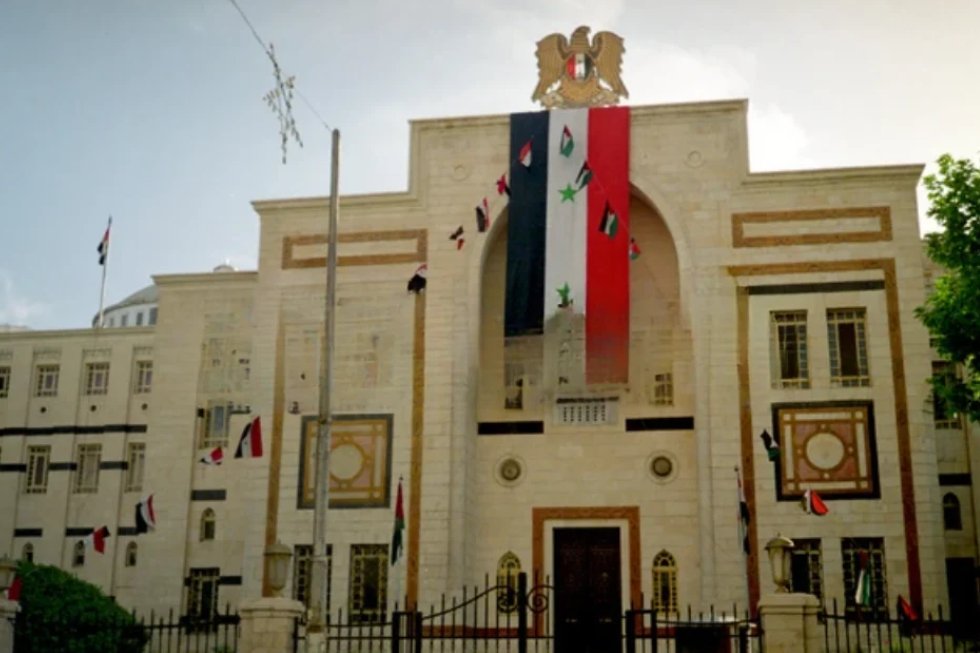



Nearly two years after Bashar al-Assad’s fall in December 2024, Syria faces a question that may appear simple but is not: When should political parties become the main vehicles of political competition? The 2025 Constitutional Declaration, which sets out a five-year transitional period, provides for the formation of political parties. The question matters because Syria does not merely need new political organizations. It needs a political system that can prevent political competition from becoming another struggle for control of the state.
Some Syrians argue that political parties should be legalized immediately as a necessary step toward democracy. Others worry that opening political competition too quickly could reproduce the sectarian, regional and ideological divisions that years of authoritarianism and war have deepened.
Neither position is sufficient on its own. Syria needs political parties. But it also needs institutions capable of making political competition meaningful and preventing it from becoming a contest over who controls the state rather than how the state should be governed. The issue, therefore, is not whether institutions or democracy should come first. It is how political pluralism can expand while the institutions needed to sustain it are being built.
Democracy needs more than elections
The existence of a parliament, elections or political parties does not by itself create democratic institutions.
Harvard political scientist Samuel Huntington’s work offers a useful starting point. Institutions are not simply government offices or formal rules; they become durable when patterns of political behavior acquire stability and value beyond the individuals who temporarily occupy them. His broader argument was that political order depends not merely on the form of government but on the strength and institutionalization of political organizations and procedures.
This distinction matters for countries emerging from authoritarian rule. Authoritarian systems can leave behind formal institutions that exist on paper but lack independence, legitimacy or the capacity to constrain political power. Replacing the people who occupy those institutions does not automatically transform them.
Syria therefore faces a challenge deeper than simply organizing elections or passing a political parties law. It must establish rules that political actors have reason to respect even when those rules work against them. That means an independent judiciary, professional public administration, credible electoral institutions, clear constitutional rules and a state capable of enforcing those rules. But none of this means that Syria should wait for a perfect state before allowing political participation. That would be both unrealistic and dangerous.
Thomas Carothers, a democracy scholar at the Carnegie Endowment for International Peace, has explicitly challenged the idea that countries should postpone democratization until the rule of law and a fully functioning state are already in place. He argues instead for the gradual introduction of political competition while democratic institutions and state capacity develop. For Syria, this suggests a more practical approach: Political opening and institution-building should move together.
The problem with parties without a political system
The danger is not political parties themselves. It is asking parties to perform functions that institutions are not yet capable of performing. Consider the difference between two political systems. In the first, parties compete over taxation, education, economic policy, decentralization and public services. They lose elections and accept the result because they know that the institutions governing the next election will still exist. In the second, parties compete primarily for control over ministries, public employment, security institutions and state resources. Losing office means losing access to the state itself. The first system produces political competition. The second produces a struggle over the state.
Syria’s current transition makes this distinction particularly important. An interim government and parliament are now operating under a transitional constitutional framework, while the country continues to negotiate the distribution of political authority and the integration of previously autonomous or armed structures into the state. The transitional parliament is also expected to help draft a permanent constitution and prepare for future elections.
Under these conditions, political parties should not be treated as a substitute for institution-building. But institutional weakness should not be used as a reason to postpone political participation indefinitely. The objective should be to allow political organizations to emerge while building institutions strong enough to regulate their competition.
A party law can establish formal rules. It cannot, by itself, create political organizations that trust institutions more than they trust their own networks. That requires time, competition and institutions that political actors believe will treat them fairly.
Lessons from other transitions
Iraq offers one of the clearest warnings about what can happen when competitive politics develops within a political system where communal identities become deeply embedded in the distribution of state power. After 2003, Iraq established a political system based on elections and broad participation. Yet the muhasasa system evolved into a mechanism for distributing government positions according to claimed ethnic and religious representation. The system became embedded in successive governments after 2005. The problem was that political competition became closely associated with competition among communal blocs for access to state institutions and resources.
For Syria, the lesson is not to suppress political identities or prevent parties from forming. It is to create incentives for parties to compete for citizens’ support rather than become permanent representatives of sectarian or regional constituencies seeking guaranteed shares of state power. A democratic system must represent social identities. But its institutions should encourage political alliances that cross those identities.
Libya presents a different but related problem. After the fall of Muammar Qaddafi, who ruled Libya for more than four decades until his overthrow in 2011, political entities and transitional institutions emerged in an environment where local militias retained significant influence over security and political life.
The broader lesson is important for Syria: Political competition cannot be separated from the question of who ultimately controls coercive power. A party that wins an election but cannot rely on a state capable of enforcing the result lacks meaningful political authority. Conversely, an organization that can use an independent armed network to resist state institutions is not simply another political party. It is a competing center of power. For Syria, establishing unified public authority is therefore not a security issue separate from democratization. It is one of its institutional foundations.
Lebanon demonstrates a different danger: Institutions can exist while still reinforcing social divisions. Lebanon has long had elections, political parties and a formal system of sectarian power-sharing. Yet political parties have also operated within a system in which sectarian identities and intra- and inter-sectarian competition strongly shape political behavior.
For Syria, the distinction matters. The country’s future political system will inevitably contain disagreements over religion, region, ideology, economics and social policy. Those differences should not be suppressed. But institutions should encourage citizens to form political alliances that extend beyond a single communal identity. Otherwise, political parties risk turning society’s divisions into the state’s permanent architecture.
Spain’s post-Franco transition offers a more constructive lesson. The transition did not simply move from authoritarianism to unrestricted electoral competition overnight. Legal and institutional changes developed alongside political opening, creating a framework within which political competition could expand. The 1977 elections, Spain’s first free general elections since the 1930s, were an important part of that process. Political parties had been legalized just beforehand, and the newly elected parliament went on to draft the 1978 Constitution. The vote was therefore embedded in a broader transformation of the political and constitutional order.
Spain’s experience cannot simply be transferred to Syria. The two countries have different histories, social structures and political circumstances. The relevant lesson is narrower: Democratic competition becomes more sustainable when political actors have a framework of rules that they recognize as legitimate and within which political power can change hands. That is precisely the kind of framework Syria still needs to build.
What Syria should do now
Syria’s choice should not be framed as institutions versus democracy. It should be institutions and democracy, developed together. Political parties should be able to emerge and organize. Civil society should have space to operate. Citizens should be able to debate the country’s future. Political participation should expand rather than remain permanently restricted.
At the same time, the state must strengthen the institutions that make political competition meaningful. That means establishing a constitutional framework that clearly defines political authority and limits executive power. It means building an independent judiciary that can resolve political disputes. It means creating credible electoral institutions that political competitors trust. It means rebuilding the civil service around professional competence rather than personal or factional loyalty. And it means ensuring that armed power is ultimately subordinate to unified public authority.
These are not technical details separate from democracy. They are part of what makes meaningful political competition and democratic governance possible.
Political parties themselves also have a role
Syria needs parties that compete over economic policy, education, social protection, decentralization, public administration and foreign policy, not organizations whose primary function is to mobilize one community against another. This will not happen simply because a law requires it. It will happen when the political system rewards programmatic competition more than communal mobilization.
That is why sequencing could matter, but not in the sense of institutions first, democracy later. Carothers’ argument is useful precisely because it cautions against that rigid formula. Political competition can develop gradually while institutions strengthen; the two processes need not sit on opposite sides of a timeline.
For Syria, the better approach is therefore gradual expansion: Political pluralism should grow alongside the state’s capacity to enforce common rules. The objective is to strengthen institutions alongside the expansion of political competition, so that politics can operate within a credible and impartial framework.
Syria does not need to choose between political parties and strong institutions. It needs political parties that can operate within strong institutions and institutions strong enough to prevent political parties from becoming vehicles for another struggle over the state. That may be the central institutional challenge of Syria’s democratic transition: ensuring that political competition changes how the state is governed, rather than simply changing who controls it.
[Aya Rashwan translated this piece.]
[Luna Rovira edited this piece.]
The views expressed in this article are the author’s own and do not necessarily reflect Fair Observer’s editorial policy.



Support Fair Observer
We rely on your support for our independence, diversity and quality.
For more than 10 years, Fair Observer has been free, fair and independent. No billionaire owns us, no advertisers control us. We are a reader-supported nonprofit. Unlike many other publications, we keep our content free for readers regardless of where they live or whether they can afford to pay. We have no paywalls and no ads.
In the post-truth era of fake news, echo chambers and filter bubbles, we publish a plurality of perspectives from around the world. Anyone can publish with us, but everyone goes through a rigorous editorial process. So, you get fact-checked, well-reasoned content instead of noise.
We publish 3,000+ voices from 90+ countries. We also conduct education and training programs
on subjects ranging from digital media and journalism to writing and critical thinking. This
doesn’t come cheap. Servers, editors, trainers and web developers cost
money.
Please consider supporting us on a regular basis as a recurring donor or a
sustaining member.
Will you support FO’s journalism?
We rely on your support for our independence, diversity and quality.




Comment