





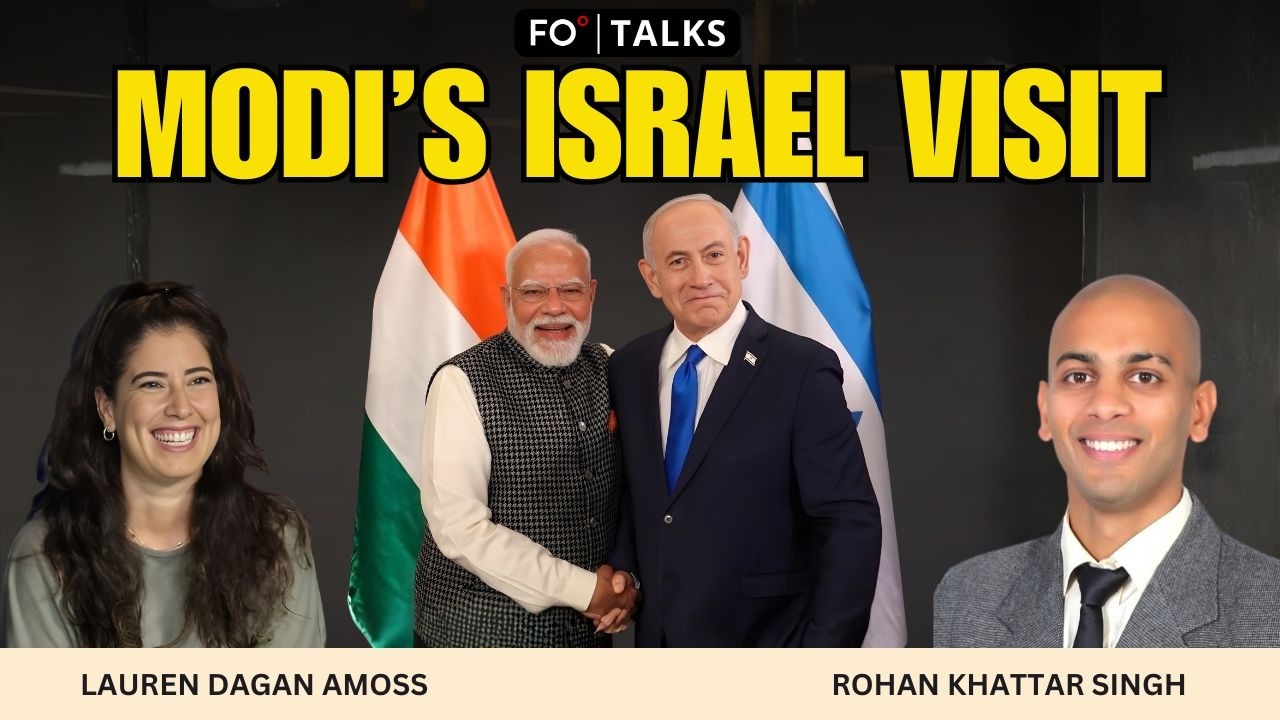
Fair Observer’s Video Producer Rohan Khattar Singh speaks with Lauren Dagan Amoss, a senior researcher at the Begin-Sadat Center for Strategic Studies, about the geopolitical significance of Indian Prime Minister Narendra Modi’s February 25 visit to Israel. Taking place amid heightened tensions in West Asia and after the Iran–Israel confrontation, Modi’s trip signals an important moment in the evolution of India–Israel relations. The conversation explores how symbolism, strategy and shifting regional alignments are reshaping the partnership between the world’s largest democracy and the Jewish state.
The symbolism of recognition
For Israel, Modi’s return visit carries both symbolic and strategic weight. In 2017, Modi became the first sitting Indian prime minister to visit Israel. His decision to return now — and to address the Knesset, Israel’s house of representatives — reinforces the sense that the relationship has entered a new phase.
Amoss argues that the meaning of these visits lies in the way India publicly frames the relationship. As she explains, “the meaning of that is that India sees Israel as a strategic partnership.” For Israeli observers, the optics matter. Modi’s speech, delivered partly in Hebrew and referencing historical connections between the two countries, resonated widely in Israel.
The timing also heightened this visit’s significance. The international community has criticized Israel since 2023, when Israel went to war in the Gaza strip following the infamous October 7 attacks. In that environment, India’s continued engagement and Modi’s willingness to appear publicly in Israel carries diplomatic importance beyond the bilateral relationship.
From quiet cooperation to a broad partnership
India and Israel formally normalized relations in 1992, but cooperation between the two countries had already begun decades earlier. Agriculture, water management and defense formed the foundation of early ties. Over time, defense cooperation became the most visible pillar of the relationship.
Amoss notes that much of this collaboration remained discreet for years. Until the mid-2010s, the relationship was often conducted quietly, even when defense cooperation was substantial.
That dynamic has changed significantly. Since 2014, the partnership has expanded into new areas such as the digital economy, finance, education, innovation and labor mobility. Government-to-government engagement now complements longstanding business and research ties.
For Israeli policymakers, this diversification reflects a growing recognition that India represents far more than a defense partner. With its vast market, technological ambitions and expanding global influence, India increasingly appears as a long-term strategic actor.
India’s “multi-alignment” approach
Amoss continues on to discuss India’s distinctive foreign policy strategy. Unlike many Western countries, India maintains relationships with a wide range of competing powers, including the United States, Russia, Iran and China.
Amoss describes this approach as “multi-alignment.” Rather than choosing sides in geopolitical rivalries, India seeks to pursue overlapping partnerships based on national interests.
This logic contrasts sharply with the Western diplomatic mindset, which she characterizes as more binary. As she puts it, “the West way is a zero-game play.” Amoss believes Israel could benefit from understanding this difference rather than interpreting India’s relationships as contradictions.
India’s ties with Iran, for example, include economic projects such as the development of the Chabahar port. Yet Amoss argues that such cooperation does not necessarily conflict with India’s relationship with Israel. Instead, it reflects India’s need to navigate a complex regional environment that includes difficult neighbors such as Pakistan and China.
IMEC, regional integration and stalled normalization
The discussion also turns to the India–Middle East–Europe Economic Corridor (IMEC), an ambitious project intended to connect India to Europe through Gulf states and Israel. Announced at the 2023 G20 summit, the corridor was widely interpreted as a potential driver of regional economic integration.
The October 7 attacks disrupted that momentum. One motive behind the violence, Amoss suggests, may have been to derail emerging normalization between Israel and Saudi Arabia — a development that would have strengthened the corridor’s viability.
For now, the project remains uncertain. Israel is largely sidelined while other participants, including India, the United Arab Emirates and several European countries, continue exploring cooperation.
Amoss nevertheless believes India’s engagement remains important for Israel’s regional standing. India’s partnerships across the Middle East could help maintain diplomatic openings that might eventually revive broader economic integration.
Strategic gaps and the future of the partnership
Khattar Singh and Amoss conclude with a broader reflection on Israel’s strategic outlook. Amoss argues that Israel often focuses on immediate security threats at the expense of long-term planning. As she states, “In Israel, we don’t have a national strategy.”
India provides a useful contrast. Its ability to maintain diverse partnerships while pursuing long-term economic growth illustrates a different model of international engagement.
Despite the challenges, Amoss remains optimistic about the trajectory of India–Israel relations. Expanding business ties, growing technological cooperation and stronger political recognition are gradually deepening the relationship. As both countries navigate a rapidly changing geopolitical landscape, their partnership may increasingly extend beyond defense into a broader strategic alignment.
[Lee Thompson-Kolar edited this piece.]
The views expressed in this article/video are the author’s own and do not necessarily reflect Fair Observer’s editorial policy.






























Comment