

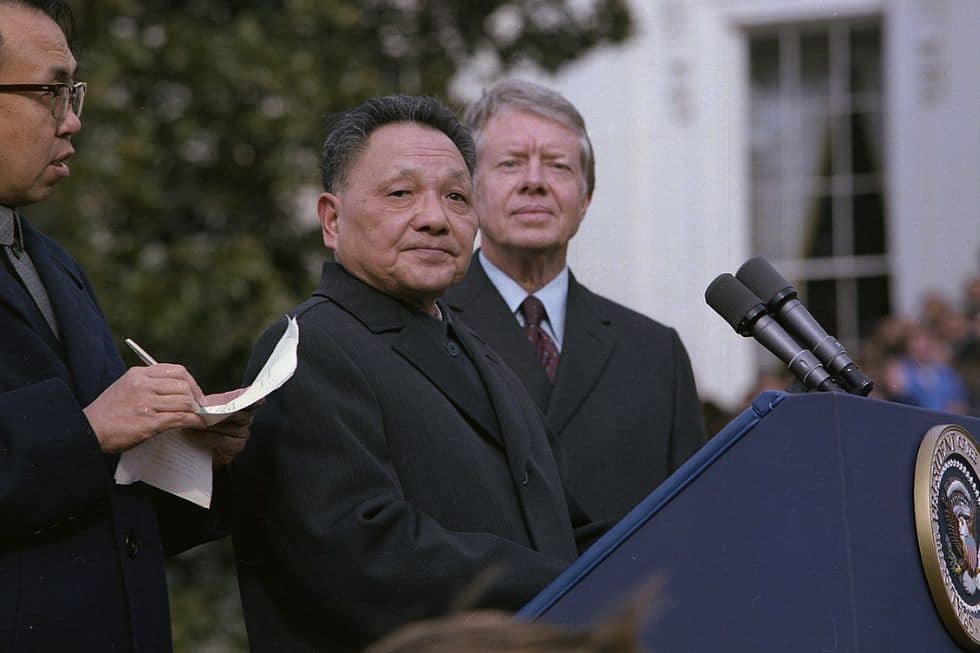



The year 1979 was a pivotal time in history when fundamental changes occurred. During that year, three processes that would shape the following decades emerged: the rise of Islamism, the surge of evangelical fundamentalism in the US and the economic opening of China.
The emergence of fundamentalisms
In both the Middle East and the US, an unexpected phenomenon occurred. In her book The Battle for God, Karen Armstrong summarized it in the following terms:
The fundamentalist assault took many by surprise. They had assumed that religion would never again be a major player in politics, but in the late 1970s, there was a militant explosion of faith … This sudden eruption of religion seemed shocking and perverse to the secularist establishment. Instead of embracing one of the modern ideologies, which had proved so effective, these radical traditionalists quoted religious texts and cited archaic laws and principles that were quite alien to the twentieth-century political discourse.
In 1979, the Islamic Revolution triumphed in Iran, unleashing a movement that would completely change the face of the Middle East. Although initially identified with the Shiite faith, Islamism would subsequently extend its overwhelming influence to the Sunnis. The hostage crisis of 1979, 9/11, the war in Afghanistan (although not in Iraq), the Islamic State of Iraq and Syria (ISIS), and even the current war in Iran can be counted among its consequences. -0[
That same year, the so-called “Moral Majority” movement also emerged in the US. Through it, extreme expressions of Baptism, Pentecostalism and other manifestations of dissident Protestantism not only converged but forcefully intruded into American politics. The following decades would attest to its true impact. Christian nationalism, social conservatism and even the current cultural war significantly fall under its consequences.
Although totally independent in nature, these two fundamentalist movements seemed to represent, in Karen Armstrong’s words, “an atavistic return to the past.”
China’s economic opening
But 1979 also put in motion China’s economic takeoff. Given that, as a result of that process, this country became a rival superpower to the US, threatening to surpass it, this represented the most meaningful of the three events that took place that year. Especially so, as war between the two countries could ensue as a result of China´s rise.
Beginning in 1979, Chinese Leader Deng Xiaoping initiated an ambitious process of economic change based on a new interpretation of the dangers posed by the international order. This implied a convergence between international relations and economics, as the two pillars of his proposal were the abandonment of former Leader Mao Zedong’s “war and revolution” thesis and the entry into an era of “economic opening without political change.”
The Mao Zedong era, indeed, had been characterized by the conviction that war was inevitable. This led to an emphasis on economic policies designed to sustain a two-front war — with both the Soviet Union and the US. As a result of this conviction, economic resources had been dispersed, including to costly, mountainous areas ill-suited for the production or movement of products. This also entailed avoiding vulnerable coastal areas, which had historically been the epicenters of China’s economy.
Based on his interpretation of the international environment, Deng concluded that a world war was improbable in the foreseeable future. Under such conditions, the Maoist policy of “war and revolution” could be replaced with another one of “peace and development.” In Joshua Cooper Ramo’s words: “It was one of those great strategic intuitions by a historical leader, a coup d’oeil (“a quick glance”) that defined the basis of all that came afterward.”
This would translate, a few years later, into a foreign policy defined by non-aggression, non-intervention and peaceful coexistence with all countries, regardless of their political systems.
An indigenous model
However, Deng not only prioritized economic development but also emphasized doing so in an endogenous way. He called it “socialism with Chinese characteristics.” Others, however, talked of “capitalist measures with Chinese characteristics.”
This implied a highly pragmatic model, far removed from the shock therapies that characterized the then fashionable Washington Consensus. A set of policies that was causing much damage in different places around the world. Indeed, instead of the inflexible directions of the former, China chose a flexible path that allowed for trial and error.
By clearly defining goals through strategic planning, the country allowed itself ample tactical room for maneuver, leaving space to react to undesirable effects or changing circumstances. According to Deng’s aphorism, this was tantamount to “crossing the river by feeling the stones.”
Such a process took a pathway of progressive stages and periodic adjustments in which transitory policies acted as bridges from one stage to the following:
The reform process has been gradual and pragmatically introduced in progressive stages that build on, and adjust to, experience in the development of greater market forces in the economy. This incrementalism involves the interaction of initial conditions with transitional policies.
But if this process differed from the Washington Consensus, it also differed from Perestroika in the Soviet Union, which underwent simultaneous economic and political liberalization. An experiment that brought with it the collapse of the Soviet system. China, by contrast, pursued economic liberalization under political control. Not surprisingly, in 1989, Deng preferred the bloody repression of the student movement demanding democratization rather than allowing the Chinese Communist Party to lose political control of the process.
By remaining between the extremes represented by the Washington Consensus and Perestroika, Deng Xiaoping achieved the success of his economic liberalization model.
Gradualness
The model’s gradualness was evident in the management of its export and domestic production industries. The former was channeled through special areas that subsequently expanded, while the latter saw a progressive reduction of the protection assigned to them.
The establishment of the Special Economic Zones in 1979 began the opening up of the Chinese economy to foreign investments. Its initial centers were in Southeast China, in the newly created cities of Shenzhen, Zhulai and Shantou in the province of Guangdong, and Xiamen in the province of Fujian. In 1983, eight additional zones for priority investments were added in the Beijing-Bohai Bay area, the Shanghai Zone, the Wuhan Zone and the Pearl River Delta Zone. In 1984, 14 additional coastal cities were opened up for foreign investment in Tianjin, Shanghai, Dalian, Qinhuangdao, Lianyungang, Nantong, Ningbo, Wenzhou, Fuzhou, Guangzhou, Zhanjiang and Beihai. And so on and so forward.
Meanwhile, tariff protection was being reduced in direct relation to the capacity of Chinese companies to face foreign competition: 55% in 1982, 24% in 1996 and 12% in 2003. In 2006, as a result of China’s accession to the World Trade Organization (WTO) in 2001, tariffs went down to 6%. As a matter of fact, by joining the WTO, economic opening ceased to be confined to special economic zones and spread to the whole country.
The greatest economic growth in human history
The opening process was not only gradual but also strategically planned to promote specific sectors and activities through selective policies. The gradualness of this process, though, should not make us lose sight of its velocity. The extraordinary magnitude of changes that occurred in just a few decades is the best proof of its speed, which, according to the World Bank, resulted in the “fastest sustained expansion of a major economy in history.” Between 1979 and 2018, such economic growth averaged 9.5% a year. This not only lifted 800 million people out of poverty, but also allowed China to double the size of its economy every eight years. According to the International Monetary Fund, in 2014, China overtook the US as the largest world economy on a Purchasing Power Parity (PPP) basis, which resulted in an even more impressive outcome when bearing in mind that in 1980, China’s GDP on a PPP basis was just one-tenth of that of the US.
The above implies having moved from an “iron rice bowl” economy to the world’s largest economy on a PPP basis in little more than four decades. Shenzhen exemplifies this dimension of change: a small city of 20,000 inhabitants in 1979, it had a population of 17.5 million in 2020.
A strong return to State intervention and a clear subordination of the economy to politics has taken place since President Xi Jinping’s arrival to power, which has created numerous problems for that country’s economy. However, no one can deny the magnitude of what has been achieved since Deng’s time.
Without doubt, among the three major climatic events that took place in 1979, the Chinese economic opening had the greatest historical significance. Although confronting Islamism seemed to be America’s top priority for a time, this ended up being a big distraction in relation to that country’s real challenge: China’s forceful emergence. One, that seems to represent the decline of the US and the Western dominance, and the advent of a new Eastern epoch led by China.
[Kaitlyn Diana edited this piece.]
The views expressed in this article are the author’s own and do not necessarily reflect Fair Observer’s editorial policy.






Join the conversation
Share your perspective
Log in to share your thoughts and take part in the discussion.