





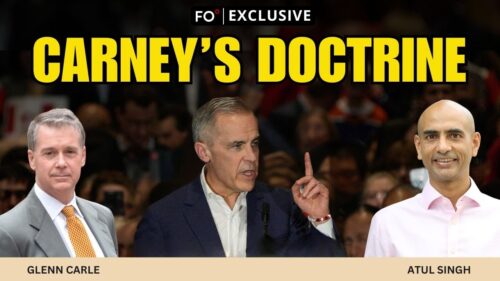
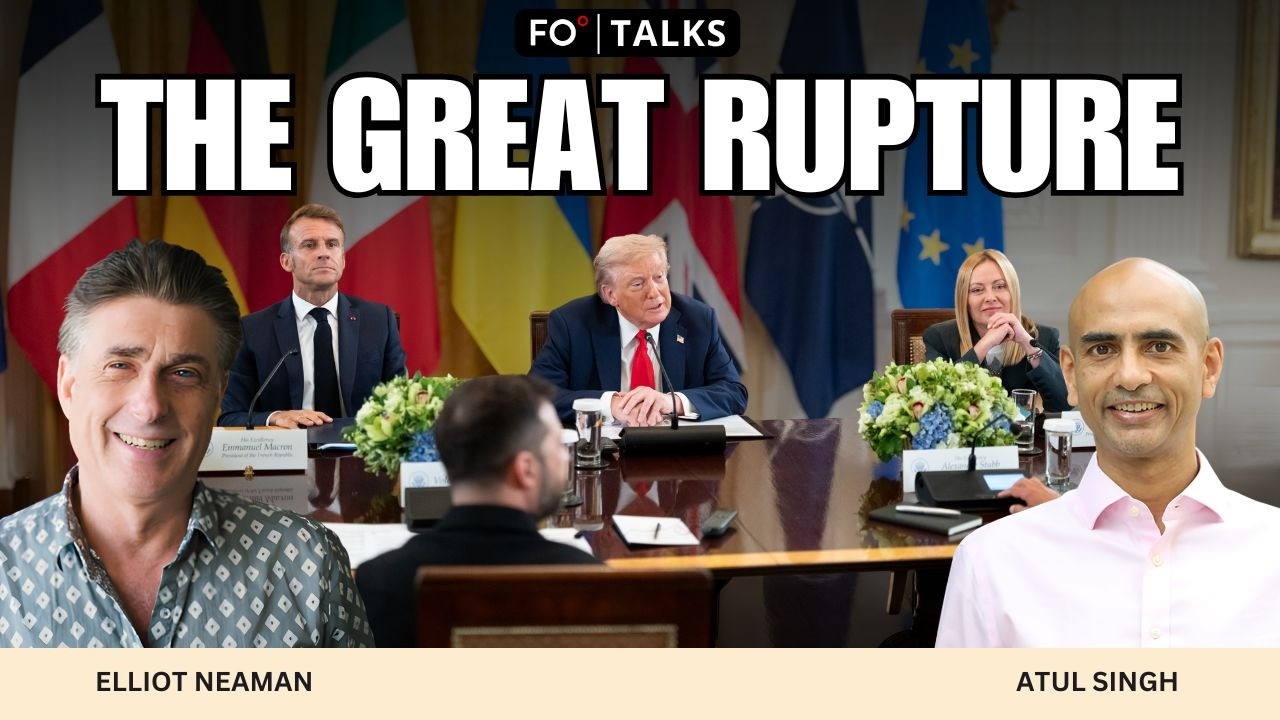
Editor-in-Chief Atul Singh speaks with Elliot Neaman, a Canadian analyst and author, about the unraveling of the transatlantic order that has defined global politics since World War II. Prompted by Canadian Prime Minister Mark Carney’s 2026 Davos speech, the discussion examines why both Europe and Canada are rethinking their dependence on the United States. Neaman argues that the world is experiencing not a temporary adjustment, but a structural rupture that is forcing traditional allies to pursue greater strategic autonomy.
The breakdown of the postwar order
Neaman begins by reflecting on the postwar system the US has created and led. Institutions such as the United Nations, the World Bank, the International Monetary Fund and the World Trade Organization emerged under American leadership and helped shape decades of globalization and economic integration. For Europe in particular, US security guarantees allowed governments to build prosperous welfare states while relying on American military protection.
Neaman sees the second Trump administration as a turning point. Unlike US President Donald Trump’s first term, which he believes was constrained by institutional guardrails, the current administration has become detached from many of the norms and alliances that underpinned the postwar order. He describes the US as an “untethered superpower,” pursuing its interests with less regard for allies and established institutions.
As a result, countries that once assumed American reliability are reassessing their strategic position. Canada and Europe increasingly view the US as a source of uncertainty. According to Neaman, this has triggered a search for new buffers, partnerships and forms of insurance against future disruptions.
Canada’s search for leverage
Canada’s response reflects both necessity and limitation. Neaman notes that Ottawa has sought closer economic and diplomatic ties with countries ranging from China and Vietnam to states in South Asia and Latin America. The goal is not to replace the US but to reduce vulnerability to shifts in American policy.
Singh points to broader trends supporting this strategy. Trade between Brazil and China increased dramatically between 2001 and 2024, illustrating China’s growing role as a global economic partner. Canada is also expanding energy infrastructure, including new pipelines designed to move oil and liquefied natural gas to Pacific export terminals, creating greater access to Asian markets.
Yet Neaman emphasizes that geography imposes limits. The US remains Canada’s largest trading partner, and the two economies remain deeply integrated. Canada cannot sever what he calls its economic “umbilical cord” to its southern neighbor. Instead, Ottawa’s strategy is one of hedging: diversifying relationships where possible while continuing to accommodate the reality of American leverage.
Europe’s security transformation
The shift in Europe is more profound because it centers on security rather than trade alone. Neaman argues that Germany, Poland, the Nordic countries and the Baltic states are gradually building new forms of military cooperation outside the assumptions that have guided NATO for decades. The driving force is Russia’s proximity and the belief that Europe must increasingly defend itself.
The war in Ukraine has accelerated this reassessment. Neaman views the conflict as a glimpse into the future of warfare, where drones, cyber capabilities and asymmetric tactics increasingly challenge traditional military advantages. He argues that Ukraine has demonstrated that smaller states can impose significant costs on larger powers through innovation and adaptability.
The same lesson appears in the Middle East. Singh notes that Iranian asymmetric capabilities have complicated efforts by vastly stronger militaries to achieve decisive outcomes. Neaman agrees, arguing that recent conflicts have revealed the limits of conventional superiority. As European governments increase defense spending, they are likely to focus not only on traditional platforms but also on emerging technologies better suited to modern conflict.
Trauma, trust and strategic autonomy
Europe has lost a great amount of trust in the US. Neaman points to several developments that Europeans view as deeply unsettling, including Trump’s interest in acquiring Greenland, shifts in US policy toward Ukraine and the lack of consultation with allies during the US/Israel–Iran conflict. Together, these events reinforced the perception that Washington could make major strategic decisions without considering European interests.
Neaman argues that the Greenland episode was especially significant because it challenged assumptions about NATO solidarity. German soldiers were prepared to deploy in defense of Greenland during the controversy, which illustrates how seriously many Europeans viewed the issue. European leaders and citizens will not forget this.
As a result, European governments have grown increasingly determined to pursue strategic autonomy. They may continue to cooperate with Washington, but they are increasingly unwilling to base their security entirely on American guarantees. Even countries that remain committed to NATO are exploring alternative partnerships and capabilities.
A new order, not a restoration
Despite the current tensions, Neaman does not believe that national interests have fundamentally changed. Germany’s long-standing reliance on Russian energy, maintained under both former German Chancellors Gerhard Schröder and Angela Merkel, illustrates how strategic realities often transcend partisan politics. Similar calculations may continue to shape policy regardless of changing governments.
Neaman expects future American politics to become more fragmented, creating additional uncertainty for allies. Because Europeans and Canadians cannot predict what kind of administration might emerge next, they are likely to continue building new partnerships and contingency plans.
Some elements of the old transatlantic relationship may eventually return, but not the order that existed before. The shocks of recent years have permanently altered assumptions on both sides of the Atlantic. As Neaman concludes, “the old order” cannot simply be restored. Instead, a new arrangement will emerge, shaped by strategic hedging, regional autonomy and a more multipolar world.
[Lee Thompson-Kolar edited this piece.]
The views expressed in this article/video are the author’s own and do not necessarily reflect Fair Observer’s editorial policy.
























Comment