





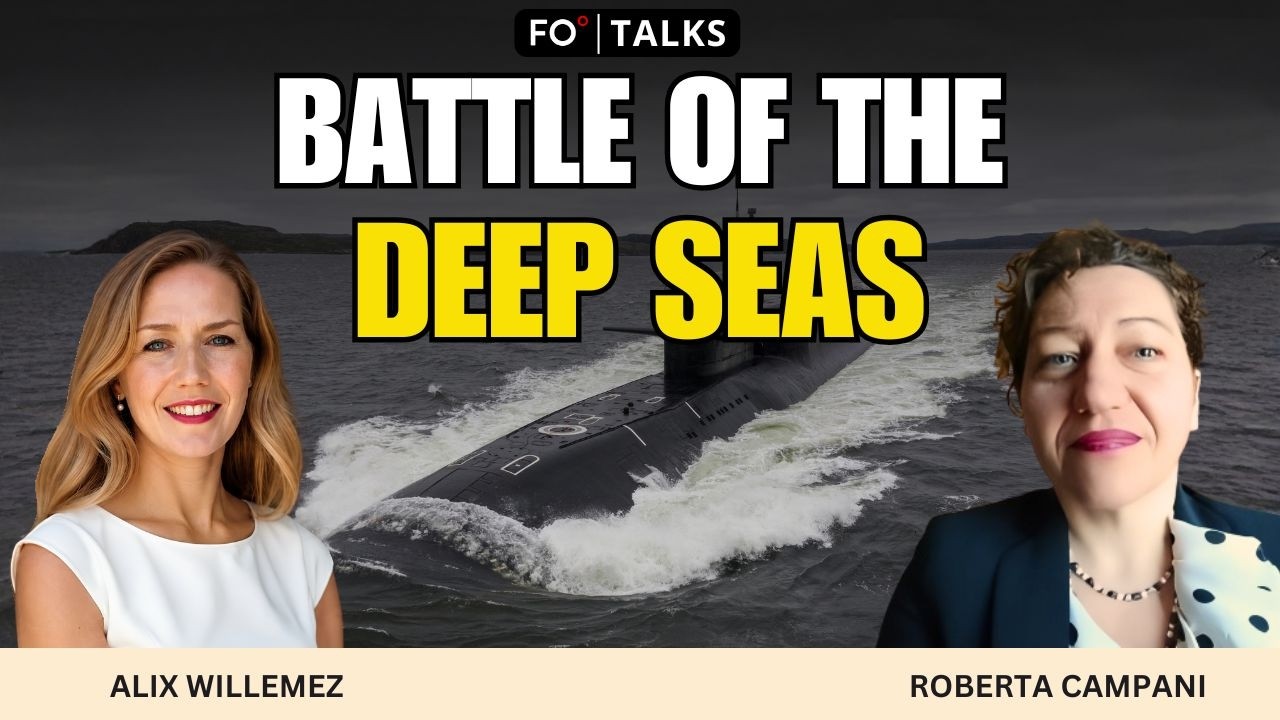
Fair Observer’s Communications and Outreach officer, Roberta Campani, speaks with Dr. Alix Willemez, a specialist in the law of the sea, about the growing importance of ocean governance in an era of geopolitical competition, environmental pressure and technological dependence. Their discussion ranges from the foundations of maritime law to the emerging High Seas Treaty and the strategic waterways that keep the global economy functioning. Willemez argues that humanity is only beginning to understand the ocean’s central role in sustaining modern life and regulating the planet.
The ocean’s hidden role in modern life
Campani begins by asking a deceptively simple question: Who owns the ocean, and why does it matter?
Willemez explains that the ocean underpins nearly every aspect of modern civilization. Half of the oxygen humans breathe is produced by marine phytoplankton. The ocean also absorbs and redistributes heat through global currents, moderating temperatures and creating the stable climate conditions that make agriculture possible.
Its economic importance is equally significant. Roughly 90% of global trade travels by sea, while approximately 95% of international communications rely on fiber-optic cables laid along the ocean floor. Internet traffic, banking transactions, streaming services and countless other digital activities depend on infrastructure hidden beneath the waves.
The ocean is also becoming an increasingly important source of renewable energy through offshore wind and tidal power. Yet despite this dependence, Willemez notes that many people remain largely unaware of the ocean’s role in their daily lives.
From cannonballs to freedom of the seas
The legal framework governing the oceans developed gradually over centuries. Willemez describes how early maritime jurisdiction was based on the so-called cannonball rule. A state’s authority extended only as far as a shore-based cannon could fire, roughly three nautical miles.
As maritime technology advanced and states expanded their commercial ambitions, this approach became inadequate. The emergence of global trade routes forced governments to develop more sophisticated legal principles.
A pivotal figure in this process was the 17th-century Dutch jurist Hugo Grotius. Working during an era when Spain and Portugal sought to dominate major sea routes, Grotius argued that oceans should remain open to all rather than becoming private domains controlled by individual powers.
His principle of freedom of navigation became one of the foundations of modern maritime law. While states eventually expanded their maritime claims, the idea that ships should generally be able to move freely across the world’s oceans remains central to contemporary governance.
UNCLOS and the rise of the High Seas Treaty
The modern legal foundation for ocean governance is the United Nations Convention on the Law of the Sea (UNCLOS), adopted in 1982.
UNCLOS established territorial seas extending 12 nautical miles from a country’s coastline, where states exercise broad sovereignty. Beyond that lies the Exclusive Economic Zone, stretching to 200 nautical miles, where states enjoy rights over fisheries and natural resources while preserving freedom of navigation for foreign vessels. The convention also recognizes continental shelf rights over seabed resources.
However, UNCLOS left significant gaps regarding the high seas, the vast areas beyond national jurisdiction that cover roughly half the planet’s surface.
Scientific discoveries have transformed understanding of these regions. Researchers increasingly recognize the importance of deep-sea ecosystems and genetic resources that could contribute to future medical and technological breakthroughs.
To address these challenges, governments negotiated the Biodiversity Beyond National Jurisdiction agreement, commonly known as the High Seas Treaty. The treaty was adopted by UN member states on June 19, 2023, and entered into force on January 17, 2026, after reaching the 60-ratification threshold required to take effect. It seeks to strengthen protections for biodiversity in international waters and establish new mechanisms for cooperation.
Willemez notes that support continues to grow. “145 countries have signed the treaty,” she explains, while a large and growing number have formally ratified it, making its provisions legally binding.
Maritime chokepoints and geopolitical conflict
The conversation then turns to places where maritime law collides with geopolitical realities.
The Strait of Hormuz remains one of the world’s most critical waterways. Although international law guarantees freedom of passage, tensions between Iran and the United States have produced a de facto double blockade.
Iran raises commercial risks through threats involving mines and drones, dramatically increasing shipping insurance costs. Simultaneously, Washington seeks to restrict Iranian oil exports. The result is growing pressure on one of the world’s most important energy corridors.
Other chokepoints face different challenges. The Strait of Malacca serves as a vital route for Asian trade and global electronics supply chains. The Suez Canal, governed through separate treaty arrangements and administered by Egypt, remains indispensable to commerce linking Europe, Africa and Asia.
The Panama Canal faces a different threat. Because its lock system depends on freshwater supplies, drought conditions can significantly reduce shipping capacity, increasing transportation costs and disrupting supply chains worldwide.
Toward a more integrated system of ocean governance
Despite progress, Willemez argues that ocean governance remains fragmented. Shipping, fisheries, biodiversity protection and seabed mining are overseen by different organizations operating largely independently of one another.
That fragmentation is increasingly at odds with scientific understanding of the ocean as an interconnected ecosystem.
Willemez considers the most promising development to be the growing shift toward ecosystem-based governance. The High Seas Treaty could enable the creation of marine protected areas that safeguard migratory species throughout their entire life cycles rather than only within individual national jurisdictions.
“The fact that we think of the ocean as an ecosystem is a real progress,” she says.
Looking ahead, Willemez believes the combination of scientific discovery, international cooperation and growing environmental awareness is pushing governments toward a more holistic approach. As debates over deep-sea mining, biodiversity and maritime security intensify, the ocean is becoming one of the defining arenas of global governance in the 21st century.
[Lee Thompson-Kolar edited this piece.]
The views expressed in this article/video are the author’s own and do not necessarily reflect Fair Observer’s editorial policy.



































Comment