





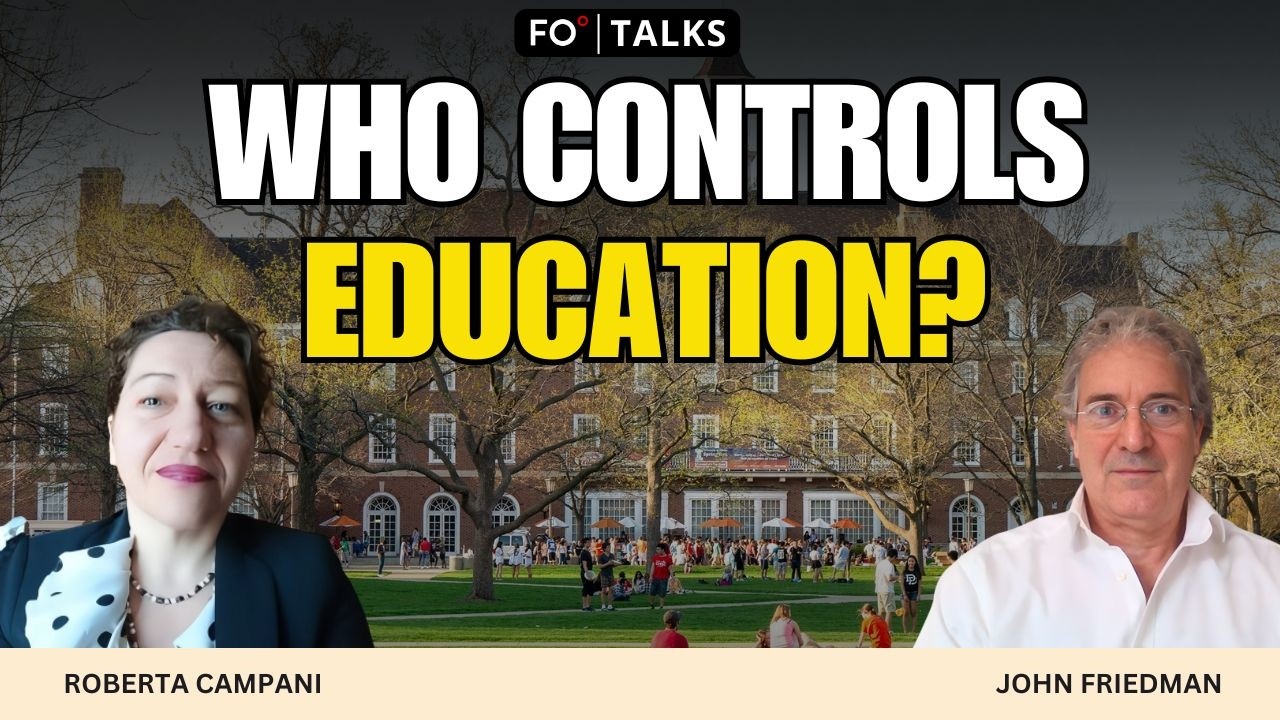
Fair Observer’s Communications and Outreach officer, Roberta Campani, speaks with Professor John Friedman, a public anthropologist who spent over two decades teaching at University College Roosevelt, part of Utrecht University in the Netherlands. They diagnose the neoliberal transformation of higher education, the erosion of academic freedom and the uncertain future of the humanities.
Shock therapy: the “startup university”
Friedman begins by recounting the moment his university abruptly dismissed roughly 30% of its staff. Administrators locked the campus, summoned faculty into brief meetings and informed them of their termination. He watched colleagues emerge from five-minute sessions in tears, before going in himself and returning to finish his lecture.
The episode reflects what Friedman calls a “startup type of management mentality.” Universities, he argues, are increasingly run by professional managers rather than educators — leaders trained to optimize processes, pivot quickly and prioritize efficiency. In this model, institutions once conceived as public goods begin to resemble corporations, guided by short-term metrics and quarterly logic rather than long-term intellectual commitments.
Campani presses him on whether management theory has colonized academia. Friedman agrees. A broader neoliberal framework, he explains, has seeped into universities, nonprofits and public administration. Executive boards operate with the mindset of CEOs, treating education as a system to be streamlined. The result is speed over deliberation, flexibility over stability and performance indicators over intellectual mission.
From classroom to TikTok
After Friedman’s dismissal, a student proposed making a TikTok video. Within days, one clip reached 40 million views. What began as a protest became a new pedagogical experiment.
Anthropology, he notes, is traditionally slow. Classroom learning unfolds over semesters; intellectual transformation takes years. Social media operates in flashes. Yet Friedman sees value in these brief interventions. He does not aim to replicate the seminar room, but to create moments of recognition.
If a 30-second clip helps viewers grasp two ideas — that others experience the world differently, and that we share common ground despite those differences — then it succeeds. “If I can provide more questions than answers,” he says, “I always feel I’m being an effective educator.”
Contrary to his expectations, he finds online exchanges often earnest and constructive. He has not had to block anyone. Social media becomes for him a form of participant observation — anthropology conducted in a digital field site.
The humanities under pressure
Campani raises a familiar critique: Disciplines like anthropology are impractical and ill-suited to the job market. Friedman defends liberal arts education as preparation for a lifetime of adaptability. Its strength lies in breadth — the ability to connect politics and economics, history and culture, rather than remaining confined within hyper-specialized silos.
He traces the rise of academic specialization from the late 19th century onward. Over time, disciplines fractured into increasingly narrow domains. Scholars often write for a few hundred peers worldwide. Promotion systems reward peer-reviewed output over teaching or public engagement. This emphasis, he says, “detracts from anthropology itself,” narrowing its impact.
Department closures across the United Kingdom and the Netherlands illustrate the consequences. Programs are gutted; students find their degrees destabilized midstream. Even tenure, once designed to protect intellectual independence, no longer guarantees security. Friedman himself was tenured when dismissed. Becoming a public intellectual now carries risk, particularly in political climates where universities fear losing funding.
The fight for relevance
Friedman distinguishes between academic anthropology, applied anthropology and what he calls public anthropology. The first seeks to understand what it means to be human. The second applies anthropological tools to specific problems, sometimes in corporate or governmental contexts. Public anthropology, by contrast, aims to insert anthropological perspectives into public debate.
Why, he asks, are anthropologists absent from conversations on immigration, climate crisis or geopolitics? Why are these debates ceded to politicians and economists alone? A discipline that examines culture, power and meaning should have a visible voice in news media, schools and even popular platforms.
The stakes are existential. If anthropology fails to demonstrate relevance beyond conferences and journals, its future dims. Friedman acknowledges cyclical crises in the field’s history but believes this moment demands greater outward engagement.
A slower future?
Campani and Friedman end the conversation on a note of cautious optimism. Friedman senses that many young people are questioning perpetual growth and transactional logic. They seek meaning, reflection and a slower pace of life.
Universities, he argues, should embody that slowness, and be places where long-term thinking survives in a culture obsessed with immediacy. The destruction of knowledge infrastructures, from department closures to shrinking archives, threatens not only academic careers but society’s capacity to remember and reflect.
The task ahead is modest but vital: generate recognition, spark curiosity and cultivate better questions. In a profit-driven global system that rewards speed and efficiency, the humanities may endure precisely by insisting on depth, context and the complexity of being human.
[Lee Thompson-Kolar edited this piece.]
The views expressed in this article/video are the author’s own and do not necessarily reflect Fair Observer’s editorial policy.



























Comment