



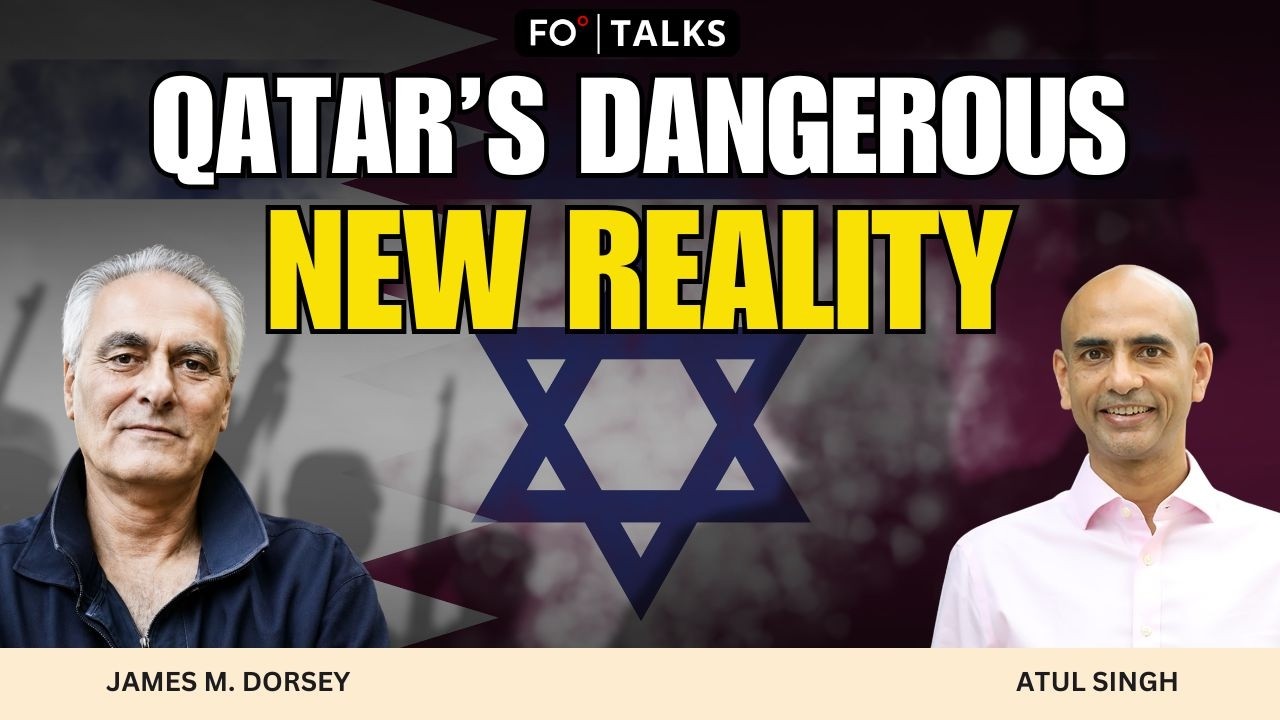
Editor-in-Chief Atul Singh speaks with journalist and author James M. Dorsey about Qatar’s position at the heart of the US/Israel–Iran war. They explore the consequences of attacks on Qatar’s critical energy infrastructure, the limits of the country’s long-standing soft power strategy and the broader transformation of Gulf security. While the war has exposed new vulnerabilities, Qatar possesses the financial resources, diplomatic experience and strategic flexibility to remain an influential regional actor.
Soft power meets military reality
Dorsey begins by explaining why Qatar occupies such an important position in the Middle East despite its small population. As one of the world’s largest natural gas producers, it shares the world’s largest offshore gas field with Iran, creating a relationship unlike that of any other Gulf state. The country has also built an international reputation as a mediator in regional conflicts, making Iran’s decision to strike Qatar particularly significant.
The attack on the Ras Laffan gas facility marked a turning point. Around 17% of Qatar’s production capacity was disabled, with estimated losses of roughly $20 billion annually and repairs expected to take as long as five years. Dorsey calls the strike a “very significant blow” to Qatar’s economy. It forced Doha to step back temporarily from its traditional mediating role before later helping facilitate negotiations between Iran and Pakistan that contributed to the recent memorandum of understanding.
Singh notes that Qatar’s influence extends well beyond energy through the Al Jazeera network and its successful hosting of the FIFA World Cup. Dorsey argues these initiatives formed part of a broader security strategy developed after Iraq’s invasion of neighboring Kuwait. Rather than relying solely on military strength, Qatar sought to make itself globally indispensable through diplomacy, media and international visibility. The current conflict, however, demonstrates that while soft power enhances influence, it cannot substitute for effective missile defenses.
Geography limits Qatar’s options
Singh describes Qatar as a “prisoner of geography,” wedged between Saudi Arabia and Iran and heavily dependent on shipping through the Strait of Hormuz. Dorsey explains that this dependence is even greater for natural gas than for oil because gas exports cannot easily be redirected through pipelines.
Unlike Saudi Arabia and the United Arab Emirates, which have invested in alternative export routes, Qatar remains closely tied to maritime access through the Strait. This explains why Doha has adopted a more measured position on proposals involving Iranian control or temporary fees for shipping through Hormuz, emphasizing stability rather than confrontation.
Dorsey says Qatar has spent decades “having to maneuver and balance on a tightrope,” maintaining workable relations with competing regional powers. Until the recent war, this balancing strategy proved remarkably successful. The attacks nevertheless demonstrate that even careful diplomacy cannot entirely shield a small state from the consequences of great-power conflict.
Security priorities shift across the Gulf
The discussion then turns to the future of Gulf security. Dorsey believes that the United States will remain the principal security guarantor because no alternative power possesses both the capability and willingness to assume that role. However, Gulf governments are likely to demand a relationship that is more consultative and conditional than in the past.
Simultaneously, Qatar and its neighbors are expected to increase defense spending significantly. Dorsey contrasts Qatar’s earlier emphasis on “software” — its diplomatic influence and soft power — with a new focus on military “hardware.” Investment in missile defense, domestic weapons production and defense industries is likely to accelerate throughout the region.
Singh questions whether countries with relatively small citizen populations can sustain larger military establishments. Dorsey responds that labor shortages can be addressed through immigration, as Gulf economies have long relied on foreign workers. He points to the UAE as evidence that a small population does not necessarily prevent the development of capable armed forces or an expanding defense industry.
The conversation also highlights increasing diversification in Gulf security partnerships. Alongside continued American protection, countries are strengthening ties with Pakistan, India, European states and potentially China while expanding indigenous military capabilities.
A permanent relationship with Iran
Despite the conflict, Dorsey argues that geography ultimately forces the Gulf states and Iran to coexist. He describes their relationship as “a Catholic marriage,” emphasizing that neither side can simply walk away from the other.
Both speakers suggest that discussions over managing the Strait of Hormuz may eventually become part of a broader regional security framework that includes Iran. Such an arrangement would remain politically difficult, particularly given unresolved tensions involving Israel and the Palestinian issue, yet both regard regional dialogue as unavoidable over the long term.
Dorsey believes Iran has emerged from the conflict strategically stronger despite suffering military and economic damage. The survival of the Iranian regime, the prospect of sanctions relief and the possibility of reconstruction funding leave Tehran better positioned than many observers expected. Although domestic grievances remain unresolved, he believes that they have temporarily been overshadowed by wartime nationalism.
Qatar remains resilient despite greater risks
In concluding, Singh asks whether Qatar can preserve its international influence despite becoming a direct target during the conflict. Dorsey says that although the country’s security environment has become considerably more dangerous, its core strengths remain intact.
Qatar retains substantial financial resources, sophisticated diplomacy and decades of experience navigating complex regional rivalries. Those advantages, combined with its central role in global energy markets, provide the resilience needed to adapt to a changing Middle East.
The Gulf states are entering a new era in which diplomacy alone is no longer sufficient. Soft power will remain an important source of influence, but it will increasingly be complemented by stronger defense capabilities, diversified security partnerships and greater regional coordination as the balance of power continues to evolve.
[Lee Thompson-Kolar edited this piece.]
The views expressed in this article/video are the author’s own and do not necessarily reflect Fair Observer’s editorial policy.
























Comment