




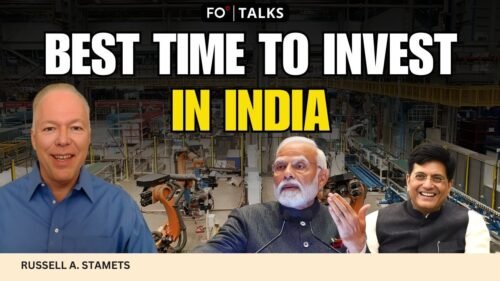
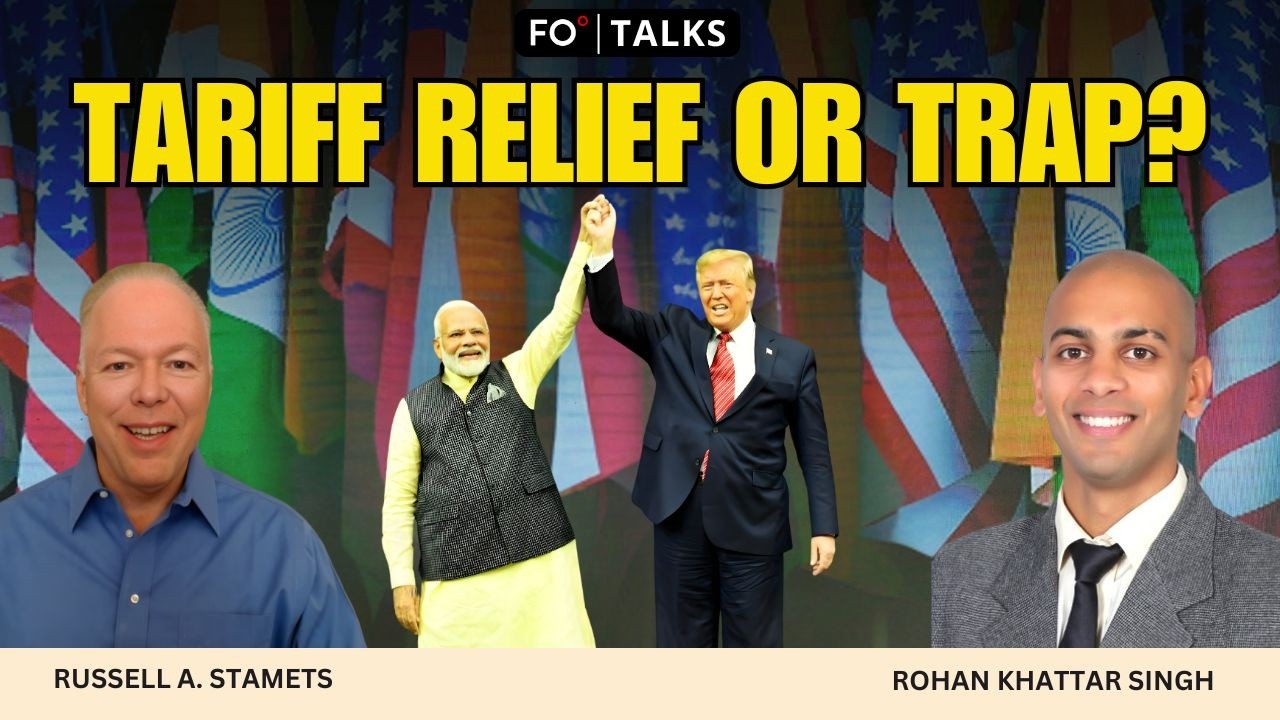
Fair Observer’s Video Producer Rohan Khattar Singh speaks with FOI Partner Russell Stamets, a lawyer who has spent more than two decades advising American and multinational firms on doing business in India. They discuss the significance of the India–US trade deal at a time when global commerce is shifting away from multilateral frameworks toward bilateral agreements. They examine tariffs, foreign direct investment, IT services, agriculture and the broader geopolitical logic of decoupling from China. The agreement may mark the beginning of what Stamets calls Liberalization 2.0 for the Indian economy.
Stamets frames the deal as part of a structural transition in global trade. As the World Trade Organization loses centrality, countries are increasingly pursuing direct, negotiated arrangements. For India and the United States, the absence of such a deal had become a major issue and even an embarrassment after earlier efforts collapsed. Given the political investment on both sides, the failure to secure an agreement had taken on disproportionate symbolic weight.
Divergent languages, necessary convergence
Khattar Singh presses Stamets on why negotiations have previously stalled and whether one side wanted the deal more than the other. Stamets says the breakdown was more about mindset than desire. The Trump administration approached trade from an intensely transactional, mercantile perspective, while India treated negotiations as matters closely tied to sovereignty and pride.
The two sides, he says, were speaking “the most divergent language.” When trade becomes entangled with emotion and national honor, rational bargaining becomes harder. In that environment, asking who “won” obscures the larger shift that was needed.
Still, Stamets credits New Delhi’s performance. In his estimation, India has done a “terrific job” navigating a difficult political and economic landscape. He suggests that Indian Prime Minister Narendra Modi has used the deal as leverage to restart a reform agenda that had stalled. For Stamets, this moment may later be remembered as Liberalization 2.0, echoing the watershed reforms of 1991 that opened India’s economy to global competition.
Decoupling from China and FDI revival
A central question is whether the agreement meaningfully advances US efforts to reduce reliance on China. Khattar Singh connects the deal to earlier discussions about American firms shifting manufacturing footprints. Apple’s expanded production in India is one visible sign, but Stamets emphasizes that the broader objective is not deglobalization. Rather, it is diversification.
Washington, he argues, desperately seeks a confident and economically vibrant India as a partner in global supply chains. The reaction to early tariff announcements underscores that appetite. When the 18% tariff figure emerged, Stamets recounts that his phones were abuzz with US businesses eager to explore sourcing and manufacturing opportunities in India.
This renewed interest, he believes, could help reverse a worrying decline in foreign direct investment. By lowering tariffs from 25% to 18% in key areas and signaling policy stability, the agreement restores market confidence and invites longer-term commitments.
Tariffs, consumers and agricultural red lines
Agriculture, dairy and poultry have long been politically sensitive sectors in India. Publicly, these areas were described as red lines. Stamets notes that public and private negotiating positions often differ, but he acknowledges the government’s need to protect farmers while managing transition.
Khattar Singh highlights concrete examples, including walnuts and almonds. India produces only a fraction of its domestic demand, yet it previously imposed tariffs as high as 120% on certain imports. Such measures, Stamets argues, were “anti-consumer” and “mostly punished the Indian consumer,” even if they were justified as protective tools for the domestic industry.
The deal’s tariff reductions, including cuts from 25% to 18% in several categories, may appear technical. But for consumers, lower import costs translate into tangible price changes. Apples, dairy and other everyday goods illustrate how trade policy filters into household budgets. While the details are still emerging, both Khattar Singh and Stamets expect benefits to broaden over time.
Media noise and strategic reality
Khattar Singh observes that the Indian media has fixated on the agreement, while American outlets have given it limited attention. Stamets bluntly explains that economically, India “doesn’t really matter that much to the United States” relative to its largest trading partners. That asymmetry shapes coverage.
However, the strategic value exceeds immediate trade volumes. For India, securing stability for IT services and the outsourcing sectors is crucial. Stamets describes the avoidance of potential US protectionist action against these industries as “an ICBM dodge,” safeguarding one of India’s most important exports.
Ultimately, the deal’s deeper significance may be psychological. Stamets hopes it signals a more self-confident India, willing to defend its interests and say yes when integration advances them. For Washington, a stable and self-assured India strengthens efforts to reshape supply chains and counterbalance China.
Whether this marks the beginning of a new trade architecture remains uncertain. But as bilateralism replaces multilateralism, the India–US agreement stands as an early test case for how two large democracies reconcile protectionist impulses with global ambition — and whether Liberalization 2.0 can deliver on its promise.
[Lee Thompson-Kolar edited this piece.]
The views expressed in this article/video are the author’s own and do not necessarily reflect Fair Observer’s editorial policy.






















Comment