





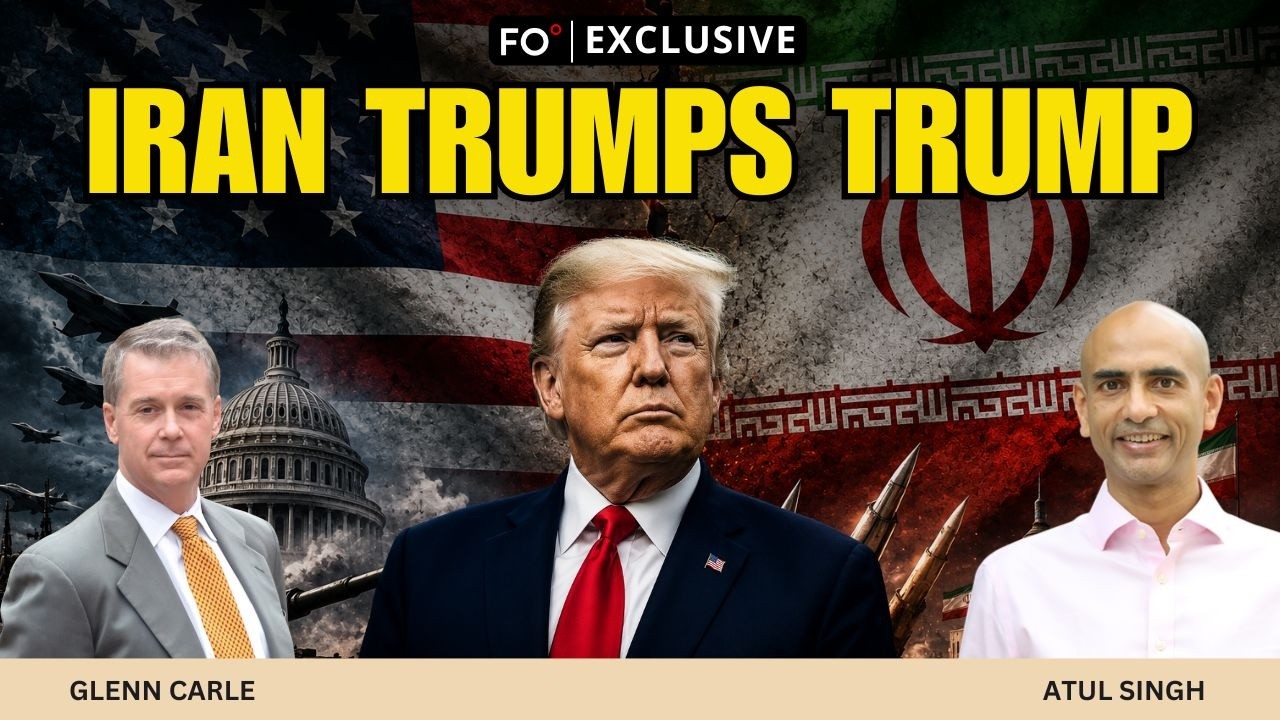
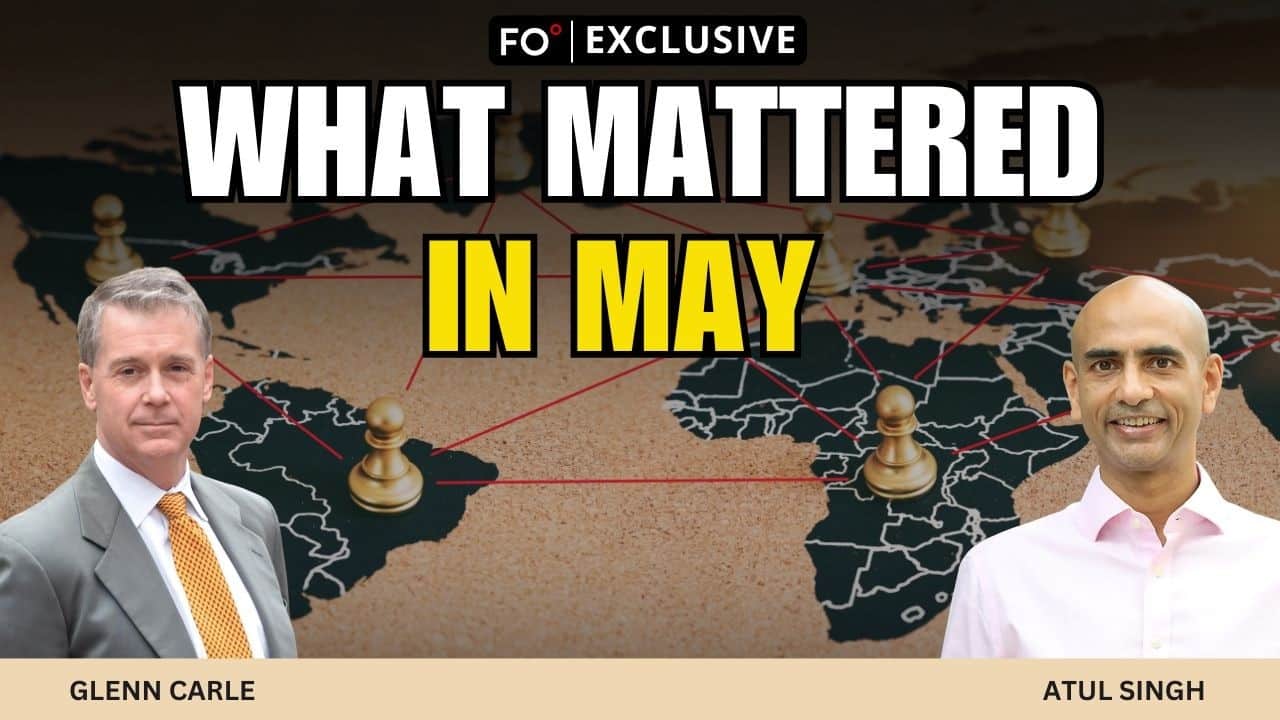
Editor-in-Chief Atul Singh and FOI Senior Partner Glenn Carle, a retired CIA officer who now advises companies, governments and organizations on geopolitical risk, examine the broader strategic implications of the US/Israel–Iran conflict. Its significance extends well beyond the immediate military and diplomatic outcomes, revealing a changing balance of power in the Middle East and a transformation in the character of modern warfare. The lessons, they contend, will shape how both great and lesser powers approach conflict in an increasingly contested international order.
A memorandum in Iran’s favor
Perhaps the month’s most consequential geopolitical development is the reported US–Iran Islamabad Memorandum of Understanding. This memorandum reveals that the state of affairs is worse than prior to the conflict.
According to the memorandum, Washington would lift its blockade on Iran, allowing normal commercial transit through the Strait of Hormuz to resume. The US would also withdraw its naval forces from the region within 30 days and end sanctions on Iranian petrochemicals and oil. This would make large-scale sales to China and other countries possible once again. In addition, Washington reportedly pledges to prepare an international reconstruction fund worth $300 billion.
Iran’s commitments are more limited and explicitly temporary. Tehran offers a 60-day pause in hostilities, together with a temporary 60-day agreement allowing commercial vessels to transit the Strait of Hormuz. Iran also agrees to maintain the status quo on its nuclear program while negotiations continue, rather than expanding or dismantling it during the talks.
The memorandum also raises questions about Israel and Shia militia Hezbollah, which is based in Lebanon. Iran insists that the understanding includes a cessation of Israeli attacks on Hezbollah in Lebanon. Israel has resisted and denied that such a commitment exists. Even so, the practical effect appears to be that the US has pressured Israel to adhere to Iran’s conditions by avoiding further escalation while negotiations proceed.
The memorandum leaves many of the underlying strategic issues unresolved while granting Iran major economic and diplomatic concessions. If implemented, the memorandum would represent a settlement that is fundamentally different from, and arguably less favorable to Washington than, the status quo ante bellum (the situation before the conflict).
Trump’s war aims: incoherent, ad hoc and changing
Four principal strategic objectives justified the conflict. The sine qua non was eliminating Iran’s nuclear program. Yet the reported outcome appears to represent a regression from the Joint Comprehensive Plan of Action (JCPOA), rather than an improvement on it. The Obama administration negotiated the JCPOA over many years and curbed Iran’s nuclear program. The memorandum does not dismantle Iran’s nuclear capabilities. Instead, it merely maintains the status quo on its nuclear program while talks continue, leaving the central issue of nuclear proliferation unresolved.
A second objective was overthrowing Iran’s regime of mullahs. US President Donald Trump’s attack on Iran has enabled hardliners to take charge in Iran. They are now more securely in power than antebellum. Rather than weakening the Islamic Republic politically, the war seems to have strengthened the regime and bolstered the people’s fighting spirit.
A third objective was degrading Iran’s conventional military capabilities, notably its missile capabilities and stockpiles. Iran’s conventional capabilities were always largely toothless, incapable of projecting power beyond its immediate region. To that extent, any degradation of those conventional capabilities is strategically irrelevant and does not materially change the balance of threats.
Iran’s missile capabilities have been degraded, but remain at roughly 70% of their antebellum level, leaving Tehran still able to strike anywhere in the Middle East and destabilize the region. Drones, by contrast, were barely mentioned before the conflict. They are now defining the war space worldwide, demonstrating an ability to challenge conventional military power, particularly by denying access to territory and destabilizing entire regions.
The fourth objective was stopping Iran’s support for its regional surrogates: Houthis, Hezbollah, Hamas and Iraqi Shia militias. Those surrogates have been weakened, but primarily as a result of Israeli military action rather than US action. Simultaneously, they remain supported de facto and de jure by Iran. Tehran has not renounced its long-standing commitment to them. As a result, the broader regional network that has underpinned Iranian influence has been damaged, but not dismantled.
Taken together, none of the four principal strategic objectives appears to have been fully achieved. The nuclear program remains intact, the regime has become more secure, missile capabilities remain a regional threat and Iran’s proxy network survives despite suffering important setbacks.
Strategic implications
The memorandum has other far-reaching strategic implications. In the region, Iran appears stronger than before. Although it has suffered military and economic costs, Iran has emerged with its political system intact, its missile deterrent largely preserved and the prospect of renewed economic relief through the easing of sanctions.
Israel is tactically and operationally safer in the medium term. Hezbollah and other Iranian-backed groups have been weakened, reducing the immediate military threat on Israel’s borders. In the long term, however, Israel may be worse off, becoming more isolated from the US, from its allies and within the region if Washington increasingly prioritizes regional stability over confrontation with Iran.
Beyond the Middle East, the US and all great powers must now confront the equalization of the battle space. Hegemony has become harder to achieve than ever before. Technological change has made it increasingly difficult for even the most powerful militaries to dominate weaker adversaries at an acceptable cost.
Drones in 2026 are what the machine gun was in 1914. Just as the machine gun transformed warfare by making traditional offensive operations extraordinarily costly, drones are reshaping the modern battlefield by making it easier to deny territory, disrupt logistics and impose significant costs on conventionally superior forces.
As a result, offensives have become harder, and lesser powers are increasingly able to challenge great powers. This lesson extends well beyond the Middle East and is relevant for the US, China, Russia and even Turkey. The strategic environment has shifted in ways that make military intervention more uncertain and more expensive than many policymakers have so far assumed.
In that context, he who hesitates might survive, instead of becoming bogged down and suffering defeat. Strategic restraint may increasingly prove to be a source of strength rather than weakness as major powers adapt to a more contested and technologically equalized battlefield.
The conflict has ultimately panned out much as FOI predicted in May. The Trump administration is trapped in a Hormuz Crisis, and the memorandum reveals that America is playing a weak hand badly.
[Lee Thompson-Kolar edited this piece.]
The views expressed in this article/video are the author’s own and do not necessarily reflect Fair Observer’s editorial policy.

























Comment