


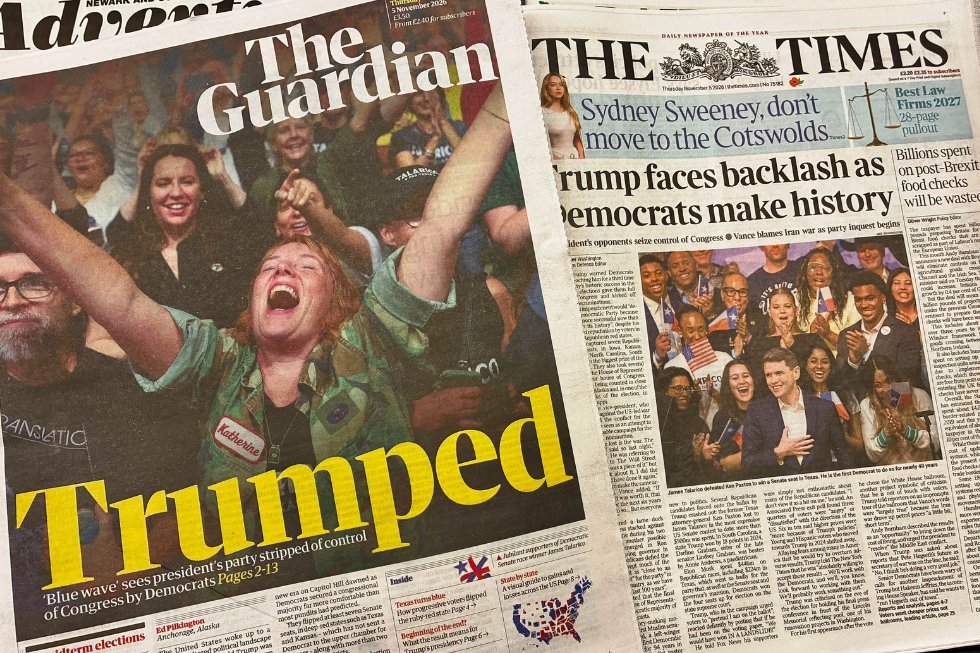



Democrats won both chambers of Congress in the November midterms, but the national result tells only part of the story. In races from Texas to Georgia, candidates gave voters specific answers to a question that mattered at home: What would they do about the cost of getting by?
In Texas, Governor Greg Abbott’s allies wanted voters to ask whether Democrat Gina Hinojosa was “too woke.” In a campaign ad, she turned the question around: Why were working Texans “too broke”? She proposed freezing electricity rates and suspending state fuel taxes. Then she beat the three-term governor.
In ABC News voter polling, seven in ten House voters said the economic system favored the wealthy. They backed Democrats by roughly three to one. Forty-four percent described their vote as opposition to Trump, compared with 16% who called it an expression of support. The poll captures the mood in which these candidates ran.
The eight campaigns examined here put different ideas behind the promise of relief. In Ohio, Amy Acton proposed a child tax credit. In Georgia, Keisha Lance Bottoms pledged to expand Medicaid. Their victories put those promises to the test.
Gina Hinojosa brought the argument home
Hinojosa entered electoral politics through the Austin school board after budget cuts threatened her son’s campus. Her subsequent career in the Texas House gave her fight against Abbott’s voucher program a foundation in public-school politics.
Her commitments included a one-time $1,500 payment to every Texas household from state savings, alongside Medicaid expansion. She proposed suspending state fuel taxes and freezing electricity rates. The authority and legislative support needed to deliver those measures now become governing questions. Her criticism of corporate privilege was equally specific. She called for data centers to pay sales taxes on their electricity, challenging exemptions while households struggled with bills.
Her priorities matched an identifiable concern. A Cook Political Report–TelevisaUnivision survey of likely Hispanic voters, conducted in late August and early September, found the economy outranked immigration and Immigration and Customs Enforcement (ICE) combined two to one. But deportation policy also damaged Republican support. Economic anxiety and resistance to coercive government were intertwined.
James Talarico challenged the right on its own ground
Texas also elected James Talarico to the Senate. A former middle-school teacher and Presbyterian seminarian, he challenged Christian nationalism while arguing for the separation of church and state. Talarico joined moral conviction to a teacher’s understanding of what happens when public institutions fail children. His religious identity allowed him to dispute the right’s claim to speak for believers.
His account of being diagnosed with type 1 diabetes supplied a concrete indictment of healthcare costs: $684 for his first month’s insulin. His proposed federal public insurance option would compete alongside private coverage. His agenda also calls for stronger drug-price negotiation and action against healthcare monopolies.
His anti-corruption politics also create an obligation to examine his own coalition. Although he rejects corporate political action committee (PAC) contributions, a super PAC supporting him received billionaire funding. Democratic participation in that system belongs in any serious account of concentrated wealth.
Amy Acton made competence personal
Ohio elected Amy Acton over Vivek Ramaswamy. The physician and former state health director grew up in Youngstown, experiencing abuse and homelessness. She campaigned with unusually calculable proposals. Her affordability agenda includes an annual child tax credit of $1,000 for children aged six and under and $500 for older children, for families earning up to $85,000. It proposes medical-debt relief and using Ohio’s purchasing power to reduce prescription costs. Acton offered public-health experience and a family policy voters could cost against their own budgets. Her childhood supplied the story; her professional record supplied the claim to govern.
The political opening extended beyond committed Democrats. An October Marist survey found 40% of likely Ohio voters viewed their congressional ballot mainly as a vote against Trump, compared with 21% who viewed it as a vote for him. Those figures concern congressional voting intentions, but show the hostile environment his party faced.
Keisha Lance Bottoms put coverage on the ballot
In Georgia, Keisha Lance Bottoms defeated healthcare billionaire Rick Jackson, becoming the first Black woman elected governor of a US state. The former Atlanta mayor and Biden adviser brought executive experience to a contest against a wealthy self-described outsider. Her platform promised full Medicaid expansion and replacement of Georgia’s more restrictive Pathways program. She also proposed access to pre-kindergarten for every family wanting it.
Georgia’s shift reached beyond the Democratic base. The Atlanta Journal-Constitution’s account of voter polling found Bottoms carried independents, while Governor Jon Ossoff won roughly two-thirds of them. Their differing performances also caution against treating every Democratic victory as the same event.
Bottoms now faces a measurable test: whether her administration can extend insurance coverage to people excluded under existing policy. Her historic election carries a practical promise about who gets treated.
Jon Ossoff followed the evidence
Georgia’s Jon Ossoff won reelection after bringing the methods of investigative journalism into the Senate. Before taking office, he ran a company that produced investigative documentaries. His Senate investigations examined abuse in federal prisons and the treatment of military families by private housing contractors. His work also exposed failures in Georgia’s foster-care system. His proposals to ban congressional stock trading and corporate PACs connect those investigations to the incentives governing public life. An official profiting from privileged access is a recognizable conflict, regardless of party.
The economic backlash helped him. According to ABC News voter polling, roughly nine in ten Georgia voters who described the national economy as poor voted for Ossoff. His distinctive contribution was to attach opposition to documented abuses and identifiable remedies.
Deb Haaland understood the safety net from both sides
New Mexico elected Deb Haaland, a citizen of Laguna Pueblo, as the country’s first Native American woman governor. Her experience includes serving in Congress and leading the Interior Department. Before that came life as a single mother using food assistance and Medicaid, and running a small salsa business. Her background joins experience receiving assistance to responsibility for administering large public institutions. That gives her a particular perspective on the distance between announcing a benefit and making it available.
Her campaign account places those experiences alongside proposals to raise the minimum wage and expand the child tax credit. Haaland also supports faster housing construction and a ban on algorithmic rent fixing. Her commitment to strengthening universal childcare builds on an existing New Mexico program. The immediate task includes ensuring enough providers and places.
Abdul El-Sayed challenged the business of healthcare
Michigan elected Abdul El-Sayed to the Senate. A physician and former Detroit health director, he secured glasses for children and addressed lead exposure in schools. His platform advocates Medicare for All and taxation of billionaire wealth. It also seeks to break up large healthcare companies. El-Sayed made the organization of healthcare itself a subject of political conflict.
His housing proposals combine investment in construction with restrictions on corporate speculation and a federal renter bill of rights. Proposed protections for communities hosting data centers extend his argument into the physical consequences of the technology boom. El-Sayed’s position is more ambitious than Talarico’s public-option approach. Their victories cannot establish agreement on a single healthcare blueprint. However, they do show that candidates could challenge the existing distribution of economic power without accepting the premise that such challenges were electorally disqualifying.
Nithya Raman challenged her own side
Los Angeles chose Nithya Raman over Karen Bass. Both were Democrats. Her victory therefore complicates an account confined to repudiating Republicans: Local incumbents also faced demands for better results.
An urban planner and co-founder of a homelessness outreach group, Raman promised to triple annual housing construction. Her platform combines faster approvals for private builders with publicly owned, permanently affordable housing. It would allow more apartments near transit in neighborhoods dominated by single-family homes.
Raman has said she prefers Scandinavian social democracy, which combines a market economy with broad public services and strong labor protections. This differs from the Democratic Socialists of America’s (DSA) stated aims to replace capitalism with a system in which working people have democratic control over the economy. Despite this, Raman remained a member, and DSA-LA endorsed her and helped organize for her campaign. She also supported revising LA’s property-transfer tax.
Raman makes delivery an argument within the left. Expanding housing may require challenging restrictions defended by progressive constituencies. Her election asks whether commitments to inclusion will survive the decisions needed to build.
A defeat for the politics of purchase
The backlash against concentrated wealth had concrete targets. Hinojosa disputed tax privileges for data centers. Ossoff challenged financial conflicts inside Congress. These arguments concerned the terms on which private interests gain advantages from public decisions.
Tesla CEO Elon Musk supplied the most conspicuous electoral example. The Associated Press reported that Musk bet at least $445 million supporting Republicans, a disclosed minimum rather than a complete accounting of his political influence. Abbott and former texas Attorney General Ken Paxton still lost. The same report found more than half of surveyed Texas voters viewed Musk unfavorably. That combination supports an argument about political liability, although it cannot assign a precise share of either defeat to Musk. Losing candidates does not erase a donor’s access or corporate power. It demonstrates that enormous financial resources can meet an electorate unwilling to comply.
These victories also resist the claim that economic politics requires abandoning civil rights. The Texas evidence includes an opposition to deportation policy. Talarico challenged Christian nationalism; Raman retained socialist support. The campaigns differed in emphasis without becoming culturally identical.
Trump remains president. Republican victories elsewhere prevent any credible obituary for the “Make America Great Again” crowd. But the loss of both chambers of Congress and these major state contests constitutes a severe repudiation of his government. Hinojosa’s “too broke” argument now returns as a standard of judgment. Voters who wanted relief from their bills will expect to find it. The task for these winners is to make the change visible when those bills arrive.
[Kaitlyn Diana edited this piece.]
The views expressed in this article are the author’s own and do not necessarily reflect Fair Observer’s editorial policy.
The American Electoral Landslide: Democrats Rediscover God and Guys
The 2026 US elections marked a historic Democratic landslide, as the party won across rural, Southern and Midwestern Republican strongholds....
Can We Reverse Out-of-Control Campaign Spending?
Every election, wealthy elites spend record-breaking amounts of money to influence outcomes, and the 2026 US midterm election is no...

Support Fair Observer
We rely on your support for our independence, diversity and quality.
For more than 10 years, Fair Observer has been free, fair and independent. No billionaire owns us, no advertisers control us. We are a reader-supported nonprofit. Unlike many other publications, we keep our content free for readers regardless of where they live or whether they can afford to pay. We have no paywalls and no ads.
In the post-truth era of fake news, echo chambers and filter bubbles, we publish a plurality of perspectives from around the world. Anyone can publish with us, but everyone goes through a rigorous editorial process. So, you get fact-checked, well-reasoned content instead of noise.
We publish 3,000+ voices from 90+ countries. We also conduct education and training programs
on subjects ranging from digital media and journalism to writing and critical thinking. This
doesn’t come cheap. Servers, editors, trainers and web developers cost
money.
Please consider supporting us on a regular basis as a recurring donor or a
sustaining member.
Will you support FO’s journalism?
We rely on your support for our independence, diversity and quality.




Comment