


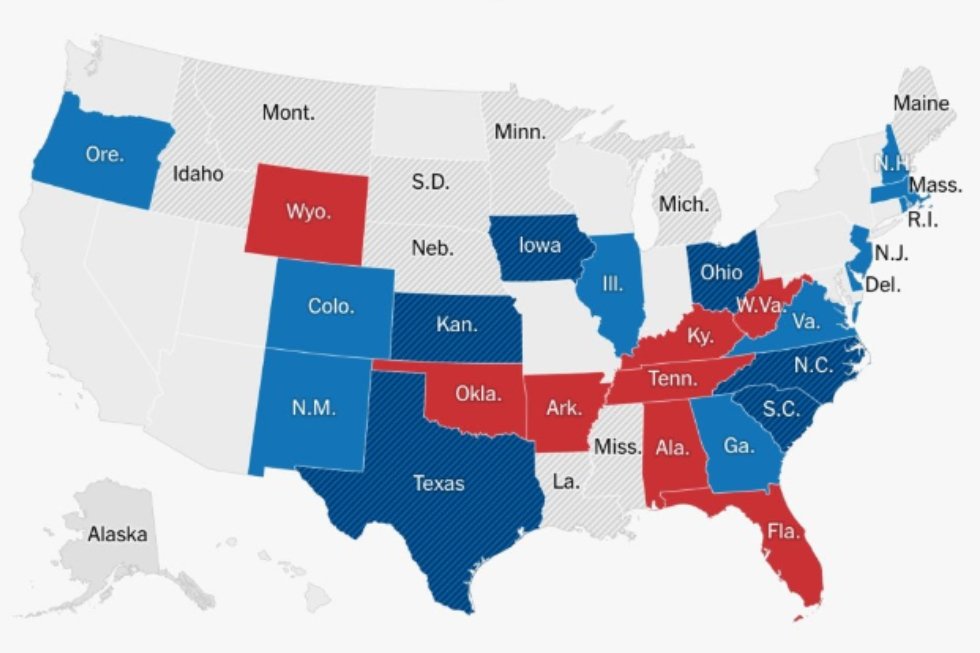



The US Democratic Party literally transformed the American political landscape overnight. With their astonishing sweep of the November 3 elections for Congress and hundreds of state and local offices, Democrats did more than rout their Republican rivals and vaporize the aura of impunity that for a decade enveloped President Donald Trump.
In a stunning reversal of political precedent, Democrats won dozens of elections in small towns and rural areas scattered across the American South and Midwest, communities where voters had turned their back on the party for decades. Democrats did this by fielding a nationwide slate of candidates who did not look or talk like any in recent memory.
Gone (or well camouflaged) were the patrician lawyers and elite Ivy League graduates. In their place was an unassuming cadre of denim-clad, just-plain-folks who launched an all-out counterattack against Trump’s culture war, ostentatiously embracing provincial, blue-collar values like religion and traditional masculinity.
For the first time in a generation, Democrats reconnected with God and guys. The result was a landslide that not only expanded the party’s geographic power base but, at least for the moment, dramatically altered its personality. Suddenly, Democrats figured out how to win back working- and middle-class voters who had seemed forever lost to Trump and the Republican Party (GOP).
Baseball caps and cowboy hats
On election night, examples of this tectonic cultural shift were on display from coast to coast. In Texas and Kansas, states that had voted overwhelmingly Republican for generations, a Presbyterian seminarian named James Talarico and a Methodist minister named Adam Hamilton were elected to the Senate. In their victory speeches, they quoted scripture, retold the parable of the Good Samaritan, and urged cheering supporters to “love thy neighbor.” For Democrats, who have long been more secular and less religious than Republicans, their embrace of pulpit oratory and Christian teachings was unprecedented.
And across the country, Democratic men who flaunted their working-class bona fides seized traditionally Republican territory. Susan Collins, a Republican veteran of 30 years in the Senate, was unseated by Troy Jackson, a state legislator and a logger. Jamie Ager, a farmer who described himself as a “mountain Democrat,” was elected to the House in rural western North Carolina. Sam Forstag, a “smoke jumper” who fights wildfires by parachuting into isolated forests, won the House race in western Montana. And in South Texas’s mostly Hispanic Rio Grande Valley, the new congressman is a Tejano musician named Bobby Pulido.
During their victory speeches, not one of the four bothered with a jacket or necktie. Jackson and Ager appeared in sweat-stained baseball caps. Pulido donned a massive white cowboy hat, much like others he has worn on stage for 30 years.
Perhaps the most telling cultural indicator was Abdul El-Sayed’s hard-fought Michigan Senate campaign, during which he spent months on the stump in jeans and a form-fitting, collarless black shirt that highlighted his muscular physique. Sayed rarely, if ever, managed to mention that he is a Rhodes Scholar who captained the Oxford lacrosse team.
“A populist moment”
In remarks to the Center for American Progress the day after the election, veteran Democratic pollster Geoff Garin called the 2026 elections “a populist moment.”
“One of the things that’s being underestimated is the importance of populism,” Garin said, adding that Democrats won because of “the ability of our candidates to connect with voters’ values and frustrations. They reflected the values of individual Americans, individual Kansans, individual Texans.”
This populist makeover helped propel Democrats to a victory that far exceeded any political polls or the party’s own most wildly optimistic aspirations. In the 100-member US Senate, Democrats needed to win four additional seats to gain a majority; they picked up at least seven and, as the final votes in a few very close races are tallied, could reach nine. Before the election, there were 215 Democrats in the 435-member House of Representatives; they increased their ranks by 20%, to around 255.
For the first time in 17 years, a majority of the governors of America’s 50 states will be Democrats. The party also racked up huge gains in communities where it has been out of power for decades. One of North Carolina’s most powerful Republicans, the Speaker of the state House of Representatives, Tim Moore, lost his bid for reelection in a district that was majority Republican and 75% white to Democrat LaKesha Womack, a Black woman who has never held public office and was outspent 20 to 1.
Rarely in living memory have similar tidal waves swept through American legislative elections. In 1994, a sharp-tongued Georgia congressman named Newt Gingrich led a “Republican Revolution” that ended 40 years of Democratic control of the House and Senate. And 20 years earlier, in the wake of President Richard Nixon’s Watergate scandal, Democrats added 49 House seats and four Senate seats to amass overwhelming majorities in both chambers, establishing the political foundation for a wave of “Watergate reforms.” The chronically overused adjective “historic” actually applies to the 2026 Democratic triumph.
The underlying political forces that set this landslide in motion are well documented and were triggered by Trump, not Democrats. The President imposed a series of policies that inflicted widespread economic pain on middle- and working-class Americans. And he generated equally widespread anger with actions that many voters considered capricious and deeply self-serving.
Two unilateral actions by Trump — his imposition of tariffs and his attack on Iran — generated economic shock waves that hit all Americans and pounded some of his most ardent supporters especially hard. For example, farmers and rural Americans have historically voted for Trump, but in 2026 they were battered by sharp spikes in the price of gasoline, diesel fuel and fertilizer. This translated into higher grocery prices for the entire country.
Trump’s harsh, nationwide crackdown on immigration also affected the economy-construction companies and farms had trouble keeping workers — but the political impact was far greater. Many Americans were shocked to discover masked Immigration and Customs Enforcement (ICE) officers in their communities, conducting mass arrests they found excessively violent and cruel. And Trump’s unprecedented pursuit of personal wealth-his investments made him more than $2 billion last year-and fixation on construction projects like the White House ballroom struck many voters as let-them-eat-cake detachment and disdain.
A message for the middle-class
By November 3, the popular backlash against Trump was evident, but it was far from clear that Democrats would be able to capitalize on it. The reason? Voters detested Democrats almost as much as they detested Trump. A Pew Research Center poll conducted in early October found that only 30% of Americans approved of the job Trump was doing, his lowest score ever. But the same poll found that just 40% of the public viewed Democrats favorably while 58% disapproved. Public anger was aimed not just at one political party but at Washington in general.
So, how did Democrats persuade voters to take a chance on them? By directly addressing class and culture blind spots that had obscured the party’s political vision for decades. Democrats nominated candidates who resonated with demographic groups that had shunned the party or moved away from it in recent elections, including “heartland” voters outside urban centers, young people, Hispanics and men.
In the 2024 presidential election, when Trump easily defeated Vice President Kamala Harris, who is Black, Democrats were shocked to find that their support declined among Black and Hispanic men compared to previous elections. This year, they made a determined effort not only to address economic issues important to those groups but to find candidates who could connect with them personally.
The effort worked. Surveys in 2024 found Trump was supported by about a third of young Black men, half of young Hispanic men and nearly two-thirds of young white men. But a Tufts University analysis of voter exit polls found that this year Democrats won almost three-quarters of young Black men, two-thirds of young Hispanic men and a majority of young White men.
Perhaps the cleverest and most memorable example of this combined appeal to economic and cultural concerns was a commercial aired by Mississippi Senate Candidate Scott Colom, who led Republican incumbent Cindy Hyde-Smith with a handful of votes left to count. In overwhelmingly Republican Mississippi, Colom was considered the longest of long shots. He now appears on track to become the first Black senator from Mississippi since 1881.
The commercial begins with a TV news interview in which Hyde-Smith is asked about the high cost of beef, and she remarks that “there are lots of proteins to choose from.” It then cuts to a series of middle-class voters, including a young white man flipping hamburgers on a charcoal grill, who respond incredulously, “Pick another protein? I’d rather pick another senator.”
During Trump’s second term, Republicans have courted young male voters by promoting a physically aggressive version of hyper-masculinity. Trump famously hosted a mixed martial arts spectacle at the White House during Independence Day celebrations and has surrounded himself with buff, middle-aged Cabinet members who publicly pump out push-ups and pull-ups. During this year’s campaign, Republicans lashed out against several high-profile male candidates like Talarico and Hamilton with attacks that directly questioned their manhood.
None worked. Other Democratic candidates who worked in physically demanding trades prior to entering politics — such as Forstag of Montana, Ager of North Carolina and Jackson of Maine — proved immune to such assaults.
It’s particularly noteworthy that Democrats were able to appeal to men and rural voters, who generally tilt moderate or conservative, without compromising their ties to more liberal, Democratic core groups like women and Blacks. The party found a way to avoid infighting and produce something that echoed its powerful, 20th-century New Deal coalition, broadening support among the white middle class while at the same time creating notable firsts for women and minority candidates.
Keisha Lance Bottoms, a former mayor of Atlanta, was elected Governor of Georgia, becoming the first Black woman ever to lead any American state. Deb Haaland, a former Cabinet official in the administration of President Joe Biden, was elected Governor of New Mexico, and will be the first Native American to hold that office. And Texas state legislator Gina Hinojosa is the first Latina to win election as Governor of Texas.
Democratic Socialists take a back seat
By contrast, one Democratic constituency that had a very successful summer was largely sidelined on November 3: Democratic Socialists. Of the 255 or so Democratic House members who will take office in January, no more than eight will be Democratic Socialists. And while about 30 newly elected Democratic moderates flipped districts that Trump carried two years ago, all the Democratic Socialists sit in safe seats that would remain Democratic in virtually any political scenario.
For the past 18 months, since Democratic Socialist Zoran Mamdani won the Democratic primary election for Mayor of New York City, a coterie of his fellow socialists has proclaimed its intention to transform the Democratic Party. Mamdani helped two other socialists win House seats in New York, and socialists were elected mayor of Washington, DC and Los Angeles.
Democratic Socialism was an issue in many fall campaigns, but only because Republicans brought it up. Trump and others repeatedly accused virtually every Democratic candidate for Congress or statewide office of being a socialist or a Communist. But the vast majority of Democrats disavowed the movement, and Republican efforts to equate Democrats with Democratic Socialism fell flat. Since the Democratic Party will hold a majority of about 40 seats in the House, the eight-member Democratic Socialist caucus appears poorly positioned to exercise significant influence.
“Conservative with my mind and a Democrat with my heart”
Instead, November 3 was a moment for new and different Democratic voices, with none less likely than that of South Texas’s Bobby Pulido, the Tejano vocalist who won a Latin Grammy Award in 2025 and currently has more than 11 million monthly listeners on Spotify. If election night was any indication, Pulido is having little trouble with the transition from musical stage to political platform.
Declaring that “I’m conservative with my mind and I’m a Democrat with my heart,” he coupled soaring rhetoric-some of it delivered in Spanish- with a commitment to old-fashioned, middle-American moderation. “I believe in balanced budgets, making a dollar stretch, living within your means and owning your mistakes,” Pulido said. “But I also believe that a country as wealthy and as powerful as ours has a moral obligation to protect the vulnerable, care for the broken, and lift up the downtrodden. I believe that compassion and fiscal responsibility belong in the same conversation. Because a government that wastes people’s money is failing them just as surely as a government that ignores their needs.”
An untypical Democratic victory speech from a different breed of Democrat. But as Pulido and at least 60 other newly elected Democrats take their seats in the House and Senate, a message likely to ring louder across Washington in the months ahead.
[Kaitlyn Diana edited this piece.]
The views expressed in this article are the author’s own and do not necessarily reflect Fair Observer’s editorial policy.
Can We Reverse Out-of-Control Campaign Spending?
Every election, wealthy elites spend record-breaking amounts of money to influence outcomes, and the 2026 US midterm election is no...
Blue Wave, Green Tide: Politics in an Age of Liquidity
Election-night headlines reach for metaphors (waves, floods, flips) that dramatize change while hiding structure. Donald Trump is a symptom, not...

Will America’s Democratic Flaws Be Its Undoing?
America faces a crisis of democratic legitimacy as structural flaws concentrate wealth and power while undermining citizens’ trust in government....
Will the Midterm Elections Restore Normalcy?
Bipartisanship is a healthy institutional measure that strengthens democratic institutions by bringing people with differing views together to pursue common...
Support Fair Observer
We rely on your support for our independence, diversity and quality.
For more than 10 years, Fair Observer has been free, fair and independent. No billionaire owns us, no advertisers control us. We are a reader-supported nonprofit. Unlike many other publications, we keep our content free for readers regardless of where they live or whether they can afford to pay. We have no paywalls and no ads.
In the post-truth era of fake news, echo chambers and filter bubbles, we publish a plurality of perspectives from around the world. Anyone can publish with us, but everyone goes through a rigorous editorial process. So, you get fact-checked, well-reasoned content instead of noise.
We publish 3,000+ voices from 90+ countries. We also conduct education and training programs
on subjects ranging from digital media and journalism to writing and critical thinking. This
doesn’t come cheap. Servers, editors, trainers and web developers cost
money.
Please consider supporting us on a regular basis as a recurring donor or a
sustaining member.
Will you support FO’s journalism?
We rely on your support for our independence, diversity and quality.




Comment