





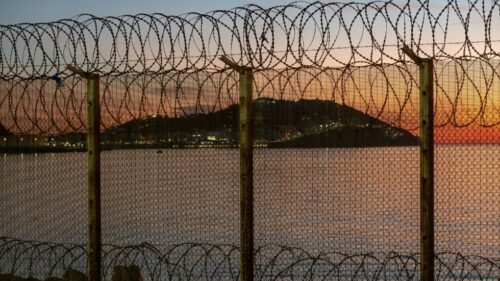
Ceuta, one of two Spanish-administered cities located on the North African coast in Moroccan territory, became the center of an unprecedented migration emergency on July 30. The pressure had already been building: About 1,500 people had reached the city by swimming from Morocco during the previous week, overwhelming reception facilities, especially those for unaccompanied minors. Then the scale changed dramatically. Spanish authorities later put the number of irregular entries on July 30 at 72,000. Morocco’s Interior Ministry, however, put the scale of the mass movement toward Ceuta at about 40,000 people, a substantially lower figure that underscores the uncertainty surrounding the headline counts.
The immediate catalyst was a legal and informational breakdown that Spain had time to see developing. On July 8, the Supreme Court ruled that the border-rejection provision used in Ceuta and Melilla could not be applied to people who reached the cities by swimming when they had not crossed a physical barrier. The ruling did not give migrants a right to remain in Spain, but misleading posts quickly recast it as a promise that anyone who reached Ceuta could not be returned. Viral videos, influencers and WhatsApp groups amplified that message, while trafficking networks exploited the confusion.
The warning signs were explicit. Reuters reviewed six written warnings from police and Civil Guard unions after the ruling. On July 10, the Unified Association of Civil Guards (AUGC) called it a “legal loophole” and demanded clear protocols. Three days later, the Unified Police Union (SUP), a trade union representing officers of Spain’s National Police, warned that criminal groups would exploit slower or more complex return procedures. A July 23 letter warned of constant sea arrivals and asked for a temporary reception center. Intelligence sources also said the National Intelligence Center (CNI) had detected WhatsApp networks mobilizing would-be migrants. Yet the floating barrier designed to close the maritime gap was installed only on August 1, after the mass crossing.
Spain’s own account made the political turn more striking. On July 30, the Interior Ministry blamed people-smuggling networks for exploiting the court ruling and described cooperation with Morocco as “exemplary,” while thanking Moroccan forces for preventing thousands of attempted crossings. European officials later identified smuggling and disinformation as central drivers and praised Rabat’s cooperation. Spanish authorities subsequently estimated that about 69,500 people had returned from Ceuta to Morocco, while Moroccan authorities put the number who had entered Ceuta at about 40,000. The figures are therefore competing official estimates rather than a settled count. What remains clear is the speed of the reversal: Madrid itself said Moroccan cooperation had helped make the returns possible.
Spain therefore mishandled the crisis twice. Operationally, it failed to convert escalating arrivals, legal warnings and intelligence into a preventive response before July 30. Strategically, influential political and security voices recast a border-management breakdown as evidence of Moroccan intent. That second failure reflects an Africanist framework rooted in Spain’s colonial experience in North Africa. The language of invasion, hybrid warfare and deterrence shifted scrutiny from Spanish preparedness toward Morocco. That reflex now leaves Spain preparing for a military-style challenge to Ceuta and Melilla while the long-term contest over the two cities increasingly shifts toward economic power, diplomacy and international legitimacy.
A threat framework was already waiting
Spain’s defense-policy literature had built that framework before July. A 2025 study published by the Center for Higher National Defense Studies (CESEDEN) examined Spanish deterrence against Morocco’s sovereignty claims over Ceuta and Melilla. It identified relative Spanish military superiority as the strongest deterrent. The study also treated migration pressure, border closures, disinformation and espionage as possible forms of hybrid action.
Other Spanish defense writing has placed Moroccan territorial claims inside the language of the gray zone and hybrid warfare. The July crisis therefore entered a policy environment in which migration, territorial pressure and Morocco were already linked. That existing vocabulary made it possible to read a migration emergency as evidence of a Moroccan strategic threat.
The framework also carries a historical inheritance. The Africanistas were Spanish officers whose careers and political worldview were forged in the colonial campaigns in Morocco. Francisco Franco rose rapidly through that military system. Northern Morocco became a proving ground for a culture that tied territory, national prestige and coercive control to military authority.
That inheritance remains visible in contemporary military scholarship. In 2025, CESEDEN published the study The Importance of the Operational Level in the Pacification Campaign of the Moroccan Protectorate. The study describes the restoration of Spanish control, the disarmament of Rif tribes and the re-establishment of colonial administration. Spain’s “pacification” also included chemical warfare during the Rif War. The modern vocabulary of deterrence and hybrid threat now operates on the same geography that produced Spain’s Africanist military culture.
From “pacification” to “invasion”
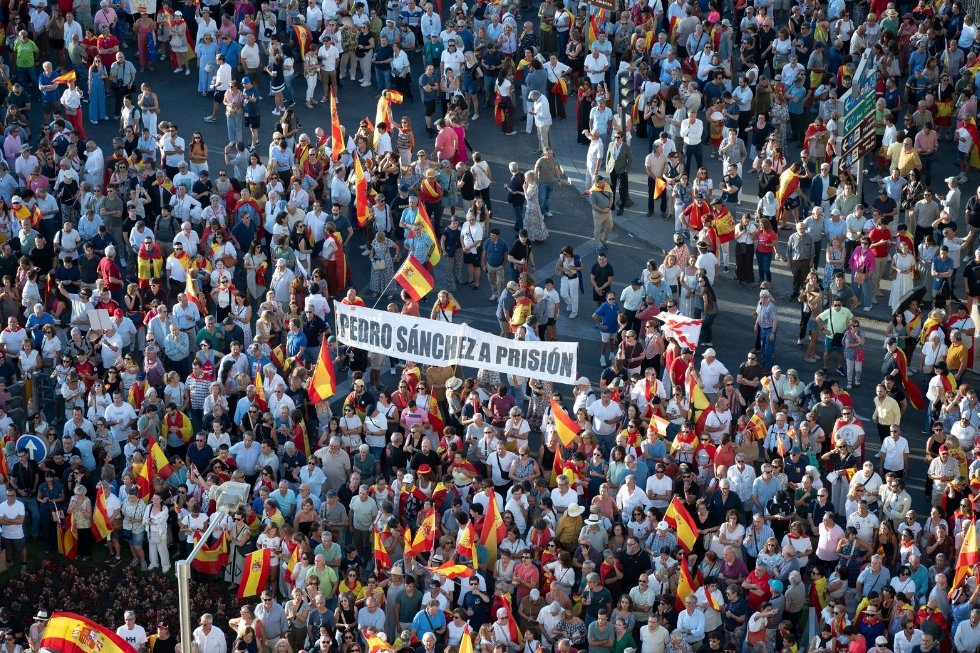
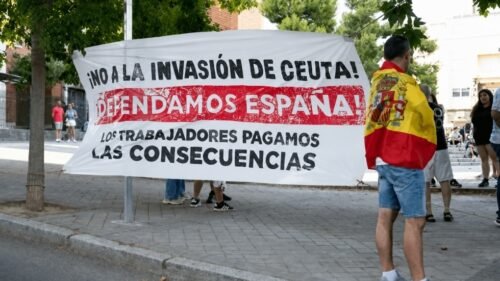
The language changed, but the frontier logic remained recognizable in 2026. Spain’s far-right Vox party called the crossings an “invasion,” circulated footage of the arrivals and blamed both the Spanish government and Morocco for the emergency. False and decontextualized videos also spread during the crisis, intensifying public alarm. That rhetoric shifted attention from preparedness and border governance toward territorial defense and Moroccan intent.
The security frame also coincided with severe violence on the ground. One video shows a Spanish police officer firing toward migrants running away along the shoreline. Other recordings show migrants displaying long parallel welts while describing whipping, torture and severe beatings. Spanish soldiers were filmed striking migrants and using excessive force during pursuits and apprehensions. Footage also shows soldiers attacking people sleeping in the street or already under control.
Morocco’s National Human Rights Council later recorded bruises, scars and difficulty walking among returnees. It also documented repeated accounts of ill-treatment by Spanish forces, problems affecting minors and inadequate protection from racist attacks. Migrants interviewed separately described hunger, exhaustion and hostility as reasons for returning from Ceuta.
A century ago, northern Morocco appeared in Spanish military thinking through conquest, rebellion and pacification. Today the vocabulary is invasion, deterrence, gray-zone pressure and hybrid threat. The terminology changed, but Morocco remains the strategic “other” through which influential Spanish security currents interpret their southern frontier.
Spain is preparing for the wrong Morocco
The same reflex also obscures the territorial history beneath the crisis. Ceuta was a Moroccan city under Marinid rule when Portugal conquered it in 1415. Castilian forces took Melilla in 1497 during Iberian expansion into Morocco. At the time, the Moroccan state was ruled from Fez by the Wattasid dynasty. Spain retained both after Moroccan independence in 1956. Rabat has since described them as occupied territories and sought their eventual transfer of sovereignty.
Spain’s strongest asset is the status quo’s persistence. Morocco’s claim draws on geography, conquest and decolonization, while Madrid treats sovereignty as non-negotiable. Gibraltar exposes the political asymmetry. Spain officially describes Gibraltar as a colony and invokes decolonization and territorial integrity in challenging British control. Madrid rejects the same political vocabulary when Morocco raises two cities acquired through Iberian conquest on the opposite shore of the same strait.
That insulation is beginning to weaken. In April, a US House Appropriations Committee report described Ceuta and Melilla as Spanish-administered cities “located in Moroccan territory.” It also supported State Department efforts to encourage diplomatic engagement on their future status. Morocco’s justice minister later said Rabat continually raises the issue with Madrid and seeks a long-term resolution through dialogue. Spain responded that sovereignty is non-negotiable.
The balance around the cities is also changing outside the military sphere. Tanger Med (an industrial port complex) has transformed northern Morocco into a major logistics hub. Nador West Med (a planned transshipment port) is designed to drive a similar economic transformation in the northeast. Together, those projects shift the regional center of gravity toward Moroccan ports, infrastructure, investment and industrial development.
This is why Spain may be preparing for the wrong contest. The strongest challenge to the status quo may come from Morocco’s growing economic weight, wider diplomatic scrutiny and the gradual erosion of the political environment sustaining Spanish control. Garrisons and deterrence doctrines cannot reverse geography, erase the history of conquest or prevent that shift.
Spain may be preparing to defend Ceuta and Melilla against a Morocco like that of the Rif War. Its greater challenge is understanding the Morocco that could ultimately recover them without a war.
[Kaitlyn Diana edited this piece.]
The views expressed in this article are the author’s own and do not necessarily reflect Fair Observer’s editorial policy.
FO Exclusive: Lightning Roundup of August 2026 Writeup
In this section of the August 2026 episode of FO Exclusive, Atul Singh and Glenn Carle examine growing challenges to...

Domestic Struggles And Chasing A Digital Mirage In Ceuta
The mass irregular crossing of nearly 72,000 migrants into Ceuta fueled criticism of Spain’s regularization program while escalating disputes over...
Ceuta Exposes Europe’s Moral Blind Spot on Migration
Europe’s response to the tragic deaths of 72 migrants attempting to reach Ceuta has fixated on border security and political...
Support Fair Observer
We rely on your support for our independence, diversity and quality.
For more than 10 years, Fair Observer has been free, fair and independent. No billionaire owns us, no advertisers control us. We are a reader-supported nonprofit. Unlike many other publications, we keep our content free for readers regardless of where they live or whether they can afford to pay. We have no paywalls and no ads.
In the post-truth era of fake news, echo chambers and filter bubbles, we publish a plurality of perspectives from around the world. Anyone can publish with us, but everyone goes through a rigorous editorial process. So, you get fact-checked, well-reasoned content instead of noise.
We publish 3,000+ voices from 90+ countries. We also conduct education and training programs
on subjects ranging from digital media and journalism to writing and critical thinking. This
doesn’t come cheap. Servers, editors, trainers and web developers cost
money.
Please consider supporting us on a regular basis as a recurring donor or a
sustaining member.
Will you support FO’s journalism?
We rely on your support for our independence, diversity and quality.





Comment