

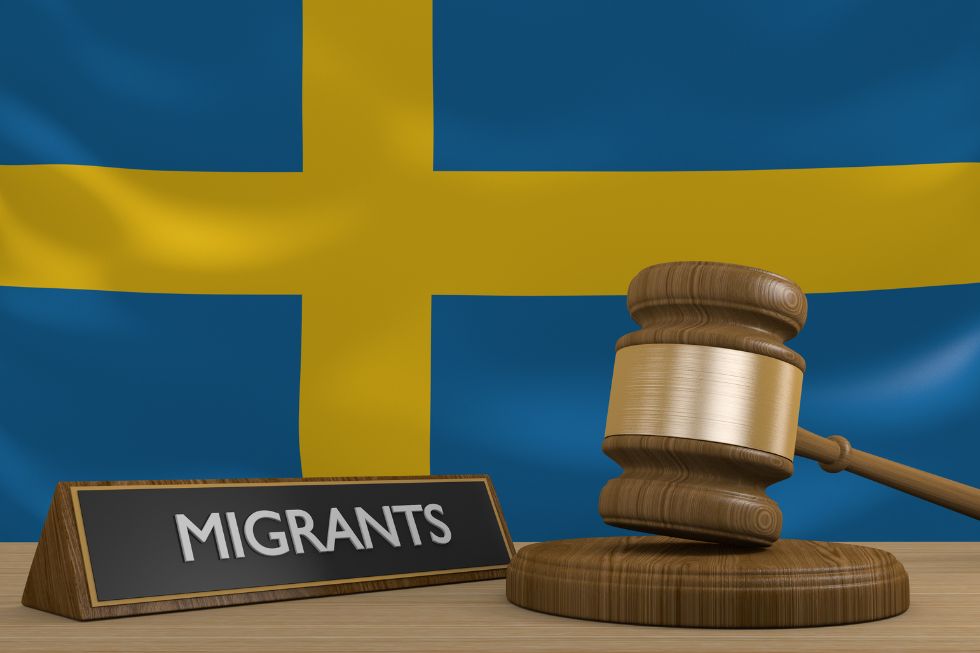



As Sweden heads toward general elections on September 13, old fears and irrationalities about national identity and religion are once again a central part of the political debate. One of the clearest examples is the recurring claim that Sweden must never become “a Muslim country.” However, such phrases say less about social reality and more about how far-right politics transform fear into a language of hate and exclusion.
Sweden is already a pluralistic society
The phrase “a Muslim country” is often misused to manipulate language and political communication. Far-right actors in Europe often misuse it to present a descriptive social fact as “a civilizational threat.” This is even the case in Sweden, which is already a plural, individualistic and multi-faith society.
Statistics Sweden’s latest population projections place the country at about 10.6 million people. While Sweden does not maintain a comprehensive official register of religion, public information identifies Muslims as the country’s largest non-Christian faith group, and Pew Research estimates that Muslims made up about 8% of Sweden’s population in 2020.
This means Muslims in Sweden are not some strange or external presence. They are citizens, residents, workers, students and voters. Many are born in Sweden, educated and active in everyday life in society.
Therefore, there is no inherent contradiction between being Muslim and being Swedish unless Swedishness itself is redefined in ethnoreligious or collectivist civic terms. If by “a Muslim country” one means a society that includes Muslim citizens and residents, then Sweden already fits that description in a limited sociological sense.
Pluralism in Sweden is not limited to formal demographics since it is reflected in the fact that the country’s institutions, public spaces and everyday social life already include people with different beliefs, customs and social experiences. In practice, this means that Swedish society is not organized around one uniform way of living, believing or identifying. Different ways of being Swedish already exist and coexist within the legal and democratic order.
This is important to understand because public debate often treats pluralism as though it were something recent, unstable or externally imposed. But Sweden has for a long time been shaped by internal social change, international movement and cultural diversification. Generations have now grown up in a country where classmates, colleagues, neighbors and fellow citizens do not all share the same background, language or religious tradition. For many people, this is not a future scenario but an everyday life social reality.
Such understandings also matter because language shapes political imagination. If Muslims are constantly described as evidence of national decline, then ordinary diversity is transformed into a negative narrative. That move is central to exclusionary and collectivist politics because it turns pluralism into a threat. A religious minority is no longer seen as part of the population, but as a sign that the nation is supposedly losing itself. Muslim populations around the world are far too diverse, politically, socially and denominationally, to be seen as part of one giant extremist community.
Islam is not Islamism
Islam is a world religion followed by over a billion people in many different ways. Therefore, a serious democratic debate must begin with a distinction that many political actors often blur by mixing Islam with Islamism. The difference is that Islamism is a political ideology that seeks to use religion as an instrument of state power and social control. When those categories are merged, criticism of extremism quickly becomes suspicion toward Muslims in general.
This is why the repeated use of Iran as proof of “what Islam leads to” by the far-right actors in Sweden is so misleading. Iran is not evidence of Islam itself. It is evidence of what happens when a state monopolizes religion, represses pluralism and denies people freedom of conscience. The Iranian regime is an example of an authoritarian system and a theocracy, not about Muslims in general.
What this rhetoric also ignores is that many of those resisting authoritarian rule in Iran are themselves Muslim in religious, cultural or social terms. Thereby, actions and deeds of such individuals are proof that Muslims are part of the struggle for freedom, dignity and rights worldwide.
It is also vital to understand that the Muslim community in Sweden is not a singular social or political actor. It is better understood as a set of communities shaped by different migration histories, national backgrounds, class positions, languages and degrees of religious observance. Muslims in Sweden include people with a history in Bosnia, Iraq, Iran, Syria, Somalia, Afghanistan, Kosovo, Turkey and other societies, as well as converts and Swedish-born individuals who have grown up in Swedish schools, neighborhoods and institutions. Some arrived as refugees fleeing war and persecution, while others came through family reunification, study, work or long-term settlement.
Muslims in Sweden also differ greatly in how they relate to religion itself. Some are highly observant and active in mosque life, while others relate to Islam mainly through family background and more moderate lifestyles. Some are Islamists and socially conservative, while others are secular-minded, socially liberal or feminist. Many Muslims are mainly concerned with ordinary matters such as education, employment, housing, family life and social mobility rather than theology or ideology.
This diversity is often ignored in Swedish public debate, where Muslims are frequently discussed less as individuals and communities than as a symbolic category linked to integration, crime, extremism or cultural conflict. They are often spoken about as if they formed one coherent bloc with one worldview and one political agenda. That is misleading. It erases the differences between recent arrivals and second-generation Swedes, between practicing believers and culturally Muslim secular individuals, and between those who are socially integrated and those facing exclusion.
The current political discourse often also ignores that many Muslims in Sweden have themselves fled Islamism, sectarian violence, authoritarian rule or religious coercion. For that reason, reducing such a broad and internally diverse population to a single civilizational or ideological threat is not only unfair but false, untrue and irrational.
The real threat is democratic exclusion
The far-right rhetoric still suggests that Muslims remain permanently outside the national “we,” no matter how integrated, loyal or socially active they may be. With far-right politics, citizenship becomes conditional rather than universal and “cultural” rather than institutional. One of the results in official liberal-democratic systems is that religious minorities are transformed into a test of whether democratic belonging is truly equal.
This matters even more in Sweden, where the far-right Sweden Democrats have become a major force in national politics and where migration, integration and national identification have moved further in the public debate. It is important to understand that Islamist extremism exists and democratic states must confront violence and radicalization seriously. But that task becomes harder when politicians blur the line between political ideology and religious identity.
The Sweden Democrats have roots in Swedish racist, extreme nationalist and far-right networks that were shaped during the 1990s. During that time, the party communicated about the need to “defend” the Swedish race and that immigration should be stopped more or less completely. For the last 20 years, the party has worked hard to normalize its public image and become more electorally acceptable, but its political rise has still depended heavily on presenting migration and Islam as an existential threat to Sweden.
Despite branding themselves as the new conservatives, the party’s main message remains that belonging to Sweden is defined by Christian religion and ethnicity, while such rhetoric is often combined today with references to national citizenship and, ironically enough, to liberal “Swedish values.”
At the same time, many Muslims in Sweden face a difficult combination of problems such as the labor market exclusion, residential segregation, negative media framing, discrimination and repeated suspicion in public debate. Muslims are often discussed less as individuals than as a social “issue” connected to integration, crime, extremism or cultural issues. This is also happening in the more European context, where the anti-Muslim sentiments and attitudes have grown in relation to terrorism, gang crime, frustrations over failed integration and demographic change. As a result, ordinary Muslims are often treated as symbolic carriers of wider societal fears even when those fears are caused by more complex social, economic and political problems and challenges.
The real danger to Sweden does not come from Muslims identifying with the country and participating in its democratic life. It comes from those who refuse to accept that Muslims are already part of Sweden and who therefore treat pluralism itself as a threat.
[Patrick Bodovitz edited this piece]
The views expressed in this article are the author’s own and do not necessarily reflect Fair Observer’s editorial policy.







Join the conversation
Share your perspective
Log in to share your thoughts and take part in the discussion.