


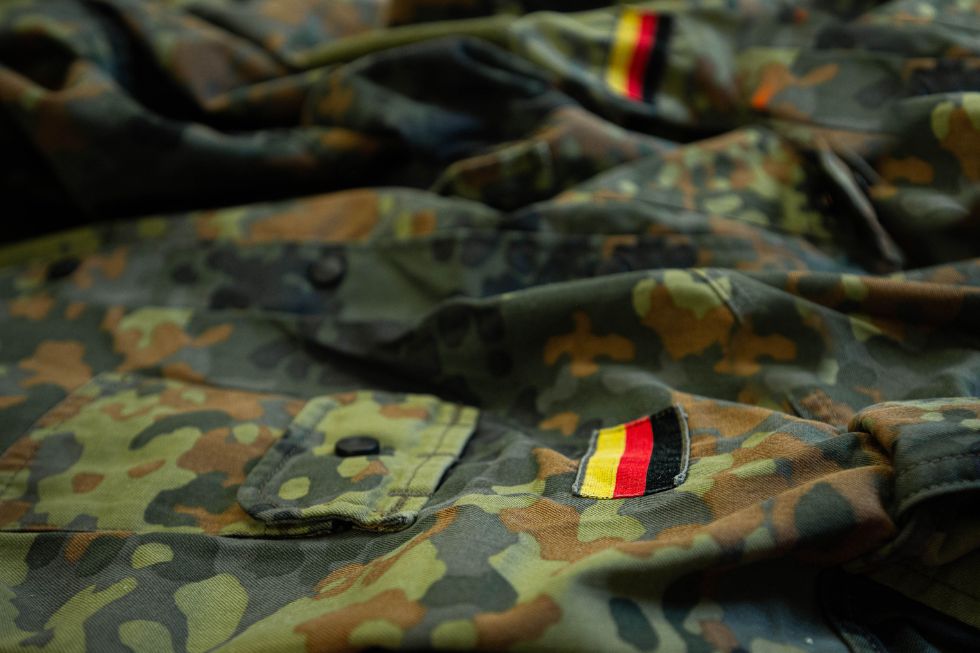



Germany is finally waking up to a harsh reality: In a world of revisionist powers and wavering alliances, a rich democracy at the heart of Europe cannot afford to be militarily weak. Since the fall of the Berlin Wall, too many Germans have lived in denial and behaved as if history had ended. Defense spending was squeezed, equipment allowed to decay, and the draft was first hollowed out and then suspended. Some units of the German army trained with toy wooden rifles. Security was outsourced to NATO and, in practice, to the US.
The Military Service Modernization Act, which entered into force on January 1, is an overdue correction. It rebuilds the state’s ability to register, examine and, if necessary, conscript young men for service in the Bundeswehr (the German armed forces). It also contains a controversial provision linking prolonged foreign travel for 17- to 45-year-old men to military registration — a rule that the government has now suspended in peacetime after public backlash.
Critics see a creep toward authoritarianism and a betrayal of post-war Germany’s pacifist consensus. But if one takes both the state’s duty seriously to protect its citizens and the lessons of European history, the logic of the new framework is compelling. Germany needs a larger, more capable army. It needs legal tools to mobilize quickly if Russia’s war spreads, if NATO fractures or if new crises emerge. And it must build this power within a robust constitutional framework that guards against abuse.
Reforming Germany’s defense: the path to a modern conscription system
A Germany that refuses to arm itself adequately is not more moral. It does not make a society of Gutmenschen (virtuous citizens), but rather of weak and vulnerable people, much more dependent on others. Besides, the 2026 reform does not restore the blanket, open-ended draft of the Cold War era. Instead, it constructs the machinery that would make a genuine conscription system work if activated.
All males born in 2008 or later will receive a mandatory questionnaire on turning 18. They must disclose basic personal data, indicate their willingness to serve and list any additional nationalities they hold. Women can participate voluntarily, but the constitutional basis for compulsory service remains gendered.
After the 2011 suspension of conscription, Germany stopped systematically collecting such data. Today, the Defense Ministry lacks precise knowledge of how many potential soldiers exist in each cohort, their health status and their skills. In a crisis, this ignorance would be crippling. Re-establishing Wehrerfassung — military registration — is a precondition for any credible defense posture.
Next will come the phased reintroduction of medical examinations (Musterung). Starting with volunteers in 2026 and expanding to all eligible 18-year-old men, the Bundeswehr will again conduct health checks to determine fitness for service. This moves Germany away from an abstract, paper-only draft and back toward a concrete understanding of who can actually carry a rifle, maintain a tank or operate a radar.
The new law further requires the creation of a needs-based conscription mechanism (Bedarfswehrpflicht). The law stops short of an immediate, general draft. Instead, it empowers parliament to activate conscription in targeted ways if voluntary recruitment falls short. The government’s stated ambition is to increase the Bundeswehr’s strength from about 184,000 active troops to between 255,000 and 270,000 by 2035. Without the option of compulsory service, this is unlikely to be achievable.
The exit-permission clause
The controversial “exit-permission” clause fits into this architecture. As amended, Section 3, Paragraph 2 of the Conscription Act nominally requires men aged 17 to 45 who are resident in Germany to obtain approval from a Bundeswehr Career Center before staying abroad for more than three months. An earlier version of the law limited such a requirement to declared emergencies. The new text extends it to peacetime.
On paper, permission is “to be granted” so long as full conscription has not been activated, and refusal must not impose “particular hardship” on the applicant. In other words, as long as military service remains voluntary, the state is not supposed to stop anyone from leaving. The provision is less about stopping travel than about maintaining an accurate conscription register: Who is where, and for how long. In a real mobilization, that information could be decisive.
The exit rule triggered outrage once it became widely known, months after the law was passed. The outrage has two main roots. The first is procedural. The provision was buried in cross-references in a long modernization bill. The Defense Ministry did not publicize or explain it, and when newspapers finally reported on it in April, Career Centers themselves lacked clear procedures. Young men technically had a legal duty to seek permission for multimonth trips abroad, but no functioning mechanism to fulfill that duty. That is bad lawmaking by any standard, and it gave critics an easy target.
The second root is Germany’s understandable obsession with civil liberties. Conditioning the right to leave one’s country on approval from a military office, even if approval is automatic, touches a nerve. Germany’s Basic Law guarantees freedom of movement and general personal liberty. Traumatic memories of state control over travel are deeply embedded in political culture, from the Nazi era to 40 years of communism in the east and the division into two Germanies during the Cold War. Opposition parties and legal scholars argued that a peacetime permission requirement could not be reconciled with these guarantees.
Under heavy criticism, Defense Minister Boris Pistorius clarified that as long as service is voluntary, there will be no practical permission procedures; an administrative directive will suspend implementation. In other words, the legal lever exists, but it is locked in a cabinet marked “break glass only in case of emergency.”
This outcome is actually a sign of a functioning constitutional democracy. Parliament legislated for worst-case scenarios; the executive scaled back the application to match current needs and rights guarantees; courts remain available as a backstop if the rule is ever used in earnest.
But it is also a reminder of the deeper tension Germany must navigate: how to arm itself seriously without sliding toward the abuses of its 20th-century past.
Assessing Germany’s military readiness
To understand why a strongly pro-armament stance is not warmongering but realism, one must begin with the Bundeswehr’s current condition.
For years, Germany spent well below NATO’s notional 2% of GDP defense benchmark. Successive governments made lofty promises about European security while quietly allowing the armed forces to shrink and age. Training hours were limited by budget constraints and ammunition stocks. Soldiers complained of a lack of basic kit, from functioning radios to winter clothing. Key weapons systems — tanks, helicopters, aircraft — were often unavailable due to maintenance problems and spare-parts shortages.
The suspension of conscription in 2011 accelerated a cultural shift. Military service ceased to be a near-universal experience for young men and became a niche career path. Many draft-age men in the late conscription years had opted out of uniformed service by choosing community work instead. When the draft disappeared altogether, so did a major channel through which the Bundeswehr connected to society at large.
Meanwhile, the technological gap widened. Modern warfare depends on integrated air defense, cybersecurity, drones, electronic warfare and robust logistics. Germany’s procurement system proved sluggish and risk-averse. By the time Berlin announced its Zeitenwende (“turning point”) in 2022 after Russia’s full-scale invasion of Ukraine, the gap between rhetoric and reality was enormous.
It is against this backdrop that the new law’s personnel focus must be judged. Without enough trained people, no amount of money for hardware will suffice. And without a functioning registration and mobilization system, Germany would be dangerously slow to respond to a sudden deterioration in its security environment.
The case for a stronger, larger German military is not abstract.
Germany’s role in European defense
Russia’s war against Ukraine demonstrates that large-scale mechanized warfare in Europe is not a relic of the 20th century. A revanchist Kremlin has shown itself willing to erase borders by force. So far, the front line has remained east of NATO territory, but there is no law of nature that guarantees it will stay there.
At the same time, the political foundations of NATO’s deterrent power have been shaken. US President Donald Trump repeatedly questioned America’s willingness to defend allies he deemed delinquent on defense spending. His rhetoric, including remarks suggesting Russia should be free to “do whatever” it wants to undermine allies, made explicit what European strategists had long feared: US security guarantees may not always be sacrosanct.
Even if future US administrations reaffirm their commitment, the message has landed in Berlin: Europe must prepare for a world in which the American shield is thinner, more conditional or, in the worst case, withdrawn.
In such a world, German weakness is dangerous. A militarily feeble Germany cannot anchor European defense. It cannot credibly deter aggression on NATO’s eastern flank. It cannot support vulnerable partners. Nor can it shape the security architecture that might emerge if NATO were to weaken or fragment.
The choice is not between armament and peace, but between responsible, democratic armament and the illusion that others will always fight Germany’s battles for it.
A strongly pro-armament stance in today’s Germany does not mean embracing militarism. It means accepting that the use or credible threat of force is sometimes necessary to defend a liberal order and building the capabilities to exercise that force under strict civilian, constitutional control. In this light, the Military Service Modernization Act is a step in the right direction. It treats defense as a national responsibility, not an afterthought. It restores tools, registration, medical examination and conscription triggers that every serious state with a conscription tradition maintains. It signals to allies and adversaries alike that Germany is no longer content to be a security free-rider.
Ensuring a responsible and transparent approach to military service in Germany
To make this project compatible with Germany’s history and civil-liberty commitments, some guardrails are crucial, beginning with transparency and parliamentary oversight. Any move from registration and voluntary service to actual compulsory service should require explicit parliamentary authorization and be accompanied by open debate. Hidden clauses and poorly communicated rules, such as the initial handling of the exit-permission provision, undermine trust and feed fears of a slippery slope.
A strong constitutional review will also be necessary. The Federal Constitutional Court should, if asked, scrutinize measures that condition core freedoms, such as movement, on military needs. A clear doctrine distinguishing necessary and proportionate wartime measures from disproportionate peacetime restrictions would help legitimize the system. Germany’s post-war success rests partly on the willingness of courts to place limits on state power; that must continue.
A set of meaningful alternatives but narrowly tailored protections for those who refuse to fight because of conscientious objections should also be included. A modern conscription system need not be purely military. Civilian service in critical infrastructure, disaster relief or social care can complement uniformed duty. Robust procedures for conscientious objection should remain in place. The key is not to force everyone into combat roles, but to make clear that citizenship in a vulnerable democracy entails obligations as well as rights. Within those guardrails, however, Germany should embrace a straightforward truth: Rebuilding the Bundeswehr is not just acceptable; it is necessary.
Germany’s shift towards military readiness and strategic responsibility
For too long, Berlin profited from a strategic environment shaped by others. It enjoyed cheap Russian gas, benefited from Chinese demand and was sheltered under American security guarantees. That era is ending. Like bankruptcy, it came gradually and now all at once. Germany now faces a world in which authoritarian powers are more assertive, alliances more contingent and the costs of military unpreparedness potentially catastrophic.
In that world, the new conscription framework is less a radical departure than a long-overdue normalization. It is what serious countries do when they acknowledge that they may, at some point, have to defend themselves and their neighbors without relying on someone else’s sons and daughters.
Yes, parts of the law were drafted clumsily. Yes, the travel-permission clause in its original peacetime form overreached, and the government was right to scale it back. But to use that misstep as a reason to reject the broader project would be to confuse procedural flaws with strategic necessity.
Europe needs a militarily capable Germany, not to dominate, but to stabilize. Germans who, with good reason, invoke history to argue for restraint should also remember a different lesson from their past: that power vacuums can be as dangerous as power excesses. A Germany that cannot defend itself invites either domination or dangerous dependence.
Arming responsibly, building a credible conscription-based mobilization system and embedding it all within the rule of law is not a betrayal of post-war Germany’s values. It is their logical extension into a more dangerous century. British Prime Minister Winston Churchill once quipped that the Germans are either at your throat or at your feet. That verdict was obviously too harsh. But a grain of truth resides in the witticism that Germans have shown themselves to be either too militaristic or too pacifist. It is high time for some common-sense middle ground.
[Kaitlyn Diana edited this piece.]
The views expressed in this article are the author’s own and do not necessarily reflect Fair Observer’s editorial policy.
Germany’s Conscription Misstep Exposes a Deeper European Problem
On January 1, Germany implemented a law requiring men aged 17 to 45 to obtain approval before staying abroad for...
Trump and German Rearmament: Sowing the Seeds of Upheaval in Europe
After eight decades of continuous peace in Western Europe, US President Donald Trump is actively sowing the seeds of upheaval....

Imagine There’s No NATO: Germany as a New Middle-Sized Military Power in an Anarchic International Order
The fracturing of the Atlantic alliance under US President Donald Trump’s erratic leadership forces Germany to reconsider its security strategy...

The Dialectic: Can Germany Outgrow Its Postwar American Model?
In this episode of The Dialectic, Atul Singh and Glenn Carle explore how Germany faces acute economic, political and social...

Support Fair Observer
We rely on your support for our independence, diversity and quality.
For more than 10 years, Fair Observer has been free, fair and independent. No billionaire owns us, no advertisers control us. We are a reader-supported nonprofit. Unlike many other publications, we keep our content free for readers regardless of where they live or whether they can afford to pay. We have no paywalls and no ads.
In the post-truth era of fake news, echo chambers and filter bubbles, we publish a plurality of perspectives from around the world. Anyone can publish with us, but everyone goes through a rigorous editorial process. So, you get fact-checked, well-reasoned content instead of noise.
We publish 3,000+ voices from 90+ countries. We also conduct education and training programs
on subjects ranging from digital media and journalism to writing and critical thinking. This
doesn’t come cheap. Servers, editors, trainers and web developers cost
money.
Please consider supporting us on a regular basis as a recurring donor or a
sustaining member.
Will you support FO’s journalism?
We rely on your support for our independence, diversity and quality.





Comment