






Europe’s rearmament plans just gained new urgency following US President Donald Trump’s decision not to deploy its 2nd Multi-Domain Task Force (2MDTF) to Germany in 2026. Announced in July 2024 by the Biden administration, this commitment to Europe most notably included the deployment of ground-launched long-range weapons to “demonstrate the United States’ commitment to NATO and its contributions to European integrated deterrence.”
While media headlines focus on the 5,000 soldiers Trump also announced would be withdrawn from German soil, experts agree the real concern is that Europe was counting on the deterrence guarantee of long-range weapons aimed at Russia and Kaliningrad. Defense specialist Christian Mölling said of the decision, “The first we can compensate for — but on long-range strikes we have a capability gap.”
Biden’s decision was meant as a “stopgap measure” for Europe, but as Rafael Loss from the European Council on Foreign Relations observed,
Europeans have known for some time that, without US capabilities, they would be outnumbered and out-ranged by Russia’s long-range strike assets, calling into question their ability to deter Russian aggression. While Russia further expands its missile production, European programs stagnate and purchases from the US face mounting delays.
The European defense industry is developing deep precision strike (DPS) missiles, but has not received orders or investments significant enough to accelerate timelines. Andrius Kubilius, European Commissioner for Defense, said, “What still needs to be done is for our industries to ramp up and produce more, and to do so more quickly.”
This might, and must, change now that America has shown its true colors. German Chancellor Friedrich Merz explained, “As I see it at the moment, there is objectively hardly any possibility from the US side to provide such weapons systems” and that “The Americans themselves don’t have enough at the moment.”
End of American reliance?
Merz has been blamed for Trump’s decision as the announcement followed his comment that “An entire nation is being humiliated by the Iranian leadership.” This was uncharacteristically undiplomatic, but he is exasperated as the consequences of Trump’s war ruin Germany’s economy (and everyone else’s) and put European security at risk as air defense systems needed in Ukraine are diverted to the Middle East.
Trump has been talking about removing troops from Europe for a year now and has made it clear America’s priorities lie elsewhere. As foreign affairs correspondent Jörg Lau argues, “One thing has become even clearer from Trump’s angry retribution: dependence on a US administration that punishes its allies while accommodating Europe’s enemies is untenable.”
The same goes for dependence on procuring American weapons systems, as Washington will give priority to refilling its own diminishing stockpiles. The Netherlands and Germany plan to equip their navies with Tomahawks, but given America used around 1,000 sea-launched Tomahawks against Iran, delivery times will likely be pushed until the mid-2030s. Last July, Germany also sent a letter of request to purchase Typhon launchers and ground-launched Tomahawk missiles, but still no answer.
Catching up
Part of Europe’s capability gap problem is that, until recently, defensive measures have been prioritized. This includes European Union (EU) plans to build a “drone wall” with an initial estimated cost of €1 billion (Poland budgeted €2 billion for its own “drone wall”) and the multinational European Sky Shield Initiative (ESSI), launched in 2022 and led by Germany, to pool European resources for integrated air and missile defense.
Experts have since weighed in about the futility of focusing solely on protecting Europe’s skies (an impossible feat), with Ann Marie Dailey, policy researcher at RAND, arguing, “But instead of focusing on defending against drones from the east, Europe should invest in its ability to strike back at Russia and take steps to demonstrate a willingness to use these capabilities.”
Countries are listening to this advice. Defense budgets have increased – particularly for military procurement. Germany’s 2026 defense budget (€108 billion) increased by €20.2 billion from 2025; military procurement alone rose €16.8 billion. The UK’s 2025–26 defense budget only increased by £2 billion from the previous period, but the government announced a 2026 allocation of £400 million for long-range weaponry.
France, while facing significant debt, plans to raise its military budget to €63.3 billion for 2027 and has earmarked €8.5 billion for missiles and drones through 2030. Its military planning law draft states “this effort is reflected in an increase in orders and deliveries and in the adaptation of industrial infrastructure through co-financing of priority production capacities.”
Indeed, in April, manufacturer Matra BAe Dynamics Aérospatiale (MBDA) announced it would resume production of the Missile de Croisière Naval (MdCN) following demand from the French Navy and other potential interest. MdCN, a Tomahawk-like, sea-launched cruise missile (1,400 kilometers range) from MBDA, is the continent’s only combat-proven long-range capability.
Following Trump’s decision, an initiative called European Long Range Strike Approach (ELSA) has gained attention. In 2024, Germany, France, Italy, Poland, Sweden and the United Kingdom joined forces with the original ambition to develop a sovereign European ground-launched missile with a range of 1000 kilometers.
After two years, no projects have been advanced collectively aside from a letter of intent signed by members in February to advance on long-range one-way effectors (drones). But mature programs for this already exist and, as defense journalist Thomas Newdick argued, “Bearing in mind the nature of the Russian threat, long-range one-way attack drones will not provide the full solution.”
As a potential ELSA project, the UK and Germany announced plans a year ago to develop a 2,000-kilometer missile, but it is still at the conceptual stage and production wouldn’t happen until at least the mid-2030s. This could also take resources away from other more mature programs, including the UK/France/Italy STRATUS program by MBDA, which just entered the development phase. MBDA is also close to testing (expected around 2027) the Land Cruise Missile (LCM), a ground-launched version of its MdCN.
These are just a few examples and efforts to catch up, even before Trump’s recent decision, have led to a wide range of scattered and sometimes competing initiatives, meaning resources are spread thin.
Missile technology expert Fabian Hoffmann says most are stuck in the conceptual phase, and countries including Germany have not even contracted bridging solutions. In a potential conflict, Europe will need thousands of missiles, far more than what the 2nd Multidomain Task Force (2MDTF) would have provided, so choices have to be made.
Put pride aside and cooperate
For Hoffmann, to fill this capability gap quickly, the only “feasible near-term solution is to convert existing longer-term development projects into crash programs for rapid procurement.” He believes the most viable candidate for such a program would be the LCM given its similarity to Tomahawk and its advanced development stage.
For this to happen, he says interested countries will have to “set aside disagreements over where development and production are localized and direct funding to whichever national players can deliver results most quickly, in this case, French industry.”
Or there is another alternative. France had apparently offered industrial cooperation to Poland for the LCM “on all supporting equipment for the LCM, Land-Attack Cruise Missile (LACM), excluding the missile itself which will be supplied from France.”
Given French financial and industrial constraints, the government should consider expanding such cooperation offers, enabling France to emerge as a leader in helping Europe fill the long-range, ground-launched capability hole Trump is leaving. Whatever leaders manage to agree to, what is certain is that strengthening the European pillar of NATO will require coordination, cooperation and political will.
[Zahra Zaman edited this piece.]
The views expressed in this article are the author’s own and do not necessarily reflect Fair Observer’s editorial policy.
Trump’s Syria Meeting Matters More than NATO Spending Debates
During the recent NATO summit, US President Donald Trump met with Syrian interim president Ahmed al-Sharaa. This meeting not only...

Europe’s Alliance Trap: Autonomy Ambitions and NATO Dependence
The war in Iran has emerged as a major challenge for the decades-old transatlantic alliance with European allies resisting Donald...

FO Talks: Why Are Europe and Canada Pivoting Away From the US?
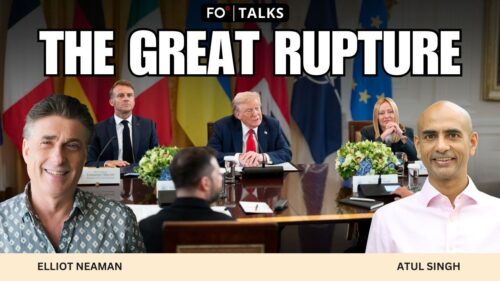
In this episode of FO Talks, Atul Singh and Elliot Neaman examine the growing rupture between the United States and...
Support Fair Observer
We rely on your support for our independence, diversity and quality.
For more than 10 years, Fair Observer has been free, fair and independent. No billionaire owns us, no advertisers control us. We are a reader-supported nonprofit. Unlike many other publications, we keep our content free for readers regardless of where they live or whether they can afford to pay. We have no paywalls and no ads.
In the post-truth era of fake news, echo chambers and filter bubbles, we publish a plurality of perspectives from around the world. Anyone can publish with us, but everyone goes through a rigorous editorial process. So, you get fact-checked, well-reasoned content instead of noise.
We publish 3,000+ voices from 90+ countries. We also conduct education and training programs
on subjects ranging from digital media and journalism to writing and critical thinking. This
doesn’t come cheap. Servers, editors, trainers and web developers cost
money.
Please consider supporting us on a regular basis as a recurring donor or a
sustaining member.
Will you support FO’s journalism?
We rely on your support for our independence, diversity and quality.





Comment