


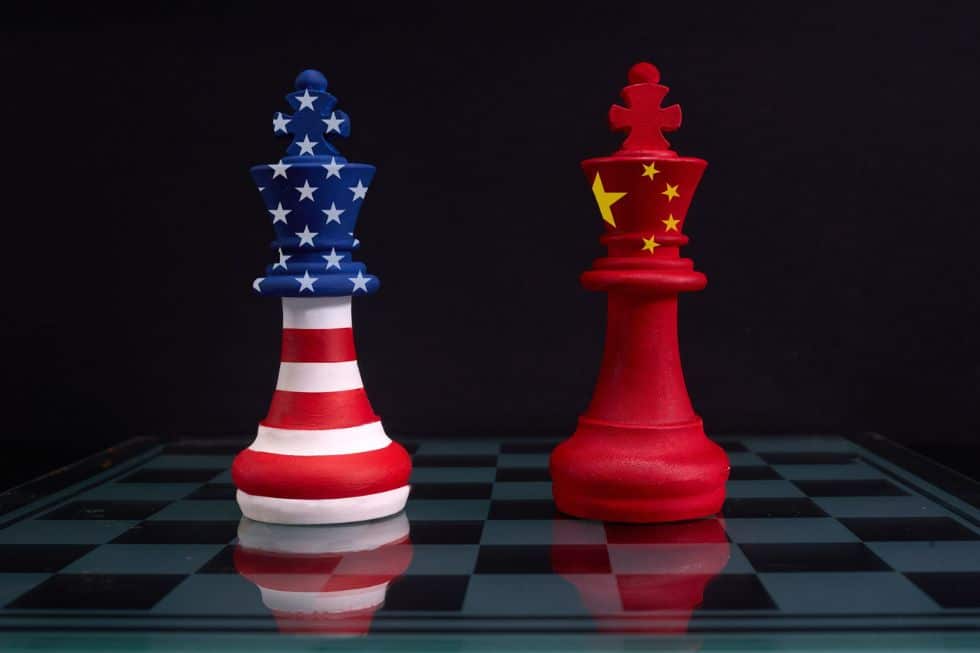



Since the so-called “pivot to Asia” during the Obama era — and with varying approaches — the policy of containing China has been the United States’ formula for addressing China’s remarkable rise and its regional expansionist footprint.
This approach follows the cardinal lines of the containment policy Washington pursued between 1947 and 1991 regarding the Soviet Union. Actually, Australian scholar Hugh White referred to it as “America’s most ambitious strategic doctrine since Truman committed America to contain the Soviet Union”.
Kennan and the policy of containment
George Kennan was the main architect of this policy towards the Soviets. Its foundations were established in the famous “long telegram” that, as American Chargé d’Affaires in Moscow, he sent to the State Department in 1946. In it, he stated that the Soviet Union “must be contained by the systematic and vigilant application of a set of counterforce measures”.
In other words, Soviet expansionist impulses had to be confronted wherever they manifested. Furthermore, this involved attempting to drain Moscow’s economic resources by imposing costs on each of its geostrategic moves.
Given the success of this policy, which ultimately led to the demise of the Soviet Union, Washington has prioritized its application towards current China as well. However, the differences in both cases are overwhelming. Beyond China’s economic strength, which the Soviets never possessed, Washington seeks to contain Beijing’s hegemonic expansion in its own backyard. This latter point is particularly noteworthy and warrants further explanation.
Respecting geostrategically sensitive areas
A few years after the end of World War II, the then-leader of the Soviet Union, Josef Stalin, realized that further European territorial gains beyond the Iron Curtain were no longer possible without directly antagonizing the United States. As a result, the Soviet expansionist drive shifted to what was then beginning to be called the Third World.
At the same time, Washington understood that any attempt to interfere with events behind the Iron Curtain could lead to a direct confrontation with Moscow. Both sides, therefore, agreed to respect each other’s geostrategically sensitive areas.
Thus, while the Soviets did not attempt to expand into Western Europe — a primary strategic area for the United States — Washington did not intervene on the various occasions when Soviet dominance was tested within its own bloc.
The latter included the brutal repression of anticommunist demonstrations in East Germany in 1953; the Warsaw Pact troops’ invasion of Hungary in 1953, after it had attempted to rebel against Moscow; the construction of the Berlin Wall in 1961, to confine the inhabitants of East Berlin within communist borders; and the invasion of a volatile Czechoslovakia, again by Warsaw Pact forces, in 1968.
Similarly, the United States remained unreactive when, through the so-called Brezhnev Doctrine of 1968, the Soviet Union made clear that it would invade any country within its own sphere of influence that attempted to break free from its communist regimes.
The only instance in which a geostrategically sensitive space on the other side was not respected occurred in Cuba in 1962. Indeed, the Soviets attempted to place nuclear missiles in the Western Hemisphere, at just 90 miles from US territory.
It is worth adding that never before or since has the world been so close to nuclear Armageddon as during the 13 days in which the two superpowers were locked in a clash of wills. Except for this occasion, confrontations between the superpowers always took place in what both considered peripheral regions.
The big difference
The contrast between US containment of the late Soviet Union and US containment of today’s China is striking. In the current case, Washington seeks to curb Beijing’s expansionist drive not only in relation to Taiwan — a territory it claims as its own — but also in an area that for millennia was tributary to China.
What is at stake for China is not only the so-called “Great Unification of its territory”, but the restoration of its past grandeur through what Xi Jinping has called the “Chinese Dream of National Rejuvenation”. Nothing could be more strategically sensitive for a country than this.
Conversely, China would like to rid itself of the inconvenient American presence in its part of the world. Its vision of hegemonic spheres translates into China controlling the Eastern Pacific Ocean, with the exclusion of alien powers. For the US, thus, containing China becomes a highly complicated endeavor.
Indeed, containing a force means confining it within certain boundaries to prevent its expansion, and what China wants is precisely to prevent outside penetration into its self-defined boundaries. How to contain someone who is in the process of containing you?
A particularly poorly prepared US
Moreover, the United States is particularly unprepared to confront China’s push-out pressure, even if it were ready to use force for that purpose. The US Air Force and Navy ceased working as a team after the end of the Cold War. On top of this, both forces decided to prioritize short-range missions over long-range ones.
The Air Force shifted its emphasis from long-range strategic bombers to short-range tactical fighters, dramatically reducing the former as a percentage of its overall force. The Navy, on its side, pulled off, all together, from long-range strike missions.
America’s campaigns in both Kuwait and Kosovo, which depended on aircraft flying short distances from their airfields or aircraft carriers, helped craft this policy. The emphasis, thus, is on short-range, high sortie rates and precision strikes. This implies that while the Chinese have developed an intermediate-range area denial strategy, the US forces need to approach their targets in order to be effective.
Additionally, America’s F-22 and F-35A are by design short-range fighters. Fifth-generation stealth strike aircraft, on the other hand, do not have sufficient range to reach their targets without support from “big wing” oil tankers, and are implicitly vulnerable to attack by a foe.
The proposition of containing China within its own sphere of influence becomes, as a result, highly complex. This bears no correlation to the successful containment of the Soviet Union. In the latter case, the US was trying to prevent the Soviet expansion in peripheral areas of the world. In this one, it seeks to contain China in its own neighborhood, where it gathers the bulk of its military forces in pursuit of an area-denial/anti-access strategy.
[Kaitlyn Diana edited this piece.]
The views expressed in this article are the author’s own and do not necessarily reflect Fair Observer’s editorial policy.
Is US Foreign Policy a Prisoner of History?
The United States clings to the pride of its 20th-century power and sees the present through the lens of its...

Why Donald Trump’s Obsession with Greenland Is All About China
US President Donald Trump has shown a strong interest in acquiring Greenland. Why? He wants to stop China from getting...
Goodbye to American Century: China and India Now Rising
The 21st century could potentially be the century of the G-3—China, India, and the US—and whether that means new cold...

Support Fair Observer
We rely on your support for our independence, diversity and quality.
For more than 10 years, Fair Observer has been free, fair and independent. No billionaire owns us, no advertisers control us. We are a reader-supported nonprofit. Unlike many other publications, we keep our content free for readers regardless of where they live or whether they can afford to pay. We have no paywalls and no ads.
In the post-truth era of fake news, echo chambers and filter bubbles, we publish a plurality of perspectives from around the world. Anyone can publish with us, but everyone goes through a rigorous editorial process. So, you get fact-checked, well-reasoned content instead of noise.
We publish 3,000+ voices from 90+ countries. We also conduct education and training programs
on subjects ranging from digital media and journalism to writing and critical thinking. This
doesn’t come cheap. Servers, editors, trainers and web developers cost
money.
Please consider supporting us on a regular basis as a recurring donor or a
sustaining member.
Will you support FO’s journalism?
We rely on your support for our independence, diversity and quality.





Comment