


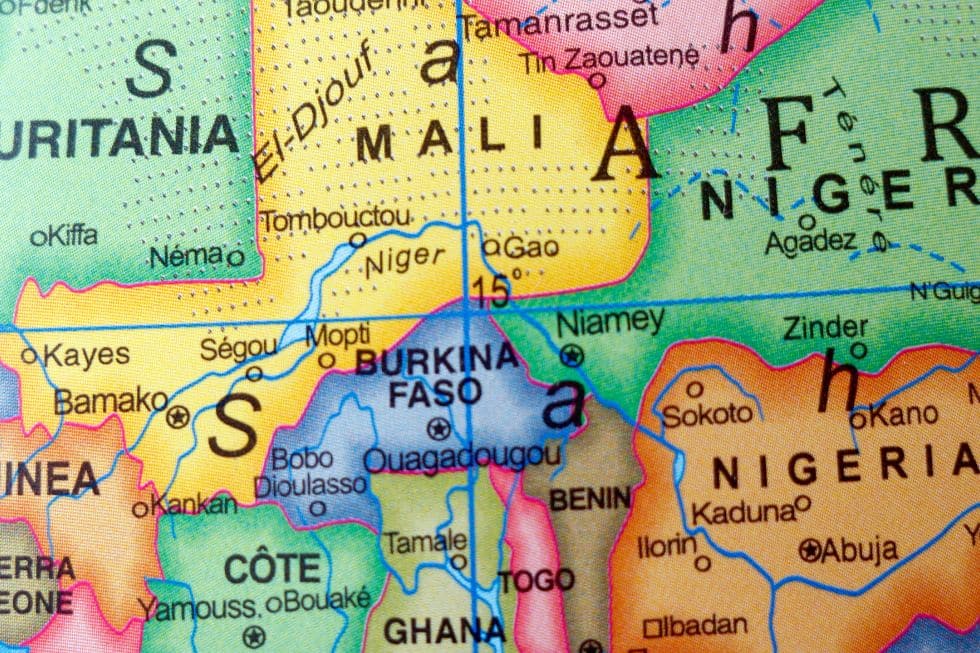



A new Unified Force of the Alliance of Sahel States (FUAES), comprising 6,000 troops, was established in early March 2026. The FUAES aims to strengthen the military capacities of Burkina Faso, Mali and Niger against terrorism and to reinforce cross-border operational coordination. Yet this force remained inoperative when Mali suffered a jihadist attack in late April.
General Assimi Goïta, president of the Malian transition, made his first appearance only on the fourth day after attacks in four regions of his country had subsided. First, he appeared alongside the Ambassador of the Russian Federation to the Malian capital of Bamako, accompanied by the Malian Prime Minister Abdoulaye Maïga and four Russian generals. Igor Gromyko, the Russian ambassador, came to the Kati palace to reaffirm “Russia’s commitment alongside Mali in the fight against international terrorism.” The president then visited Bamako’s main hospital to see the soldiers wounded during the attacks. He ended his day consoling the mother of his late Minister of Defense, Sadio Camara.
Mali’s losses and Burkina Faso’s celebration
On Saturday, April 25, the Group for Support of Islam and Muslims (Jama’at Nusrat al-Islam wal-Muslimin, or JNIM) and the National Liberation Front of Azawad jointly attacked Mali in four regions: eastern Gao; northeastern Kidal; central Sevaré; and southwestern Kati, the heart of national power. The severe assault on Kati killed Minister of Defense Sadio Camara, along with his wife and two young grandchildren.
Camara, considered the junta’s second-in-command, was a coauthor of the 2020 coup that brought Goïta’s military junta to power. With his death, Bamako’s military leadership loses the principal architect of the country’s military strategy against armed groups. He was the common thread of the Unified Force of the Alliance of Sahel States.
These armed groups, made up of rebels from the National Liberation Front of Azawad allied with the JNIM, also reached an agreement with the Russian mercenaries of Africa Corps, who agreed to leave the town of Kidal “safely.” Kidal thus becomes the symbolic stronghold of Islamist groups that are fighting the junta in power in Bamako.
Yet on the same day as the Mali attacks, neighboring Burkina Faso — the current chair of the Alliance of Sahel States (AES), formed with Niger and Mali — launched its cultural festival in grand style. This National Week of Culture began in the burkinabè city of Bobo-Dioulasso, located 545 kilometers (338 miles) from Bamako. The ceremony counted Maïga and Nigerien Prime Minister Ali Lamine Zeine as guests of honor.
Since then, a silence has settled in the palaces of power of the allied countries. The following day, in a brief statement broadcast by state television, Mali tacitly acknowledged human and material losses suffered by its army.
Mourning not shared
At the time of writing, two days have passed since the attacks. The Malian government declared two days of national mourning. On the first day, Maïga left Burkina Faso to return to his country. Burkinabè Prime Minister Jean Emmanuel Ouédraogo and around ten Burkinabè ministers and heads of institutions accompanied him to the Bobo-Dioulasso airport.
Yet in West Africa, custom dictates that “when mourning strikes a brother visiting your country, you accompany him home to share the mourning with him and his family.” These African values, promoted by Burkina Faso’s military authorities as part of a progressive and popular revolution, remained “dead letters.” Maïga boarded his plane to Bamako alone while the AES allies returned to their own cultural festival.
This demonstrates an unfortunate truth about the AES: The alliance asserts common objectives and interests with strong rhetoric, but postpones with forceful clarity the agendas for acting together.
[Lee Thompson-Kolar edited this piece.]
The views expressed in this article are the author’s own and do not necessarily reflect Fair Observer’s editorial policy.
The US Needs to Face the Rising Threat of Jihad in the Sahel Region
In 2024, the Sahel region accounted for 51% of the world’s terror-related deaths. Jihadist groups like Al-Qaeda and ISIS are...
Violence in the Sahel: Africa’s Never-Ending Crisis
For the past decade, Africa’s Sahel region has faced rising military and jihadist violence, despite promises of action by Mali,...
The New Junta in Niger Tells the United States to Pack Up Its War and Go Home
Following a coup by US-trained military officers, Niger has now become the latest West African nation to send US counterterrorism...

Why Africans Fight for Survival as Coups Pummel the Continent
Africa has had over 100 coups in the last 50 years. Old ethnic conflicts and postcolonial hangovers make African governments...


Support Fair Observer
We rely on your support for our independence, diversity and quality.
For more than 10 years, Fair Observer has been free, fair and independent. No billionaire owns us, no advertisers control us. We are a reader-supported nonprofit. Unlike many other publications, we keep our content free for readers regardless of where they live or whether they can afford to pay. We have no paywalls and no ads.
In the post-truth era of fake news, echo chambers and filter bubbles, we publish a plurality of perspectives from around the world. Anyone can publish with us, but everyone goes through a rigorous editorial process. So, you get fact-checked, well-reasoned content instead of noise.
We publish 3,000+ voices from 90+ countries. We also conduct education and training programs
on subjects ranging from digital media and journalism to writing and critical thinking. This
doesn’t come cheap. Servers, editors, trainers and web developers cost
money.
Please consider supporting us on a regular basis as a recurring donor or a
sustaining member.
Will you support FO’s journalism?
We rely on your support for our independence, diversity and quality.





Comment