


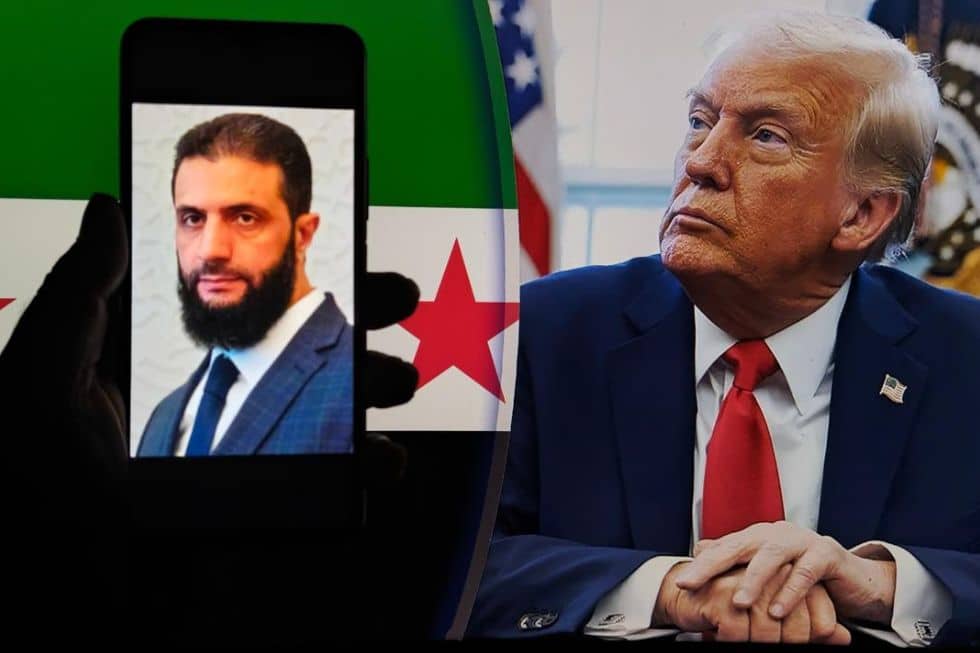



On September 22, 2025, Syrian President Ahmed al-Sharaa, a man once hunted by the United States and its allies, walked onto the stage of the Concordia Annual Summit in New York City. Waiting to interview him was retired US General David Petraeus, the same commander once tasked with pursuing him as the head of the Al Qaeda-affiliated Nusra Front during the height of the Iraq and Syria Jihadi insurgency. Petraeus, once CIA director, praised al-Sharaa’s vision and barely concealed the surreal nature of the moment.
Only weeks later, al-Sharaa sat in the White House with President Donald Trump, who suspended sanctions on Syria for 180 days and hailed him as a major advocate for peace. What was unimaginable a few years ago is now official US policy.
This rebranding of al-Sharaa is a dangerous gamble. He didn’t stumble into power through democratic reform or national consensus. He built his position through the Nusra Front, which later became the Hayat Tahrir al Sham (HTS). According to the United Nations and Human Rights Watch, this group engaged in suicide bombing, massacres, torture, unlawful killings, war crimes and coercive rule during the Syrian Civil War. West Point’s Combating Terrorism Center has shown that HTS’s rebranding didn’t change either its core jihadist ideology or methods.
Washington once placed a $10 million bounty on al-Sharaa and put him on the terrorist list. Today, these designations have been removed and replaced by handshakes and photo ops with jihadists in suits.
Al-Sharaa’s impact on Syria’s diverse communities
Trump’s description of al-Sharaa as a stabilizing partner sends a troubling message to the communities that suffered most under jihadist and authoritarian violence. Syria’s Kurds, Druze and Alawites see an unelected leader with a hardline past consolidating power in Damascus with Western blessing as a dangerous threat to building a decentralized and democratic Syria that enshrines in its constitution and institutions guaranteed rights and freedoms for all.
They understand the danger a man like al-Sharaa poses because they have not only lived through the reign of leaders with similar ideological and authoritarian tendencies but have also paid many lives responding to such forces of intolerance and repression, as in the case of the Al-Assad Dynasty and the Islamic State of Iraq and Syria (ISIS). The signals of alarm sent by the Kurds and Druze about al-Sharaa and the HTS should be heeded because nothing in this man’s record suggests he has abandoned his desire for centralized rule and homogenization politics cloaked in Jihadism.
His government has already made it clear that, in its desire for national unity, it will stand against demands for power-sharing or decentralized structures of governance. The interim constitution rejects federalism and strips Kurdish cultural and linguistic recognition in line with Ba’athist homogenization of the Assad era, rather than a break from it.
According to the London School of Economics, Al Monitor and North Press, there has been an active rollback of Kurdish language curricula, cultural programs and even public holidays such as Newroz since al-Sharaa took the helm in Damascus. These are not symbolic moves but evidence of the governing philosophy for Syria’s future under al-Sharaa.
The ethnic and religious groups in Syria will not accept marginalization reminiscent of the Ba’athist era. They will reject and revolt against any authority that seeks to strip them of the freedoms and autonomy they have paid for with blood.
Rising tensions and marginalization of the Druze
Similar to the Kurds, the Druze in Sweida suffer from marginalization and threats to their security as a people. Reporting by the Middle East Institute and Syria Direct suggests that the central government has supported Sunni Bedouin tribes in recent clashes, exacerbating sectarian insecurity and eroding local defence structures.
This forms part of a concerning pattern that emboldens groups loyal to the HTS-run government and furthers ethnic and religious fault lines rather than calming them. This leads to a security and political climate where groups like the Druze and Kurds, who demand autonomy or self-defense, are treated as threats to national sovereignty rather than forces crucial to the security of their regions and the broader country.
Al-Sharaa presents this tightening grip on power as necessary for defending national unity and Syria’s sovereignty. In reality, it is the same centralization that led Syria to civil war and eventual collapse under Bashar al-Assad. Concentrating authority in Damascus without meaningful inclusion of the periphery does not create stability. Instead, it alienates communities like the Kurds and Druze that proved to be the most resilient against ISIS and the most willing to build pluralistic governance, while the central state resorted to massacres, detention and torture of the populace seeking their democratic rights and freedoms.
Why decentralization is essential for Syria’s future
The strategic flaw in Washington’s embrace of al-Sharaa is deeply concerning and should be viewed with great caution. True stability in deeply divided states comes from balancing power between the center and the periphery, not from labeling the periphery as a national security threat and the central power as justified in whatever it does. This is clear both from international relations theory and the lived experience of pluralistic and multicultural societies.
When the center knows the periphery can check its excesses, incentives shift from the use of force towards negotiation. When the periphery knows it cannot be dominated, incentives shift toward cooperation rather than revolt. Thus, decentralization is the ideal model of governance for Syria since it creates a balance of power, whereas centralization seeks to destroy it through the domination and supremacy of the central power.
In Syria, the communities most committed to shared governance are the same ones being sidelined today. Kurdish forces protected Arabs, Yazidis, Assyrians and Christians during the fight against ISIS and were decisive in the destruction of the ISIS caliphate. While they held the line, al-Sharaa was pledging allegiance to Al Qaeda, expanding HTS control and jihadist governance. It is hard to justify rewarding al-Sharaa’s HTS while undercutting the Kurds and others.
Turkey’s role and the regional push for centralization
It is also important to highlight the influence of regional powers like Turkey in this push for centralization. According to the Atlantic Council and the Washington Institute, Ankara sees al-Sharaa as someone who could help neutralize Kurdish autonomy and reshape northern Syria in line with Turkish interests.
A US policy that strengthens the central government under al-Sharaa effectively aligns with Turkish objectives at the expense of the Kurds, who fought ISIS and pushed back against both jihadist and regime authoritarianism in Syria. Such a policy does not bode well for US allies or the objectives of stability and democracy in the region.
Given Syria’s demographic diversity, a federal or pluralistic system that provides real cultural, linguistic and administrative autonomy for Kurds, Druze and others is the only structure that can create stability and prosperity. Security arrangements might include local forces like the Syrian Democratic Forces (SDF) and community units made up of Druze, alongside, but not subordinate to, the Syrian army.
The details would have to be worked out, but the principle is paramount to the stability and harmony of all groups in a future Syria. Stability cannot be built on the pretense that Syria is a homogeneous Arab nation with one identity, one center, and one narrative.
Lastly, Al Shara is unelected. His authority rests on military power and foreign endorsement. No leader with that profile should be allowed to reshape Syria’s political future without major constitutional guarantees, independent elections and the full participation of the country’s diverse communities to check any moves towards authoritarian and discriminatory policies.
By backing al-Sharaa without strong conditions and checks on power, Washington and its allies risk empowering a force that could create a new authoritarian and Islamist system akin to the Islamic Republic built by former Supreme Leader Ruhollah Khomeini and his successors in Iran. Syria’s stability and prosperity begin with a stronger periphery, not a reinforced central authority led by a man whose record and ideology have yet to indicate any meaningful change.
[Kaitlyn Diana edited this piece.]
The views expressed in this article are the author’s own and do not necessarily reflect Fair Observer’s editorial policy.
Syria at a Crossroads: Druze Marginalization and the Threat of Wider Conflict
Syrian President Ahmed al-Sharaa and the Druze stronghold of Suwayda face ising tension as rival factions and foreign powers compete...
FO° Podcast: The Story of Millions of Syrian Refugees and Why They Can Never Return Home
In this episode of FO° Podcasts, Atul Singh and William McChesney examine why millions of Syrian refugees remain in exile...

Hay’at Tahrir al-Sham Consolidates Power in Post-Assad Damascus
HTS leader Abu Mohammed al-Jawlani is forming a new cabinet in Damascus after the fall of President Bashar al-Assad. HTS...
Support Fair Observer
We rely on your support for our independence, diversity and quality.
For more than 10 years, Fair Observer has been free, fair and independent. No billionaire owns us, no advertisers control us. We are a reader-supported nonprofit. Unlike many other publications, we keep our content free for readers regardless of where they live or whether they can afford to pay. We have no paywalls and no ads.
In the post-truth era of fake news, echo chambers and filter bubbles, we publish a plurality of perspectives from around the world. Anyone can publish with us, but everyone goes through a rigorous editorial process. So, you get fact-checked, well-reasoned content instead of noise.
We publish 3,000+ voices from 90+ countries. We also conduct education and training programs
on subjects ranging from digital media and journalism to writing and critical thinking. This
doesn’t come cheap. Servers, editors, trainers and web developers cost
money.
Please consider supporting us on a regular basis as a recurring donor or a
sustaining member.
Will you support FO’s journalism?
We rely on your support for our independence, diversity and quality.
Heroic Kurdish Fighters in Kobani Now Forgotten and Besieged
The Kurdish town of Kobani, once a symbol of resistance against the Islamic State of Iraq and Syria, now faces...
FO° Podcast: The Story of Millions of Syrian Refugees and Why They Can Never Return Home
In this episode of FO° Podcasts, Atul Singh and William McChesney examine why millions of Syrian refugees remain in exile...

FO° Talks: Josef Olmert on Syria, Part 9 — Predicting Syria’s Future
Professor Josef Olmert analyzes Syria’s unstable political future, emphasizing the unlikelihood of democratic elections and the deep societal divisions along...





Comment