





For generations, the summer job represented an important milestone in the transition from adolescence to adulthood. Whether employed at grocery stores, restaurants, retail shops, amusement parks, swimming pools or local businesses, millions of American teenagers acquired not only income but also valuable workplace experience. Summer employment taught punctuality, teamwork, customer service, responsibility, financial literacy and independence while serving as one of America’s most effective informal workforce development systems.
The structural decline of teen summer employment
Today, however, this institution is disappearing. News headlines often attribute the decline in teenage employment to AI, inflation, tariffs or slowing economic growth. Although these factors have undoubtedly weakened recent hiring, they explain only a small portion of the long-term trend. The decline in teenage employment began nearly half a century ago, long before AI, globalization or today’s inflationary pressures dominated public debate.
Recent data illustrate the magnitude of the problem. Challenger, Gray & Christmas estimates that employers will create only 790,000 summer jobs for teenagers in 2026, down from 801,000 in 2025 and 1.08 million in 2024. If realized, 2026 would mark the weakest summer hiring season since the Bureau of Labor Statistics (BLS) began collecting comparable data in 1948. Particularly striking is the collapse of traditional youth employers. Hiring announcements within the entertainment and leisure sector — historically a major source of teenage employment — have fallen approximately 70%, while camp counselor vacancies have declined nearly 30%.
Nevertheless, these disappointing statistics represent only the latest chapter of a much longer structural transformation. Teen labor-force participation reached its historical peak of 57.9% in 1979 before entering a persistent decline. Participation had fallen to approximately 52% by 2000, 34% following the Great Recession, and remains close to 34% today. During July, traditionally the peak month for teenage employment, labor-force participation has declined from 71.8% in 1978 to roughly 43% in recent years.
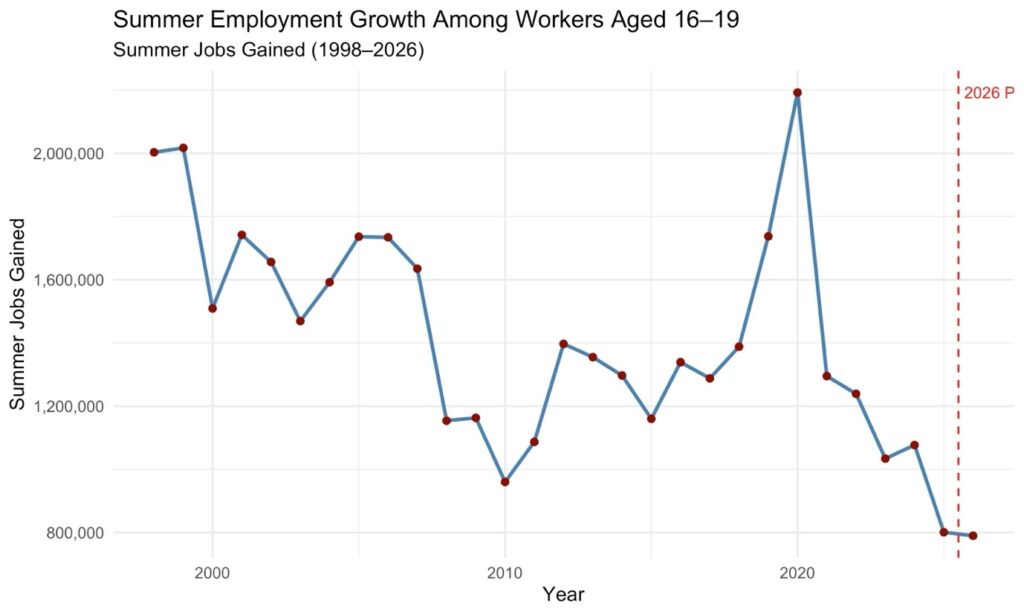
These figures demonstrate that today’s weaker hiring environment is not primarily the consequence of current economic conditions. Rather, recent developments merely reinforce a structural trend that has fundamentally altered the relationship between education and work.
The distinction between cyclical and structural change is central to labor economics. Cyclical unemployment arises during recessions when aggregate demand temporarily weakens. Structural unemployment reflects permanent changes in technology, demographics, institutions and labor market incentives. Teen employment clearly belongs to the latter category. Misdiagnosing the problem risks producing policies that address short-term symptoms while ignoring long-term causes.
The economics behind the disappearance of summer jobs
The decline in teenage employment reflects simultaneous changes in both labor supply and labor demand.
From the supply side, human capital theory offers the most compelling explanation. Individuals allocate their time toward activities expected to generate the greatest lifetime return. During the past four decades, the economic premium associated with higher education has expanded substantially. As returns to college increased, parents and students increasingly viewed summer months as opportunities for educational investment rather than paid employment.
Today’s teenagers devote summers to Advanced Placement courses, university research, coding academies, standardized test preparation, leadership programs, volunteer activities and unpaid internships designed to strengthen university applications. For many middle- and upper-income families, spending three months earning minimum wage carries a considerably higher opportunity cost than it did 40 years ago.
Supporting this interpretation, BLS data shows that school enrollment among teenagers has risen steadily. Summer school participation increased from approximately 10% during the mid-1980s to more than 42% in recent years, reflecting growing emphasis on educational attainment and college preparation.
However, changes in labor demand have been equally important.
Even traditional entry-level occupations now require greater technical competence than in previous generations. Restaurants rely on digital ordering systems and automated scheduling software. Retailers employ sophisticated inventory management technologies, electronic payment systems and customer relationship platforms. Consequently, employers increasingly seek workers capable of becoming productive immediately rather than inexperienced teenagers requiring extensive training.
Artificial intelligence further accelerates this transformation. Self-checkout systems, AI-powered customer service, automated inventory management, digital scheduling platforms and online ordering technologies increasingly perform routine tasks historically assigned to first-time workers. While AI did not initiate the decades-long decline in teenage employment, it has significantly reduced the availability of precisely those entry-level positions that once introduced young people to the labor market.
Demographic developments reinforce these technological pressures. Americans remain employed longer than previous generations, with many older workers seeking part-time or seasonal employment after traditional retirement ages. Teenagers therefore compete directly with experienced adults for positions once regarded as stepping stones into the workforce.
Minimum wage policy also deserves careful consideration. Economic theory predicts that when statutory wage floors exceed the productivity of inexperienced workers, employers become more selective in hiring decisions. Although minimum wages play an important role in protecting the living standards of adult workers, teenagers occupy a fundamentally different position in the labor market. Their principal objective is often to acquire workplace experience rather than to maximize current earnings.
Accordingly, the policy debate should focus less on whether minimum wages are universally beneficial or harmful and more on designing institutions that preserve opportunities for first-time workers while maintaining adequate labor protections.
The distributional consequences
Perhaps the most important consequence of declining summer employment is its unequal distribution across American society.
Affluent teenagers increasingly replace paid employment with internships, research opportunities, overseas educational experiences, entrepreneurship programs and professional networking activities. Although many of these experiences are unpaid, they generate substantial long-term returns by strengthening university applications and expanding future career opportunities.
Teenagers from lower-income households face a very different reality. Summer employment remains essential for financing education, supporting household income, developing workplace skills and establishing professional networks. Ironically, these are precisely the young workers encountering the greatest barriers to employment.
New York City’s summer employment program illustrates this imbalance. Approximately 200,000 teenagers applied for only 100,000 available positions, forcing administrators to allocate jobs through lotteries. Economic evaluations found that winning one of these positions increased the probability of employment by more than 70%, demonstrating enormous unmet demand among disadvantaged youth.
The resulting inequality extends beyond current income. Wealthier students accumulate stronger résumés, valuable professional contacts and enhanced educational credentials, while disadvantaged teenagers lose access to one of the few universally available pathways into the labor market.
Moreover, summer jobs generate important social benefits that extend beyond wages. Research consistently finds that structured youth employment reduces criminal activity, strengthens community engagement, improves workplace readiness and promotes long-term labor-force attachment. These positive externalities imply that society benefits from youth employment even when private employers may not fully capture its economic value.
Consequently, declining teenage employment represents far more than a labor market statistic. It reflects the gradual erosion of an institution that historically promoted human capital formation, economic mobility and social inclusion across generations.
Education, artificial intelligence and the future workforce
The disappearance of teenage summer employment coincides with another profound transformation — the rapid diffusion of artificial intelligence throughout the economy. Much of the current public discussion portrays AI primarily as a threat to entry-level employment. Although automation undoubtedly reduces demand for routine tasks, its broader economic implications are considerably more nuanced.
Historically, technological revolutions have displaced specific occupations while simultaneously creating new industries and expanding productivity. The current wave of AI is unlikely to be different. However, the transition imposes substantial adjustment costs, particularly on inexperienced workers whose traditional entry points into the labor market are disappearing.
Paradoxically, the skills becoming most valuable in the AI economy are precisely those cultivated through workplace experience rather than classroom instruction. Communication, teamwork, leadership, emotional intelligence, creativity, judgment, adaptability and ethical decision-making remain difficult to automate. These competencies are developed through interactions with colleagues, customers, supervisors and organizational environments.
Consequently, education and employment should no longer be viewed as competing investments. Instead, they are complementary forms of human capital accumulation. Academic education provides technical knowledge and analytical ability, while employment develops practical judgment, interpersonal competence and professional identity. Individuals possessing both forms of human capital will likely outperform those relying exclusively on academic credentials.
Several advanced economies already recognize this complementarity. Germany and Switzerland have long integrated apprenticeships into secondary education, enabling students to combine classroom instruction with paid employment. These dual-track systems facilitate smoother school-to-work transitions while reducing youth unemployment. Japan similarly maintains strong institutional linkages between secondary schools and employers, contributing to relatively successful labor market integration for young workers.
The US has traditionally relied upon informal summer employment to perform a similar function. As this institution weakens, policymakers must develop alternative pathways connecting education with productive employment.
Investing in America’s future workforce
The disappearance of teenage summer jobs represents one of the most significant yet underappreciated structural changes in the American labor market. For decades, these jobs functioned as an informal institution through which millions of young people acquired workplace skills, financial independence, professional confidence and early labor-market attachment. Their decline reflects not a temporary recession but the combined effects of educational incentives, technological innovation, demographic change and evolving labor market institutions.
While many middle- and upper-income students now substitute employment with educational enrichment, internships and professional networking, disadvantaged teenagers increasingly lose access to one of the few universally available pathways toward economic mobility. The result is widening inequality in human capital formation, delayed workforce readiness and diminished opportunities for social advancement.
Artificial intelligence further reinforces the urgency of this challenge. As routine tasks become increasingly automated, future labor markets will reward adaptability, communication, leadership, creativity and sound judgment — skills that emerge through practical experience as much as through formal education. Ironically, the first job has become more valuable precisely as it has become more difficult to obtain.
Economic policy should therefore move beyond viewing teenage employment solely through the lens of short-term labor market statistics. Instead, summer employment should be recognized as a strategic investment in national human capital. The economic returns extend far beyond seasonal earnings, influencing lifetime productivity, workforce participation, social stability and intergenerational mobility.
Rebuilding effective pathways from school to work will require cooperation among governments, educational institutions, employers and communities. Expanding apprenticeships, strengthening school-business partnerships, reducing hiring costs for first-time workers and modernizing youth employment policies can help restore opportunities that technological and institutional changes have gradually eroded.
Ultimately, the first job has never been simply about earning a paycheck. It is the beginning of an individual’s economic journey — a formative experience that shapes professional identity, confidence, responsibility and aspirations. Investing in that first opportunity is therefore an investment not only in young workers but also in the long-term productivity, competitiveness and inclusive prosperity of the American economy.
[Kaitlyn Diana edited this piece.]
The views expressed in this article are the author’s own and do not necessarily reflect Fair Observer’s editorial policy.








Join the conversation
Share your perspective
Log in to share your thoughts and take part in the discussion.