Login

    Sections
    Search

    • Politics
    • Economics & Finance
    • Business & Entrepreneurship
    • Art & Culture
    • Science & Technology
    • Environment & Climate Change
    • World
    • World Leaders
    • The Americas
    • Europe
    • Middle East & North Africa
    • Africa
    • Asia
    • United States
    • India
    • China
    • Russia
    • About
    • Authors
    • Publications
    • Events
    • Multimedia
    • Videos
    • Podcasts
    • Events
    • Russia
    • Publications
    • Authors
    • About
    Fair Observer

    MULTIMEDIA

    Christmas Explained

    Fair Observer

    VIDEOS

    FO° Live: Is the Quad Still Relevant? Why Southeast Asia No Longer Trusts This Alliance

    Fair Observer

    PODCASTS

    The Quad’s Evolution From Providing Public Goods to Security Cooperation

    PUBLICATION

    Fair Observer Monthly: November 2025

    Support Fair Observer

    We rely on your support for our independence, diversity and quality.

    Donate
    Search
    Fair Observer Logo
    • Donate
    Fair Observer Logo
    Europe

    Establishing Unity Within NATO by Bridging the Divide

    After the Cold War, NATO’s eastward expansion brought about former Soviet states, shifting its focus and adding members with strong anti-Russia sentiment. This has created internal divisions, with Eastern Europe advocating for a robust military presence while others prioritize diplomacy. Economic struggles further complicate matters, limiting defense spending. NATO’s ability to navigate these divisions and adapt to a changing world will be crucial to its future.
    By Flavius Mihaies &Atul Singh
    Follow
    Follow
    Flavius Mihaies, Atul Singh
    @flaviusoxford
    @atulabhas
    SHARE
    June 26, 2024 04:38 EDT
    Check out our comment feature!

    Saved Successfully.

    This article saved into your bookmarks. Click here to view your bookmarks.

    My Bookmarks

    Since the end of the Cold War, NATO has expanded from 16 to 32 members, shifting the alliance’s identity and strategic focus eastward. The expansion has brought countries with a history of Soviet domination, such as Poland, into the alliance. These countries bring their grievances and fears about Russia, affecting NATO’s future decisions and potentially pushing the alliance toward a more aggressive stance.

    LISTEN ON:
    ALSO AVAILABLE ON:
    • Spotify Spotify
    • apple-podcasts Apple Podcasts
    • YouTube Podcasts
    • Amazon Amazon Music

    Differing views on Russia within NATO

    Not all NATO members share the same perception of Russia. While some Eastern European countries, like Poland, perceive Russia as a direct threat and advocate for a stronger military presence, others, like Hungary, adopt a more balanced approach, prioritizing diplomacy and national interests. This divergence in viewpoints highlights the complexities within the alliance and the challenges of reaching a unified stance on Russia.

    The varying perspectives on Russia also reflect the influence of historical experiences. Countries like Poland, which suffered under Soviet rule, harbor deep-rooted fears and advocate for a more assertive approach toward Russia. In contrast, countries with less traumatic histories, or those prioritizing economic ties, may lean more towards diplomacy and cooperation.

    The debate over NATO’s role and the perception of Russia extends beyond Eastern Europe. Western European powers, including Germany, France and the UK, have unique worldviews influencing their foreign policies towards Russia. Germany has frequently supported Eastern European nations and sided with the US because of historical guilt. At the same time, France has traditionally sought a more balanced approach, maintaining dialogue with Russia while supporting Ukraine. On the other hand, the UK has historically been more aligned with the US and has taken a stronger anti-Russia stance.

    Recent developments, such as France’s consideration of sending troops to Ukraine and the UK’s training of Ukrainian soldiers, indicate a potential shift in the alliance’s dynamics. France’s position suggests a growing alignment with Eastern European nations, calling for a more assertive approach in light of its losses in Africa and the perceived threat posed by Russian mercenaries. The UK’s actions reflect its historical grievances with Russia and its close alliance with the US.

    Economic Woes Hinder Defense Spending in Europe

    The economic and political challenges European countries face further complicate NATO’s decision-making. Many European nations grapple with economic downturns, rising inflation and unbalanced budgets. The need to prioritize economic growth and social services may limit their willingness to increase defense spending or commit additional resources to military interventions.

    Its members’ differing priorities and security concerns exemplify NATO’s complexities. Turkey, a NATO member, has played a complex role in the Ukraine conflict, balancing its support for Ukraine with economic deals with Russia. People have raised concerns about Turkey’s reliability as an ally and its potential influence on NATO’s decisions.

    We are a nonprofit, truly independent media organization committed to delivering diverse, fact-based global analysis. If you like what you are reading, sign up for our free newsletters now.

    NATO can solidify its future by overcoming internal divisions and forging a common approach. Navigating varying perceptions of Russia, balancing member priorities and adapting to a shifting geopolitical landscape are crucial tasks. As the world becomes increasingly multipolar, NATO’s role and effectiveness will face new challenges. The alliance must demonstrate agility in adapting to these challenges while ensuring its core principles of collective defense and security cooperation remain robust.

    [Peter Choi edited this podcast and wrote the first draft of this piece.]

    The views expressed in this article/podcast are the author’s own and do not necessarily reflect Fair Observer’s editorial policy.

    LISTEN ON:
    ALSO AVAILABLE ON:
    • Spotify Spotify
    • apple-podcasts Apple Podcasts
    • YouTube Podcasts
    • Amazon Amazon Music

    Comment

    Login
    Please login to comment
    0 Comments
    Newest
    Oldest Most Voted
    Inline Feedbacks
    View all comments

    Commenting Guidelines

    Please read our commenting guidelines before commenting.


    1. Be Respectful: Please be polite to the author. Avoid hostility. The whole point of Fair Observer is openness to different perspectives from perspectives from around the world.

    2. Comment Thoughtfully: Please be relevant and constructive. We do not allow personal attacks, disinformation or trolling. We will remove hate speech or incitement.

    3. Contribute Usefully: Add something of value — a point of view, an argument, a personal experience or a relevant link if you are citing statistics and key facts.

    Please agree to the guidelines before proceeding.

    Related Reading

    Breaking Free From the Bear’s Grip in the Caucasus

    The Russian invasion of Ukraine has thrust Armenia and Georgia into the media spotlight. The US has been paying close...
    by Artem Belov, June 10, 2024
    Fair Observer

    The Monumental Stakes of the Upcoming EU Elections

    Amidst a right-wing surge in France, President Emmanuel Macron is pushing for a stronger, more assertive Europe. The ongoing EU...
    by Imran Khalid, June 8, 2024
    Fair Observer

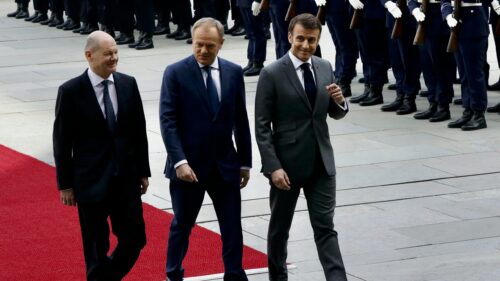
    Will the France–Germany–Poland “Weimar Triangle” Be Europe’s New Powerhouse?

    The France–Germany–Poland "Weimar Triangle" format arose after the end of the Cold War to usher Poland into NATO and the...
    by Romain Le Quiniou, Malwina Talik & Sebastian Schäffer, May 9, 2024
    Fair Observer

    More Episodes

    FO° Podcasts: Myanmar Votes During a Civil War: Why This Election Could Tear the Country Apart

    In this episode of FO° Podcasts, Rohan Khattar Singh and Asanga Abeyagoonasekera examine Myanmar’s December 28 elections against the backdrop...

    Asanga Abeyagoonasekera & Rohan Khattar Singh, January 6, 2026
    Fair Observer

    FO° Podcasts: The Forbidden C-word, Class in America

    In this episode of FO° Podcasts, Atul Singh and Kent Jenkins Jr. discuss how class shapes US identity and political...

    Kent Jenkins Jr. & Atul Singh, December 29, 2025
    Fair Observer

    The Dialectic: France: The Eternal Crisis Strikes Again. What Now?

    In this episode of The Dialectic, Atul Singh and Glenn Carle examine France’s deepening polycrisis. Rising debt, political paralysis and...

    Glenn Carle & Atul Singh, December 13, 2025
    Fair Observer

    The Dialectic: Can Germany Outgrow Its Postwar American Model?

    In this episode of The Dialectic, Atul Singh and Glenn Carle explore how Germany faces acute economic, political and social...

    Glenn Carle & Atul Singh, December 2, 2025
    Fair Observer

    Must Listen

    FO° Podcasts: The Right to Play: How Women Fought and Won the Battle for Equality in Sports

    In this episode of FO° Podcasts, Atul Singh and Lauren Greenberg explore how Title IX reshaped women’s sports and personal...

    by Lauren Greenberg & Atul Singh, November 26, 2025
    Fair Observer

    FO° Podcasts: Enemy of the Sun — How Palestinian Poetry Became a Weapon of Resistance

    In this episode of FO° Podcasts, Atul Singh and Edmund Ghareeb trace the unlikely journey of the Palestinian poetry anthology...

    by Edmund Ghareeb & Atul Singh, November 19, 2025
    Fair Observer

    FO° Podcasts: Why is the US Deporting Illegal Migrants to a Tiny African Nation Called Eswatini?

    In this episode of FO° Podcasts, Rohan Khattar Singh and Zweli Martin Dlamini examine the secret deportation deal between the...

    by Zweli Martin Dlamini & Rohan Khattar Singh, November 16, 2025
    Fair Observer

    The Dialectic: Can Germany and France Make Europe Great Again?

    In this episode of The Dialectic, Atul Singh and Glenn Carle examine Europe’s rise from Renaissance brilliance to post-World War...

    by Glenn Carle & Atul Singh, October 17, 2025
    Fair Observer

    Project 2025 and Donald Trump’s Dangerous Dismantling of the US Federal Government

    In this episode of The Dialectic, Atul Singh and Glenn Carle dissect US President Donald Trump’s destruction of federal institutions....


    by Glenn Carle & Atul Singh, September 9, 2025
    Fair Observer

    FO° Podcasts: Why Has Trump Deployed Thousands of National Guard Troops in Washington, DC?

    In this episode of FO° Podcasts, Atul Singh and Ankit Jain examine US President Donald Trump’s interventions in Washington, DC....

    by Ankit Jain & Atul Singh, September 8, 2025
    Fair Observer

    FO° Podcast: The Story of Millions of Syrian Refugees and Why They Can Never Return Home

    In this episode of FO° Podcasts, Atul Singh and William McChesney examine why millions of Syrian refugees remain in exile...

    by William McChesney & Atul Singh, August 30, 2025
    Fair Observer

    How Iran Became a Great Power and Why It Hates America and Israel

    In this episode of The Dialectic podcast, Atul and Glenn explore how Iran’s imperial history, colonial subjugation and 1953 coup...

    by Glenn Carle & Atul Singh, August 19, 2025
    Fair Observer


    Fair Observer, 461 Harbor Blvd, Belmont, CA 94002, USA

    Sections

    • Politics
    • Economics & Finance
    • Business & Entrepreneurship
    • Art & Culture
    • Science & Technology
    • Environment & Climate Change
    • World Leaders
    • World
    • The Americas
    • Europe
    • Middle East & North Africa
    • Africa
    • Asia
    • United States
    • India
    • China
    • Russia
    • Events
    • Publications
    • Authors
    • About
    • Publish
    • Contact
    • Login
    Fair Observer

    MULTIMEDIA

    Christmas Explained

    Fair Observer

    VIDEOS

    FO° Live: Is the Quad Still Relevant? Why Southeast Asia No Longer Trusts This Alliance

    Fair Observer

    PODCASTS

    The Quad’s Evolution From Providing Public Goods to Security Cooperation

    PUBLICATION

    Fair Observer Monthly: November 2025

    Support Fair Observer

    We rely on your support for our independence, diversity and quality.

    Donate
    © Fair Observer All rights reserved
    Designed, Developed and Maintained by Netleon IT Solutions
    Fair Observer Education Logo Fair Observer Leadership Academy Logo

    BOOKMARK

    Want to save this post?
    Click to Login

    Support independent, crowdsourced, nonprofit journalism.

    Fair Observer is a 501(c)(3) independent nonprofit. We are not owned by billionaires or controlled by advertisers. We publish nearly 3,000 authors from over 90 countries after fact-checking and editing each piece. We do not have a paywall and anyone can read us for free. With your vital donations, we can continue to do our work.

    Please make a recurring (or even one-time) donation today. Even $1 goes a long way because a million donors like you mean one million dollars. Thank you for keeping us independent, free and fair.

    One Time Monthly Yearly

    Sign into your Fair Observer Account

    • Lost your password?
    Forgot Password

    Forgot Password

    Enter your registered email address or username. You will receive a link to create a new password via email.

    Please enter your username or email address. You will receive an email message with instructions on how to reset your password.

    • Log in

    Or
    Return to Login

    Forgot Password

    We have sent a link to your registered email address to reset your password.

    Back to Login

    Become a Member & Enjoy Exclusive Benefits!

    • Access to comments feature
    • Bookmark your favorite articles
    • Exclusive invitations to FO° Talks & FO° Live
    • Access to all of our e-publications
    Explore Membership
    Return to Login

    NEWSLETTER

    Make Sense of the World

    Unique Insights from 2,500+ Contributors in 90+ Countries

    NEWSLETTER

    Make Sense of the World

    Unique Insights from 2,500+ Contributors in 90+ Countries

    Fair observer

    Make Sense of the World

    Unique Insights from 2,500+ Contributors in 90+ Countries

    We Need Your Consent
    We use cookies to give you the best possible experience. Learn more about how we use cookies or edit your cookie preferences. Privacy Policy. My Options I Accept
    Privacy & Cookies Policy

    Edit Cookie Preferences

    The Fair Observer website uses digital cookies so it can collect statistics on how many visitors come to the site, what content is viewed and for how long, and the general location of the computer network of the visitor. These statistics are collected and processed using the Google Analytics service. Fair Observer uses these aggregate statistics from website visits to help improve the content of the website and to provide regular reports to our current and future donors and funding organizations. The type of digital cookie information collected during your visit and any derived data cannot be used or combined with other information to personally identify you. Fair Observer does not use personal data collected from its website for advertising purposes or to market to you.

    As a convenience to you, Fair Observer provides buttons that link to popular social media sites, called social sharing buttons, to help you share Fair Observer content and your comments and opinions about it on these social media sites. These social sharing buttons are provided by and are part of these social media sites. They may collect and use personal data as described in their respective policies. Fair Observer does not receive personal data from your use of these social sharing buttons. It is not necessary that you use these buttons to read Fair Observer content or to share on social media.

     
    Necessary
    Always Enabled
    These cookies essential for the website to function.
    Social Media
    These cookies are used to enable sharing or following of content that you find interesting on our website. These settings apply to third-party social networking and other websites.
    Performance & Functionality
    These cookies are used to enhance the performance and functionality of our website. They provide statistics on how our website is used and help us improve by measuring errors. Certain functionalities on our website may become unavailable without these cookies.
    Analytics
    SAVE & ACCEPT

    Total Views: