Login

    Sections
    Search

    • Politics
    • Economics & Finance
    • Business & Entrepreneurship
    • Art & Culture
    • Science & Technology
    • Environment & Climate Change
    • World
    • World Leaders
    • The Americas
    • Europe
    • Middle East & North Africa
    • Africa
    • Asia
    • United States
    • India
    • China
    • Russia
    • About
    • Authors
    • Publications
    • Events
    • Multimedia
    • Videos
    • Podcasts
    • Events
    • Russia
    • Publications
    • Authors
    • About
    Fair Observer

    MULTIMEDIA

    The Indian Subcontinent’s Hindu-Muslim Divide

    Fair Observer

    VIDEOS

    FO° Talks: Deepfakes and Democracy: Why the Next Election Could Be Decided by AI

    Fair Observer

    PODCASTS

    FO° Podcasts: Maduro, the War on Drugs and Trump’s Revival of the Monroe Doctrine

    PUBLICATION

    Fair Observer Monthly: December 2025

    Support Fair Observer

    We rely on your support for our independence, diversity and quality.

    Donate
    Search
    Fair Observer Logo
    • Donate
    Fair Observer Logo
    Podcasts

    What Is the New Venezuela-Guyana Drama All About?

    Glenn Ojeda and Atul Singh discuss the recent referendum in Venezuela on the incorporation of the Essequibo territory in neighboring Guyana. Venezuela eyes Essequibo because it is oil-rich. Despite past agreements to settle the border dispute, Venezuela is testing the waters for the use of military force.
    By Glenn Ojeda Vega &Atul Singh
    Follow
    Follow
    Glenn Ojeda Vega, Atul Singh
    @GOjedaVega
    @atulabhas
    SHARE
    January 09, 2024 06:37 EDT
    Check out our comment feature!

    Saved Successfully.

    This article saved into your bookmarks. Click here to view your bookmarks.

    My Bookmarks

    On December 3, the people of Venezuela took to the polls. This was not for any ordinary election. Rather, the Venezuelan government held a referendum on the subject of annexing Essequibo territory, which lies in neighboring Guyana and is oil-rich. Venezuela and Guyana have been involved in a decades-long dispute over this territory. 

    LISTEN ON:
    ALSO AVAILABLE ON:
    • Spotify Spotify
    • apple-podcasts Apple Podcasts
    • YouTube Podcasts
    • Amazon Amazon Music

    For those who need a brush-up on their history, Guyana is a former British colony. It gained independence in 1966, but Venezuela has claimed two-thirds of Guyana’s land since 1899. However, the an 1899 arbitral tribunal in Paris ruled in favor of British Guyana, granting the British Empire the Essequibo territory. The tribunal drew the territorial line between the states of Venezuela and Guyana. For 124 years, Venezuela has denounced this line.
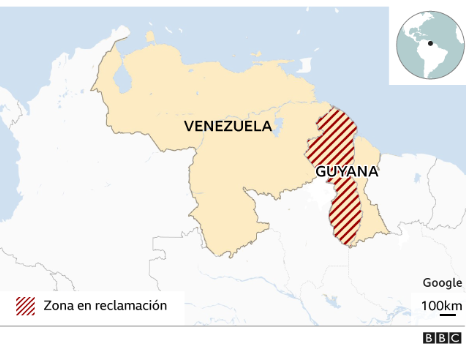
    Venezuela and Guyana. The portion of Guyana claimed by Venezuela is shaded in red.

    Hope came for Venezuela in the form of the 1966 Geneva Agreement on the eve of Guyana’s independence. Venezuela and the British Empire signed this agreement with the understanding that Venezuela and Guyana would agree to settle the border dispute at a later date. It seems that now Venezuela is coming to collect on this agreement but is doing so unilaterally.
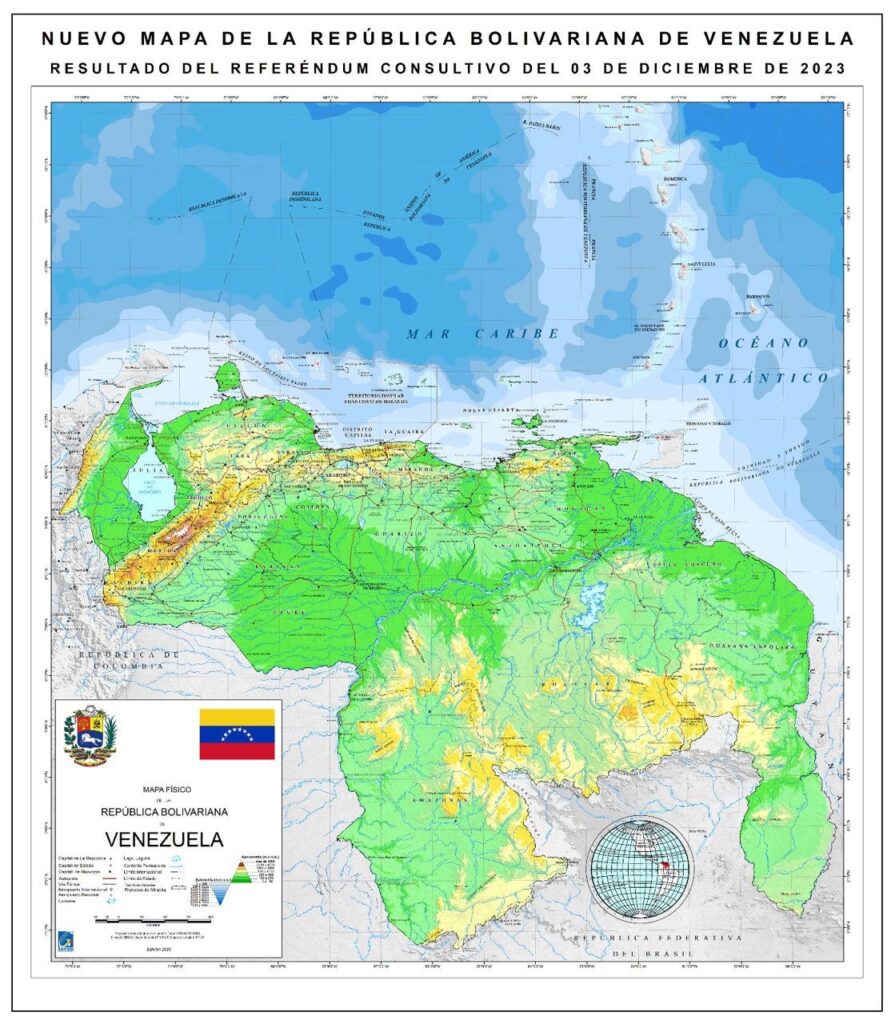
    Nicolás Maduro tweeted a map showing Essequibo as part of Venezuela.

    Venezuela questions the people’s support

    Composed of five questions, the referendum aimed to understand the position Venezuelan citizens took on the current situation of Guyana. The first question asked if the citizens rejected the decision of the 1899 Tribunal. Venezuela sees this tribunal as taking away its national sovereignty. If the country’s citizens reject the tribunal decision, then Venezuela can assert its ownership over Guyanese land with popular support.

    The second question asked if citizens embraced the 1966 Geneva Agreement. Despite being signed in 1966, no move has been made towards fulfilling the agreement. The territorial lines remain as they were in 1899. Venezuela must assert the authority granted through the agreement if it wishes to take back its territory. 

    The referendum’s third question undermines the second: Do Venezuelan citizens reject the jurisdiction of the International Court of Justice? This question sets up the idea that the Venezuela-Guyana dispute must be settled domestically rather than internationally. Both the 1899 Tribunal and the 1966 Geneva agreement were settled with major colonial players. This time around, Venezuela is hoping to settle this within Latin America.

    However, in order to settle this within Latin America, Venezuela must know where its citizens stand on the issue of military force. This is what the fourth question asks: If Guyana comes to defend the territorial line with its own military, will citizens support forceful action? Or will Venezuela’s own citizens deny the use of the military?
    GAcUO74
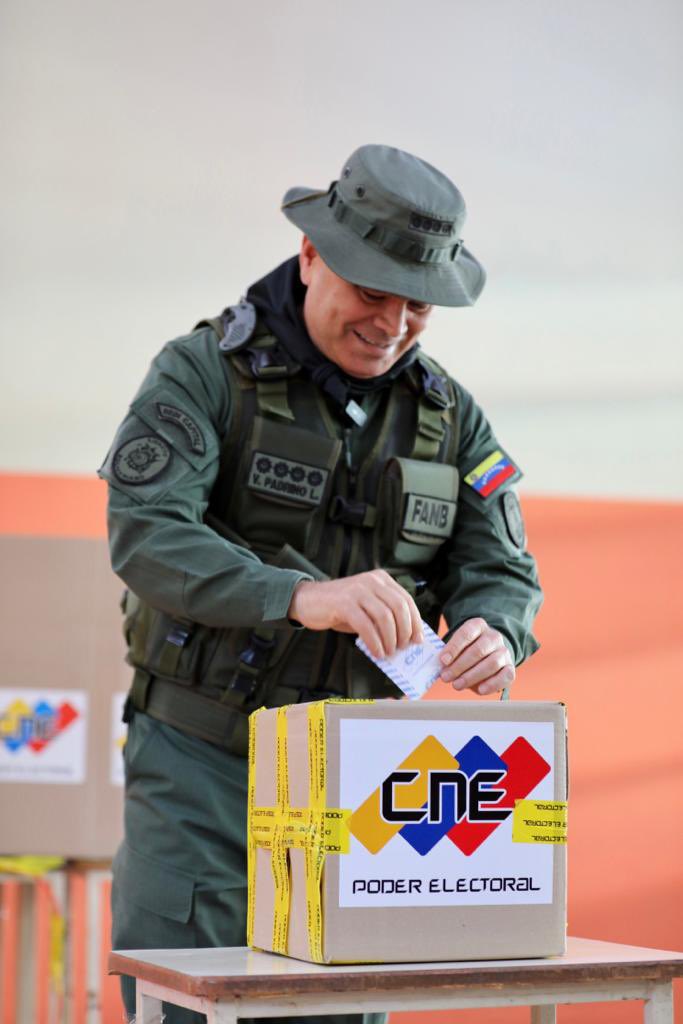
    On December 3, 2023, Venezuelan Defense Minister Vladimir Padrino cast his vote in full combat fatigues.

    CAPTION: On December 3, 2023, Venezuelan Defense Minister Vladimir Padrino cast his vote in full combat fatigues.

    The fifth question poses Venezuela’s solution to newly acquired territory. It asks if citizens would embrace the declaration of a new state within Venezuela’s territory. This new state would issue distinct “Guyana-Essequibo” IDs to identify former Guyanese citizens. In other words, Venezuela is seeking support to add a new state within its borders.

    Venezuela reported that over 95% of the millions of voters answered “yes” to every question, claiming near-unanimous support for the annexation of oil-rich Guyanese land. However, these numbers may have been falsified. Many observers have said that the turnout was much lower than the reported numbers. 

    Venezuela relies heavily on its military

    The unreliability of voter turnout is in keeping with the election fraud committed by current Venezuelan president Nicolás Maduro in 2018. It is well known that Maduro’s reign has undermined democracy in Venezuela. So, it is no surprise that the referendum numbers do not reflect reality. 

    The issues the referendum raises have no real impact on normal citizens. It is an anti-Western, political move. However, the potential invasion and subsequent annexation of Guyana still lies in the indeterminate future. Despite the lack of investment, the country’s bankruptcy, Western trade sanctions, and its inability to drill for oil, Venezuela still eyes more oil-rich territory. This aggressive posturing is a risk because the Venezuelan military is still strong. Its strength comes from the Chavista movement of the 1990s. The militaristic ideologies of revolutionary leader Hugo Chávez may have been introduced in 1992, but his influence remains ingrained in Venezuelan politics. 

    The influence of the Chavista movement is only one facet of this dispute. Other factors are in play, namely the lack of media attention to the tensions between Venezuela and Guyana. With the conflicts in Ukraine and Israel-Gaza taking center stage, Venezuela is banking on the hypothesis that the world is tired of conflict. A world tired of conflict won’t have the energy to turn its news cameras onto Guyana. 

    We’re independent, nonprofit and powered by 3,000+ voices from around the world — not billionaires or governments. Enjoy real journalism, sign up for our free newsletters.

    It takes no imagination to predict what will happen if Venezuela and Guyana fail to reach an agreement. The presence of uniformed military personnel at Venezuela’s voting centers makes the country’s stand on the use of force clear. As the eyes of the world are turned away from Guyana, Venezuela is free to move into the mineral-rich Essequibo territory. Only one question remains unanswered: What will Guyana do? And what will other countries do to protect Guyana?

    [Cheyenne Torres edited this piece.]

    The views expressed in this article/podcast are the author’s own and do not necessarily reflect Fair Observer’s editorial policy.

    LISTEN ON:
    ALSO AVAILABLE ON:
    • Spotify Spotify
    • apple-podcasts Apple Podcasts
    • YouTube Podcasts
    • Amazon Amazon Music

    Comment

    Login
    Please login to comment
    0 Comments
    Newest
    Oldest Most Voted
    Inline Feedbacks
    View all comments

    Commenting Guidelines

    Please read our commenting guidelines before commenting.


    1. Be Respectful: Please be polite to the author. Avoid hostility. The whole point of Fair Observer is openness to different perspectives from perspectives from around the world.

    2. Comment Thoughtfully: Please be relevant and constructive. We do not allow personal attacks, disinformation or trolling. We will remove hate speech or incitement.

    3. Contribute Usefully: Add something of value — a point of view, an argument, a personal experience or a relevant link if you are citing statistics and key facts.

    Please agree to the guidelines before proceeding.

    Related Reading

    Milei Or Massa: Who Was the Best Choice for Argentina?

    The 2023 presidential elections put Argentinean voters before a difficult test: to choose between a radical erratic change or the...
    by Helder Ferreira do Vale, December 30, 2023
    Fair Observer

    The Secrets Behind Brazil’s Military and the January 8 Insurrection

    On January 8, 2023, rioters stormed Brazil’s capital in support of the defeated President Jair Bolsonaro. This was not just...
    by Karin Schmalz, November 18, 2023
    Fair Observer

    Powerful Hugo Chávez’s Toxic Legacy Haunts Venezuela

    Venezuelan leader Hugo Chávez died of cancer ten years ago and his legacy remains controversial. Chávez rose to power at...
    by Leonardo Vivas, March 26, 2023
    Fair Observer

    More Episodes

    FO° Podcasts: Maduro, the War on Drugs and Trump’s Revival of the Monroe Doctrine

    In this episode of FO° Podcasts, Atul Singh and Benjamin Delille examine US President Donald Trump’s confrontation with Venezuela, questioning...

    Benjamin Delille & Atul Singh, January 18, 2026
    Fair Observer

    FO° Podcasts: Myanmar Votes During a Civil War: Why This Election Could Tear the Country Apart

    In this episode of FO° Podcasts, Rohan Khattar Singh and Asanga Abeyagoonasekera examine Myanmar’s December 28 elections against the backdrop...

    Asanga Abeyagoonasekera & Rohan Khattar Singh, January 6, 2026
    Fair Observer

    FO° Podcasts: The Forbidden C-word, Class in America

    In this episode of FO° Podcasts, Atul Singh and Kent Jenkins Jr. discuss how class shapes US identity and political...

    Kent Jenkins Jr. & Atul Singh, December 29, 2025
    Fair Observer

    The Dialectic: France: The Eternal Crisis Strikes Again. What Now?

    In this episode of The Dialectic, Atul Singh and Glenn Carle examine France’s deepening polycrisis. Rising debt, political paralysis and...

    Glenn Carle & Atul Singh, December 13, 2025
    Fair Observer

    Must Listen

    The Dialectic: Can Germany Outgrow Its Postwar American Model?

    In this episode of The Dialectic, Atul Singh and Glenn Carle explore how Germany faces acute economic, political and social...

    by Glenn Carle & Atul Singh, December 2, 2025
    Fair Observer

    FO° Podcasts: The Right to Play: How Women Fought and Won the Battle for Equality in Sports

    In this episode of FO° Podcasts, Atul Singh and Lauren Greenberg explore how Title IX reshaped women’s sports and personal...

    by Lauren Greenberg & Atul Singh, November 26, 2025
    Fair Observer

    FO° Podcasts: Enemy of the Sun — How Palestinian Poetry Became a Weapon of Resistance

    In this episode of FO° Podcasts, Atul Singh and Edmund Ghareeb trace the unlikely journey of the Palestinian poetry anthology...

    by Edmund Ghareeb & Atul Singh, November 19, 2025
    Fair Observer

    FO° Podcasts: Why is the US Deporting Illegal Migrants to a Tiny African Nation Called Eswatini?

    In this episode of FO° Podcasts, Rohan Khattar Singh and Zweli Martin Dlamini examine the secret deportation deal between the...

    by Zweli Martin Dlamini & Rohan Khattar Singh, November 16, 2025
    Fair Observer

    The Dialectic: Can Germany and France Make Europe Great Again?

    In this episode of The Dialectic, Atul Singh and Glenn Carle examine Europe’s rise from Renaissance brilliance to post-World War...

    by Glenn Carle & Atul Singh, October 17, 2025
    Fair Observer

    Project 2025 and Donald Trump’s Dangerous Dismantling of the US Federal Government

    In this episode of The Dialectic, Atul Singh and Glenn Carle dissect US President Donald Trump’s destruction of federal institutions....

    by Glenn Carle & Atul Singh, September 9, 2025
    Fair Observer

    FO° Podcasts: Why Has Trump Deployed Thousands of National Guard Troops in Washington, DC?

    In this episode of FO° Podcasts, Atul Singh and Ankit Jain examine US President Donald Trump’s interventions in Washington, DC....

    by Ankit Jain & Atul Singh, September 8, 2025
    Fair Observer

    FO° Podcast: The Story of Millions of Syrian Refugees and Why They Can Never Return Home

    In this episode of FO° Podcasts, Atul Singh and William McChesney examine why millions of Syrian refugees remain in exile...

    by William McChesney & Atul Singh, August 30, 2025
    Fair Observer


    Fair Observer, 461 Harbor Blvd, Belmont, CA 94002, USA

    Sections

    • Politics
    • Economics & Finance
    • Business & Entrepreneurship
    • Art & Culture
    • Science & Technology
    • Environment & Climate Change
    • World Leaders
    • World
    • The Americas
    • Europe
    • Middle East & North Africa
    • Africa
    • Asia
    • United States
    • India
    • China
    • Russia
    • Events
    • Publications
    • Authors
    • About
    • Publish
    • Contact
    • Login
    Fair Observer

    MULTIMEDIA

    The Indian Subcontinent’s Hindu-Muslim Divide

    Fair Observer

    VIDEOS

    FO° Talks: Deepfakes and Democracy: Why the Next Election Could Be Decided by AI

    Fair Observer

    PODCASTS

    FO° Podcasts: Maduro, the War on Drugs and Trump’s Revival of the Monroe Doctrine

    PUBLICATION

    Fair Observer Monthly: December 2025

    Support Fair Observer

    We rely on your support for our independence, diversity and quality.

    Donate
    © Fair Observer All rights reserved
    Designed, Developed and Maintained by Netleon IT Solutions
    Fair Observer Education Logo Fair Observer Leadership Academy Logo

    BOOKMARK

    Want to save this post?
    Click to Login

    Support independent, crowdsourced, nonprofit journalism.

    Fair Observer is a 501(c)(3) independent nonprofit. We are not owned by billionaires or controlled by advertisers. We publish nearly 3,000 authors from over 90 countries after fact-checking and editing each piece. We do not have a paywall and anyone can read us for free. With your vital donations, we can continue to do our work.

    Please make a recurring (or even one-time) donation today. Even $1 goes a long way because a million donors like you mean one million dollars. Thank you for keeping us independent, free and fair.

    One Time Monthly Yearly

    Sign into your Fair Observer Account

    • Lost your password?
    Forgot Password

    Forgot Password

    Enter your registered email address or username. You will receive a link to create a new password via email.

    Please enter your username or email address. You will receive an email message with instructions on how to reset your password.

    • Log in

    Or
    Return to Login

    Forgot Password

    We have sent a link to your registered email address to reset your password.

    Back to Login

    Become a Member & Enjoy Exclusive Benefits!

    • Access to comments feature
    • Bookmark your favorite articles
    • Exclusive invitations to FO° Talks & FO° Live
    • Access to all of our e-publications
    Explore Membership
    Return to Login

    NEWSLETTER

    Make Sense of the World

    Unique Insights from 2,500+ Contributors in 90+ Countries

    NEWSLETTER

    Make Sense of the World

    Unique Insights from 2,500+ Contributors in 90+ Countries

    Fair observer

    Make Sense of the World

    Unique Insights from 2,500+ Contributors in 90+ Countries

    We Need Your Consent
    We use cookies to give you the best possible experience. Learn more about how we use cookies or edit your cookie preferences. Privacy Policy. My Options I Accept
    Privacy & Cookies Policy

    Edit Cookie Preferences

    The Fair Observer website uses digital cookies so it can collect statistics on how many visitors come to the site, what content is viewed and for how long, and the general location of the computer network of the visitor. These statistics are collected and processed using the Google Analytics service. Fair Observer uses these aggregate statistics from website visits to help improve the content of the website and to provide regular reports to our current and future donors and funding organizations. The type of digital cookie information collected during your visit and any derived data cannot be used or combined with other information to personally identify you. Fair Observer does not use personal data collected from its website for advertising purposes or to market to you.

    As a convenience to you, Fair Observer provides buttons that link to popular social media sites, called social sharing buttons, to help you share Fair Observer content and your comments and opinions about it on these social media sites. These social sharing buttons are provided by and are part of these social media sites. They may collect and use personal data as described in their respective policies. Fair Observer does not receive personal data from your use of these social sharing buttons. It is not necessary that you use these buttons to read Fair Observer content or to share on social media.

     
    Necessary
    Always Enabled
    These cookies essential for the website to function.
    Social Media
    These cookies are used to enable sharing or following of content that you find interesting on our website. These settings apply to third-party social networking and other websites.
    Performance & Functionality
    These cookies are used to enhance the performance and functionality of our website. They provide statistics on how our website is used and help us improve by measuring errors. Certain functionalities on our website may become unavailable without these cookies.
    Analytics
    SAVE & ACCEPT

    Total Views: