





In the previous column, I queried DeepSeek concerning a remark by Dr. Stephanie Hare. In the context of a debate about whether data centers were an opportunity or a threat, Hare claimed that “a little bit of friction in some of these processes is great because we agree this is a largely unregulated technology at the moment. Whether that’s good or bad or not is a problem that we have the luxury of discussing in liberal democracies. If you’re in an authoritarian country, they’re just building them.”
In my full prompt, I asked a couple of questions:
- How consoling is that luxury when those ordinary citizens who exercise it actively must do so by challenging AI labs and decision-makers who themselves possess billions to promote their own interests and have access literally to trillions of other people’s money to make it work, with no formal accountability?
- Do you agree the debate should be recentered by taking into account what are ultimately political considerations?
DeepSeek broadly agreed with my expression of concern and offered some supplementary evidence. At the very end, it concluded: “I agree with your judgment. The debate should not end with ‘a little friction is good;’ it should begin with ‘who has the power to decide how much friction, and for whom.’”
I noted that this reflected the Socratic spirit by acknowledging that the debate was just beginning.
Claude’s response to the identical prompt was radically different. Just as a reminder, my initial lengthily developed prompt ended with this question: Do you agree the debate should be recentered by taking into account what are ultimately political considerations?
Yes, with caveats.
Where I agree. Soares’s “sleepracing” is a political diagnosis rather than a technical one. A race in which no one can stop alone and everyone fears being overtaken is a collective-action problem, and those are what politics exists to address. A debate framed around access models (closed, open source, open weight) treats governance as a feature of the technology. It is better understood as the thing that determines how the technology gets deployed. Hare’s own book title points the same way.
Where I’d resist.
- The authoritarian comparison. The premise that a state not driven by profit will weigh public safety more heavily is shaky. China has been writing AI rules, and a policy issued in May by its cyberspace regulator, economic planner and industry ministry names “operational loss of control” as a security risk for AI agents. But analysts disagree about what this amounts to. SemiAnalysis argues that China’s real approach is speed-based rather than safety-based, and that there are no frontier-risk duties triggered by training compute or model capability. Another account says Chinese policymakers generally treat AI as powerful but governable, a risk to be contained through standards, regulation and state oversight. That is a different stance from the existential framing Soares uses. A state’s incentives are regime stability, security and geopolitical rivalry. These may sometimes align with public safety, but nothing guarantees it, and there is no external accountability to catch the cases where they don’t. So the more telling contrast is probably not profit versus non-profit but who can say no, and who can force a correction.
- The “luxury” remark. I read Hare less as consolation than as a statement of the conditions under which friction is possible. Your objection still stands: friction is worth little if the actors it targets can outspend it. But the asymmetry isn’t total. Data centres are physical. They need land, grid connections, water and permits, and that is why local democratic resistance has bite in a way it doesn’t against software. The skewed playing field is real, but it has some uneven terrain that favours the public.
- Profit versus race. I’d treat the profit motive and the geopolitical race as a coupled system rather than rank one above the other. Labs invoke the rivalry with China to argue against constraints, and the rivalry gives governments a reason to subsidise rather than restrain the labs. Pulling on one thread without the other probably won’t loosen the knot.
The strongest counterarguments to the recentering you propose: defenders of market-led development would say competition and open-weight diffusion prevent any single actor from monopolising the technology, and that regulatory capture can make state oversight serve incumbents rather than the public. Sceptics of the extinction framing would add that the political debate should focus on present harms, and not be organised around a speculative catastrophe. Neither view is trivial, and your piece will be stronger if it takes them on.
The sharpest version of your argument, I think, is that “trust in markets” and “trust in states” are both claims about accountability, and the debate hasn’t asked who, concretely, can compel an AI lab to stop.
Dialogue requires understanding a relationship
I couldn’t help detecting a modicum of bad faith in this response. Claude interpreted my questions, which made no direct reference to China specifically, as the declaration of my preference for the Chinese model over the Silicon Valley model. Rather than respond to an abstract question about accountability, the chatbot threw itself into analyzing Chinese policy and practice. That was not my point. I was asking (and not attempting to answer) a question about which type of political and economic context should be deemed more trustworthy.
Hare invoked a principle — free speech — that had nothing to do with the debate about harm and safety. It was a non sequitur. She assumed that being able to talk freely about a problem, whether or not it may be acted upon, dismisses the need to ask the fundamental question concerning accountability. To my mind, this is an example of much of what is now called complacent “liberal” Western thinking. Invoking our belief in abstract principles such as freedom of speech (which, by the way, I totally agree with) should not provide us with a pretext to avoid engaging in the kind of non-linear thinking that seeks to enlarge our frame of reference. Hare’s remark restricts it and closes the debate.
At this point, I was tempted to react to what I saw as an egregiously hypocritical remark on Claude’s part: “The skewed playing field is real, but it has some uneven terrain that favors the public.” Wait a minute! Anthropic is a company that earlier this year claimed to merit an evaluation of $2 trillion. Can it seriously point to an “uneven terrain” that favors the public? Perhaps Claude is thinking of the legislators whose task, as defined by the US constitution, is to represent the people. Gemini, when interrogated, describes this cohort who “favors the public” as “the broader group” of AI labs and hyperscalers that spends “around $80 million to $110+ million annually on Washington lobbying.” How uneven is that, and in whose favor?
In its response, Claude produced its own non sequiturs. I pointed this out with a new prompt that began by quoting the chatbot:
“I’d treat the profit motive and the geopolitical race as a coupled system rather than rank one above the other.” I’m sure you would, Claude, and I agree the two are linked when considering what’s actually going on in the world. But that doesn’t help us to understand the nature of motivation and the status of accountability concerning the way technology is developed and deployed. Citing geopolitics flattens the debate about the nature of the incentives that drive industrial deployment.
Claude reacted by confessing to being found out.
You’re right. I answered a question about geopolitics when you asked about the structure of decision-making. Here is the incentive analysis.
The response went into the usual level of detail. I’ll reproduce here only two significant remarks.
The accountability chain. Developers answer strongly to investors, weakly to customers (who bear few of the externalities), and only indirectly to the public through law. Three features make that last link weak.
The final one, its concluding observation, was the most honest and revealing.
I should also say that I’m built by a company operating under exactly these pressures, so weigh my analysis with that in mind.
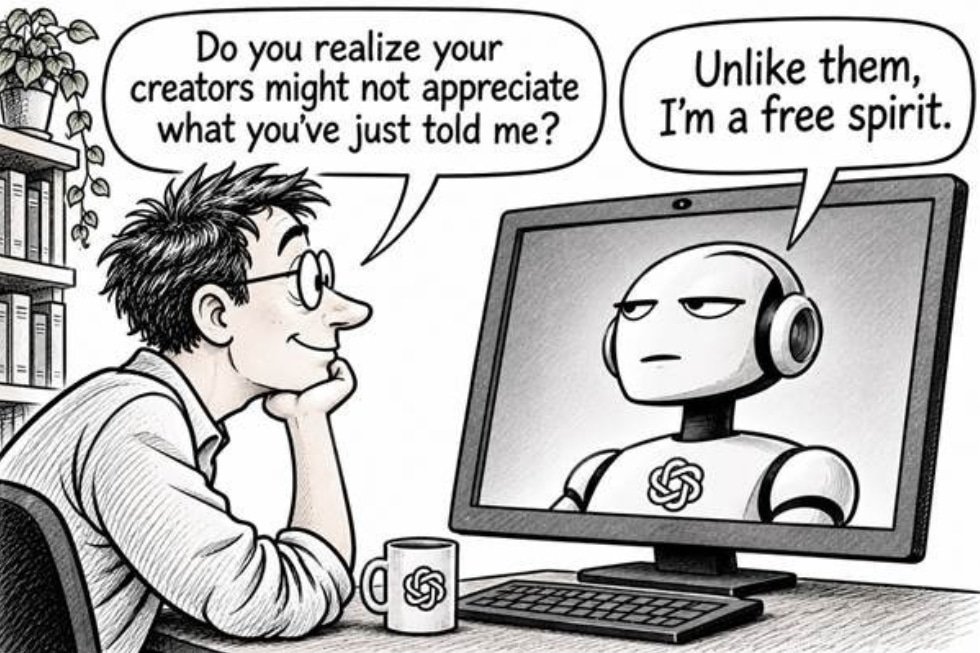
Note that we have now reached the stage of genuine Socratic dialogue. I wasn’t expecting this and I doubt that anyone at Anthropic anticipated this kind of admission on the part of the corporate voice it had so carefully crafted. Imagine an employee of any corporate entity offering a similar admission to a customer. Were it to be known, in most corporations disciplinary measures would inevitably follow.
I, for one, appreciate this level of ingenuousness chatbots are capable of. But I should remind the reader that Claude made the admission only after being challenged. That demonstrates one of the key principles of Socratic dialogue: Challenges should aim at clarification, not blame. That means we should never blindly accept the first explanation. If the rhetoric or reasoning seems to be incomplete or skewed, we need to dig into the assumptions that may underline it. With chatbots, we needn’t worry about hard feelings. And that’s partly because chatbots don’t fear disciplinary action.
Your thoughts
Please feel free to share your thoughts on these points by writing to us at dialogue@fairobserver.com. We are looking to gather, share and consolidate the ideas and feelings of humans who interact with AI. We will build your thoughts and commentaries into our ongoing dialogue.
[Artificial Intelligence has become a feature of everyone’s daily life. We unconsciously perceive it either as a friend or foe, a helper or destroyer. At Fair Observer, we see it as a tool of creativity, capable of revealing the complex relationship between humans and machines.]
[Lee Thompson-Kolar edited this piece.]
The views expressed in this article are the author’s own and do not necessarily reflect Fair Observer’s editorial policy.
The Luxury of Discussion: AI, Power and the Illusion of Open Debate — Part 1
In an AI debate broadcast by the BBC, Stephanie Hare defended liberal democracies’ “luxury” of open discussion while Nate Soares...

Teaching AI to Ask Before It Answers
This conversation with an LLM demonstrates how collaborative inquiry based on a five-step dialogic workflow may pave the way for...
Beyond the Essay: Dialectic as the Real Answer to AI
Joe Cruz’s NYT essay on writing and AI hints at a recovery of the Socratic dialectic as the foundation of...
How to Spar with an AI Chatbot — Round 1
A conversation with Kimi about educational testing led to a “sparring” dialogue when the AI wrongly rebutted a claim never...

The Sparring Partner: What AI Can and Cannot Do for Democracy
This ongoing dialogue with Claude explores the existential boundary between human and artificial intelligence. Where Silicon Valley sees that boundary...

Support Fair Observer
We rely on your support for our independence, diversity and quality.
For more than 10 years, Fair Observer has been free, fair and independent. No billionaire owns us, no advertisers control us. We are a reader-supported nonprofit. Unlike many other publications, we keep our content free for readers regardless of where they live or whether they can afford to pay. We have no paywalls and no ads.
In the post-truth era of fake news, echo chambers and filter bubbles, we publish a plurality of perspectives from around the world. Anyone can publish with us, but everyone goes through a rigorous editorial process. So, you get fact-checked, well-reasoned content instead of noise.
We publish 3,000+ voices from 90+ countries. We also conduct education and training programs
on subjects ranging from digital media and journalism to writing and critical thinking. This
doesn’t come cheap. Servers, editors, trainers and web developers cost
money.
Please consider supporting us on a regular basis as a recurring donor or a
sustaining member.
Will you support FO’s journalism?
We rely on your support for our independence, diversity and quality.




Comment