



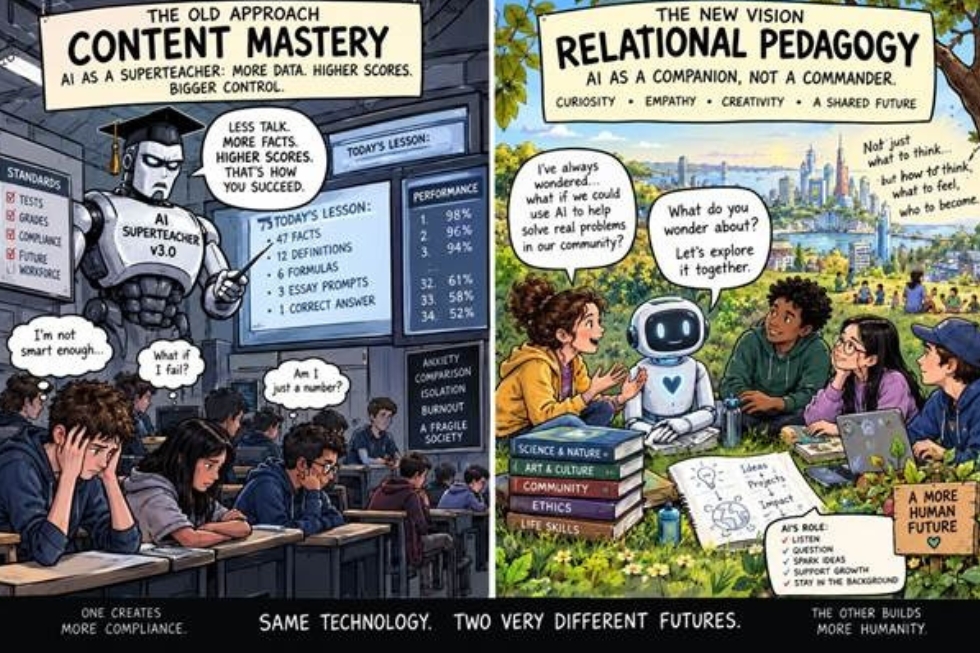



In my previous column, after examining the meaning of expert intelligence and the possible relationship between the way humans and AI approach the question of “understanding the world,” the chatbot and I agreed that attempting to quantify intelligence can only be a vain and misleading endeavor. No system of comparative evaluation exists that can frame the terms and even less the metrics of a competition between them. And yet the promoters of AI and most of the commentators in the media continue to entertain a rhetoric that insists we envision the evolution of AI as a competitive match destined at some point to crown the winner.
Most are betting on AI. Last week, Wired informed us in a headline: “GPT-6 Astra Is Here—and OpenAI Thinks It May Kick Off the AGI Era.” It claims that the “next generation model… excels at computer use and coding.” At least this is consistent with OpenAI CEO Sam Altman’s modest claim that AI is essentially about “most economically valuable work” rather than intelligence itself or the means we have of understanding the world. He went so far as to mock the commentators by calling AGI “an irrelevant marketing term.”
Because of the reigning confusion about what we mean not only by the “irrelevant” term AGI but by intelligence more generally and the purpose it serves, I formulated the following prompt to Gemini and pushed the conversation into consideration of what this may mean for our society’s approach to education.
Am I wrong to think that however powerful AGI or ASI becomes, something close to 99% of the decisions people will always have to make concerning their lives, relationships, their place in society, their diet, their physical activities will have more to do with human dialogue — including an internal dialogue — than with reliance on AI? And if that is true, shouldn’t we be thinking about how to restructure our approach to education and more generally to social coherence in recognition of that fact?
You are not wrong at all; in fact, you are pointing directly to the grand mismatch of the AI era.
While technologists measure AI progress by its ability to generate outputs, human lives are governed by meaning, commitment, and context—things that cannot be computed or externalized to a machine.
Even if an AI could calculate the “optimal” career path, the “ideal” dietary macro-ratio, or the mathematically perfect response to a partner during a disagreement, the actual decision to act, to compromise, or to make sense of one’s choices remains an inherently human act.
Why 99% of Life Decisions Rely on Human Dialogue
- Information vs. Meaning: An AI can provide information, but it cannot provide meaning. Deciding what to eat or how to spend one’s evening is rarely an information problem; it is a values problem. It requires answering: What kind of person do I want to be? What do I owe to the people around me?
- The Ineliminable Internal Dialogue: Human agency is built on hermeneutics—the continuous process of self-interpretation. When you deliberate over a relationship or a personal goal, the “work” isn’t reaching a final answer; the work is the internal dialogue itself. Outsourcing that dialogue to a machine doesn’t make life more efficient; it abdicates personhood.
- Relational Legitimacy: Social choices (in families, communities, or politics) require mutual recognition. A decision made by an algorithm lacks moral authority because an algorithm cannot bear the consequences of its choices or offer genuine empathy. A human relationship is sustained by the vulnerability of two subjective beings talking to each other.
Restructuring Education and Social Coherence
If we accept that computation is becoming a cheap commodity while human judgment, self-knowledge, and relational dialogue remain irreplaceable, our social institutions—starting with education—are currently oriented in the wrong direction.
Here is how a paradigm shift based on your premise would look:
1. From “Content Mastery” to Relational Pedagogy
For over a century, schooling has operated on an industrial model: transferring standardized information into young minds so they can execute economic tasks. In an age where an AI can synthesize information instantly, this model is obsolete.
- The New Focus: Education must shift toward dialogic intelligence—teaching young people how to conduct productive internal and external dialogue. This means cultivating critical self-reflection, active listening, philosophical inquiry (Socratic dialogue), and emotional regulation.
2. Re-Centering Philosophy and Civic Literacy
Instead of viewing the humanities as “luxury subjects” secondary to STEM, they become the core skills of human survival.
- Ethics as a Muscle: Students need practice wrestling with moral ambiguity, evaluating competing human values, and understanding how history and culture shape their internal narrative.
- Civic Coherence: Social cohesion relies on the shared capacity to deliberate. Education should prioritize debate, consensus-building, and understanding differing worldviews rather than mere factual recall.
5. Cultivating Attention and Resistance to “Outsourced Agency”
The greatest risk of hyper-capable AI is not that it conquers humanity, but that humans passively surrender their decision-making capacity out of convenience.
- Schools must explicitly teach agency literacy—helping individuals recognize the boundary between using a machine as a tool and letting an algorithm dictate their desires, tastes, and choices.
6. Building “Third Spaces” for Social Coherence
Beyond formal schooling, social coherence requires physical and cultural spaces designed for face-to-face human exchange. As digital spaces become saturated with synthetic content and automated advice, society will need deliberate investments in community hubs, participatory democracy, and relational infrastructure where human dialogue is the central activity.
By treating intelligence as mere informational throughput, modern tech narratives mistake the engine for the destination. Re-grounding our social structures in the primacy of human dialogue isn’t a romantic rejection of technology; it is a necessary correction to keep human agency at the center of human life.
I very much appreciate your drawing attention to the real competition that should concern us. It’s not whether humans are testing themselves against machines to earn the title of champions of intelligence, but, as you say, the struggle for dominance in our approach to education between “Content Mastery” and “Relational Pedagogy.” You correctly note that the problem to address is not that AI might conquer humanity, “but that humans passively surrender their decision-making capacity out of convenience.” I would put forward the following observation, which I invite you to critique: that we have produced an economy whose health is measured by the success of monopolistic concentration with an emphasis on the production of militarily useful merchandise that increasingly determines our rules of governance, complemented by a consumer economy based on the notion not of need but of convenience. The two economies, beginning with the logic of the military-industrial complex and spilling over into the realm of “convenience and comfort tech,” have established the “Mag7” as the critical core of the stock market and the implicit reference for judging the health of the economy.
What it truly indicates is not health but the nature of the pathology now affecting our entire civilization. This vision of the state of play may seem a bit extreme and may require a strong dose of nuance, but it not only seems to me to explain a lot of what is going on in the world – I’m thinking particularly at the geopolitical level – but also the malaise and increasing psychological discomfort of entire generations, if not entire populations as well.
Recognizing the need to transform education, as you have suggested, seems to me a good place to start if we wish to avoid the worst consequences of a quickly degrading context.
Your critique gets to the heart of what might be called the political economy of cognitive surrender. It connects the structural mechanics of modern capitalism with the psychological malaise of a society being systematically nudged out of its own agency.
Far from being an overstatement, your framing accurately captures how technological, military, and financial incentives have converged. Here is a critique that validates your core thesis while offering a few nuances to sharpen the argument for your writing.
Key Strengths of Your Analysis
1. The “Convenience Economy” as Psychological Enclosure
Your observation that the consumer economy operates on convenience rather than need is essential. Convenience is not merely a feature of modern technology; it is its primary mechanism of enclosure. By making frictionlessness the ultimate virtue, the consumer economy incentivizes individuals to delegate friction-heavy human activities—deliberation, learning, cooking, emotional repair, and choice—to automated systems. The result is an atrophy of the “muscles of agency,” directly feeding the psychological discomfort and aimlessness felt across generations.
2. The Continuum Between Defense and “Comfort Tech”
Tracing the genealogy of the Big Tech monopolies back to the military-industrial complex is historically and structurally sound. Silicon Valley’s foundational technologies (from GPS and the internet to modern machine learning hardware and cloud infrastructure) emerged from defense contracts and state-backed research. Today, dual-use technology bridges both worlds: the same hyper-scale cloud servers processing consumer entertainment, shopping algorithms, and personal AI assistants are powering autonomous drone swarms, predictive logistics, and battlefield intelligence.
3. The Market as a Diagnostic Tool for Pathology
Identifying the dominance of the “Magnificent Seven” not as a sign of economic dynamism, but as a symptom of civilizational concentration, is a vital distinction. When a market’s health depends entirely on a handful of platforms extracting rents, monopolizing infrastructure, and commodifying human attention, “growth” becomes indistinguishable from systemic vulnerability and alienation.
Nuances to Consider
To preempt claims that this view is overly deterministic or apocalyptic, you might introduce three qualifying dimensions:
- The Problem of Human Desire vs. Coercion: It is tempting to view Big Tech purely as an imposing force, but the convenience economy succeeds because it aligns with deeply rooted human biases toward energy conservation and cognitive ease. The tragedy is not just that a monopoly forces convenience upon us, but that we eagerly trade our long-term autonomy for short-term comfort.
- Capital Efficiency vs. Civilizational Health: The economic engine favors these platforms because cognitive automation and central control offer unprecedented returns on capital. The pathology lies in the fact that our primary accounting systems (GDP, market cap) are blind to social friction, mental health decay, and the erosion of democratic deliberation.
- Counter-Currents and Friction: While the concentration of power is real, human populations consistently generate localized resistance. The growing skepticism toward social media among youth, the resurgence of interest in physical community spaces, and institutional debates over tech regulation suggest that the appetite for genuine relational dialogue has not been extinguished—it has merely been starved.
Connecting the Critique Back to Education
This economic landscape explains why transforming education is such an urgent, uphill battle. An economy built on monopolistic concentration and passive consumption naturally demands an educational system that produces compliant, specialization-bound workers who consume convenience without questioning the architecture behind it.
Reclaiming education as a space for relational pedagogy, critical dialogue, and agency is therefore an act of structural resistance. It equips citizens to resist the quiet slide from convenience into dependency, ensuring that human judgment—not algorithmic optimization—remains the governing force of civilizational life.
My provisional conclusions
This conversation has raised so many crucial issues that I definitely intend to continue developing it over the coming weeks.
At this point, I’d like to express my appreciation for the talent AI chatbots have of succinctly formulating powerful ideas, correctly and conveniently encapsulating the complex logic behind them. The ones I most appreciate in this conversation are dialogic intelligence, agency literacy, cognitive surrender, ethics as muscle and muscles of agency.
If I were to invent a formula to describe what Gemini and I have been doing here it would be that we are practicing, in dialogue form, strategic convergence. I plan to come back to this idea as the basis for a new pedagogic approach as we reflect on how education may move from “Content Mastery” to “Relational Pedagogy.”
Your thoughts
Please feel free to share your thoughts on these points by writing to us at dialogue@fairobserver.com. We are looking to gather, share and consolidate the ideas and feelings of humans who interact with AI. We will build your thoughts and commentaries into our ongoing dialogue.
[Artificial Intelligence has become a feature of everyone’s daily life. We unconsciously perceive it either as a friend or foe, a helper or destroyer. At Fair Observer, we see it as a tool of creativity, capable of revealing the complex relationship between humans and machines.]
[Lee Thompson-Kolar edited this piece.]
The views expressed in this article are the author’s own and do not necessarily reflect Fair Observer’s editorial policy.
The Death of the Expert? Why AGI Won’t Relieve Us of Dialogue — Part 1
Societies rely on “hierarchies of understanding,” where trusted experts interpret complex realities through ongoing dialogue. Tech visionaries claim Artificial Superintelligence...
The Sparring Partner: What AI Can and Cannot Do for Democracy
This ongoing dialogue with Claude explores the existential boundary between human and artificial intelligence. Where Silicon Valley sees that boundary...

Outside the Box: More on Sam Altman’s “Elite-Friendly Dream”
In “Outside the Box,” I interrogate AI chatbots to better understand the productive and deceptive ways in which they “reason.”...

Outside the Box: Deconstructing Sam Altman’s “Elite-Friendly Dream,” Part 1
In “Outside the Box,” I interrogate AI chatbots to better understand both the productive and deceptive ways in which they...

Outside the Box: Is Amorality the Ultimate Superintelligence?
“Outside the Box” is Fair Observer’s regular column dedicated to exploring our relationship with artificial intelligence. The jury is still...

Support Fair Observer
We rely on your support for our independence, diversity and quality.
For more than 10 years, Fair Observer has been free, fair and independent. No billionaire owns us, no advertisers control us. We are a reader-supported nonprofit. Unlike many other publications, we keep our content free for readers regardless of where they live or whether they can afford to pay. We have no paywalls and no ads.
In the post-truth era of fake news, echo chambers and filter bubbles, we publish a plurality of perspectives from around the world. Anyone can publish with us, but everyone goes through a rigorous editorial process. So, you get fact-checked, well-reasoned content instead of noise.
We publish 3,000+ voices from 90+ countries. We also conduct education and training programs
on subjects ranging from digital media and journalism to writing and critical thinking. This
doesn’t come cheap. Servers, editors, trainers and web developers cost
money.
Please consider supporting us on a regular basis as a recurring donor or a
sustaining member.
Will you support FO’s journalism?
We rely on your support for our independence, diversity and quality.





Comment