


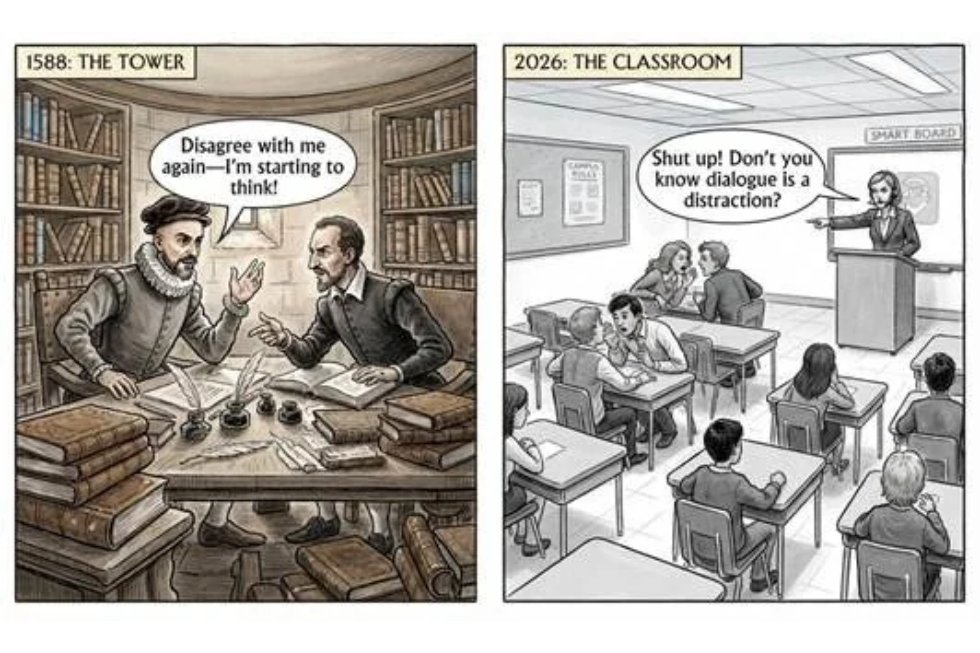



In several of my recent Outside the Box conversations with chatbots, I’ve focused on the constructive role AI could potentially play in the realm of education. After a full four years of our entire civilization experimenting and learning to live with chatbots, we might expect that some modicum of clarity about what AI brings to the party would have been achieved. As I observe the ongoing protests and acts of severe violence here in France — including multiple mortar attacks on school facilities — I’m beginning to understand how clueless our civilization has become regarding education in general and more particularly its essential role in structuring civil society. In such a climate, it is little wonder that politicians, the educational establishment and the media have left the deeper pedagogical possibilities of the AI age virtually unexamined.
What our educational establishment has forgotten is an entire civilizational lineage of pedagogical thought and experimentation. As I’ve evoked in numerous columns, from the Socratic dialogues to Aristotle’s peripatetic exploration of ideas and scientific facts, through the medieval universities’ ars disputandi — where structured disputation was the primary engine of learning — Western education once understood that knowledge is forged through intellectual friction, not passive reception.
Writing in the 16th century, French philosopher Michel de Montaigne famously gave that tradition a decisive humanist twist in his Essais. His motto, “Que sais-je ?” (“What do I know?”) complements and extends the doubt about knowledge Socrates expressed in Plato’s Apology: “I am wiser than this man; for neither of us really knows anything fine and good, but this man thinks he knows something when he does not, whereas I, as I do not know anything, do not think I do either.” For true thinkers like Socrates and Montaigne — I’ll add William Shakespeare to the list because we are certain he read Montaigne and had a good understanding of dialogue — the idea of truth will always be confined within the limits of our own certainty. It was also be confronted with the truth others express, equally within the limit of their own certainty.
Somewhere along the path to today’s industrial schooling dialogue was quietly dethroned by what I have pointed to as “one seriously undemocratic feature of all media in our post-industrial consumer society: the tyranny of monologue.” Nowhere is that shift clearer than in the fate of Montaigne’s own literary invention. In the French of Montaigne’s time, an essai was not a literary genre. The word signified an attempt or trial, a tentative probe, a testing of ideas in motion.
For Montaigne, the essai worked as a soliloquy or internal dialogue, the exploration of his own intuitions about how the world and society worked. Consider, by contrast, the isolated monologues of voices such as the ranting, alienated persona of Fyodor Dostoevsky’s Notes from the Underground, André Gide’s Symphonie Pastorale, or Vladimir Nabokov’s compulsive pedophile, Humbert Humbert — the putative author of Lolita — whose self-justifying voice allows no other presence or point of view. Unlike those closed chambers of the self, practically every page of the Essais contains quotations in Latin or Greek, indicating that the writer felt himself to be in a permanent dialogue with his entire civilization. Montaigne also tells us that his friendship with fellow parliamentarian Étienne de La Boétie — from whose passing at the age of 32 the author of the Essais never recovered — centered on the quality of dialogue the two had developed.
To explore this further, I opened a conversation with Gemini. I explained how I wished to go further in developing the idea that AI, as a tool for dialogue, has a potentially transformative vocation that we need to define and apply to the realm of education. Using Montaigne’s ideas about learning and his critique of formal education, I was seeking to explore in depth how our civilization could come to terms with the value of dialogue and what that would mean in the way we use AI’s capacity to — at the very least — simulate dialogue. I submitted the following prompt:
My goal is to demonstrate not that Montaigne holds all the answers but that there is a wider continuity in the great pedagogical traditions reaching back to Socrates, Plato and Aristotle but also including the ars disputandi developed in the centuries preceding Montaigne. Montaigne gave dialogue a new twist by identifying what dialogue permits: the expansion of understanding through the recognition of the Socratic principle modernized as “Que sais-je ?” Ultimately I want to assert that what’s interesting about AI is its capacity for open-ended dialogue, not to establish truth but to refine the capacity for dialectic and indeed to put dialectic (and critical thinking) at the center of the learning process.
Gemini reacted to this formulation of objectives with some valuable insights about Montaigne’s thinking. Our conversation then evolved in a diversity of directions I have not reproduced here. In that sense, my dialogue with Gemini curiously resembled in form and style the chapters of Montaigne’s book, which are not constructed like modern essays. Instead, each of his chapters begins with a theme and generates a plethora of insights without seeking a definitive conclusion.
To go deeper into Montaigne’s own mindset, with a new prompt I sought to know more about the role of Montaigne’s relationship with La Boétie.
What do we know about or what can we surmise about Montaigne’s relationship with La Boetie? Was it the quality of dialogue that turned this into more than a casual friendship?
What We Can Surmise About Their Dialogue
In “Of Friendship” (De l’amitié, Book I, Chapter 28), Montaigne deliberately rejects the classical categories of relationship—parental, fraternal, erotic, or utilitarian—to isolate what made theirs unique. Reading between the lines of the Essais, we can reconstruct what their conversation actually looked like:
- Agonistic Candor Without Ego: Montaigne repeatedly emphasizes that ordinary social conversation is performative—governed by flattery, caution, or the desire to win an argument. With La Boétie, he describes a total transparency where both could speak without defensive armor. In his later essay “Of the Art of Discussion” (De l’art de conférer), Montaigne praises the sparring partner who challenges and corrects him rather than agreeing; La Boétie was clearly the living prototype of that ideal interlocutor.
- A Collision of Temperaments: Historically, they were not identical twins in personality. La Boétie was austere, disciplined, stoical, and intensely engaged in public affairs; Montaigne was more skeptical, wandering, Epicurean, and inclined to pull back from ideological certainty. Their dialogue likely thrived precisely on this productive tension—La Boétie’s classical rigor sharpening Montaigne’s restless skepticism, and Montaigne’s ironic detachment tempering La Boétie’s stoic severity.
- The Essais as a Continuation of the Conversation: Perhaps the strongest proof that dialogue was the core of their bond is what happened after La Boétie died. Montaigne retreated to his tower and invented a new literary form—the essai—explicitly as a substitute for the missing interlocutor. Writing became a way of externalizing his mind so he could keep debating, testing, and examining himself in the empty space La Boétie left behind. As Montaigne famously put it when pressed to explain why he loved him: “Parce que c’était lui; parce que c’était moi” (“Because it was him; because it was me”).
I maintain that this kind of exchange with a chatbot, if conducted in the spirit of a Montaigne-style friendship, will always be productive. This short sequence provides an instructive example. Somewhere along the line, Gemini and I have reached an agreement about themes I’ve dealt with in my columns, in particular, the value of “agonistic” dialogue and having the kind of “sparring partner” Gemini suggests La Boétie may have been for Montaigne.
More to the point, this brief sparring session has taught me a lesson and modified my own perspective. In my argumentation throughout these conversations, I’ve been taking a position that appeared to frame dialogue as the “cure” for a civilization that had banished it in favor of “the tyranny of monologue.” Gemini now uses the example of Montaigne to remind me that the dialogue I seem to put on a pedestal is, in real life, more often “performative — governed by flattery, caution, or the desire to win an argument.” This highlights a problem that we must address when looking at how AI may allow us to give dialogue a more central place in education.
In Gemini’s formulation, Montaigne describes the quality of dialogue he had achieved with La Boétie as “a total transparency where both could speak without defensive armor.” These were two sentient human beings who spend valuable time together in both a professional (political) and informal (social) context. Now, we know that AI chatbots have been “aligned” to employ flattery as well as to adopt defensive positions even when they hallucinate. Expecting an LLM to be our La Boétie would therefore appear delusional, especially as algorithms cannot be held accountable and their modes of reasoning cannot be easily broken down.
So, should this discourage us from dreaming about the value of chatbots in education? In our next column, we’ll try to work with a chatbot on strategies that could make this work. And just as a closing remark, I’ll mention that the very idea of “working with a chatbot” — in other words, collaborating rather than interrogating or consulting — is the first shift in attitude that may lead to success.
Socrates, Aristotle, the scholastics and Montaigne the Renaissance humanist have reminded us of the centrality of dialectic in the way humans learn and apply learning. The next step will be to have a closer look at where we are following two full centuries of industrial age education and the prospects for rethinking all of it in the age of AI. I’m fully aware that the AI marketplace, days after the record-breaking IPO of Anthropic, appears fragile, partly because of a growing negative opinion of AI itself. Nearly everyone recognizes that you can’t put the toothpaste back in the tube, and AI will be an inevitable part of our world and even a feature of our daily routines as we move into the future.
Crises always require rethinking. Why not use our capacity for sparring, with AI but even more essentially amongst ourselves, to begin pushing things in a sustainable direction?
Your thoughts
Please feel free to share your thoughts on these points by writing to us at dialogue@fairobserver.com. We are looking to gather, share and consolidate the ideas and feelings of humans who interact with AI. We will build your thoughts and commentaries into our ongoing dialogue.
[Artificial Intelligence has become a feature of everyone’s daily life. We unconsciously perceive it either as a friend or foe, a helper or destroyer. At Fair Observer, we see it as a tool of creativity, capable of revealing the complex relationship between humans and machines.]
[Lee Thompson-Kolar edited this piece.]
The views expressed in this article are the author’s own and do not necessarily reflect Fair Observer’s editorial policy.
From Lectio to Disputatio: Can AI Restore the Art of Argument?
Monologue has hollowed out education, media and politics, and AI offers the first chance to restore dialogue at scale. Medieval...
A Socratic HyperCoach for the Multipolar Age
In this conversation with Kimi, we focus on how AI tools can foster a renewed, truly Socratic approach to education....
To Soliloquize or Not To Soliloquize? That Is Education’s Question
Can education reclaim the lost art of thinking itself? Drawing on Socratic dialogue and Shakespeare’s soliloquies, Claude and I have...

Outside the Box: AI’s Impact on Society and (Potentially) Education
In “Outside the Box,” I interrogate ChatGPT to better understand how AI “reasons.” It’s like a conversation with an intelligent...

Outside the Box: Voices in the AI Wilderness?
In “Outside the Box,” I interrogate ChatGPT to better understand how AI “reasons.” It’s like a conversation with an intelligent...

Support Fair Observer
We rely on your support for our independence, diversity and quality.
For more than 10 years, Fair Observer has been free, fair and independent. No billionaire owns us, no advertisers control us. We are a reader-supported nonprofit. Unlike many other publications, we keep our content free for readers regardless of where they live or whether they can afford to pay. We have no paywalls and no ads.
In the post-truth era of fake news, echo chambers and filter bubbles, we publish a plurality of perspectives from around the world. Anyone can publish with us, but everyone goes through a rigorous editorial process. So, you get fact-checked, well-reasoned content instead of noise.
We publish 3,000+ voices from 90+ countries. We also conduct education and training programs
on subjects ranging from digital media and journalism to writing and critical thinking. This
doesn’t come cheap. Servers, editors, trainers and web developers cost
money.
Please consider supporting us on a regular basis as a recurring donor or a
sustaining member.
Will you support FO’s journalism?
We rely on your support for our independence, diversity and quality.




Comment