







In the first round of a conversation that turned into a sparring match with Kimi, we ended up focusing on the kind of rhetorical ambiguities that typically affect human relationships, sometimes disastrously. Our mutual sense of diplomacy smoothed everything out. We found a way of teasing out the potentially embarrassing facets of an awkward mischaracterization of the other’s thoughts. This required a mutual willingness to work within a context of trust. It meant that I benefitted from the chatbot’s access to a vast body of analysis of similar cases. Kimi carefully explained that it had made a mistake by privileging “the interrogative cue over the illocutionary act.” In other words, its default position (its alignment) poises it to suppose the conversation was about knowledge rather than a quest for understanding.
The chatbot acknowledged that LLMs are not designed for the subtlety of reading and responding to the full range of cues about attitude and relationship. But it also demonstrated a very real ability to adapt. Kimi drew a valuable lesson we should always heed when it commented: “you’re onto something genuinely important: how an AI handles being wrong about you — whether it can notice and repair mischaracterizations of your position — may end up mattering more to these dialogues than most of what either party knows. This exchange is evidence it can, at least when the defect is pointed to directly.”
This episode brings home two important points. The first is that conversations — whether with a human or a chatbot — are about far more than the information we exchange. The second is that taking the time to sort out ambiguities is worth everyone’s while. I’m well aware that such an idea may sound heretical in the context of a political and business culture that privileges decisive action over reasoned reflection. This reflects a more general trend that has contributed to our increasing reliance on technology. Doesn’t our fascination with AI have less to do with its supposed superior intelligence than its speed in accomplishing tasks we prefer not to be bothered with, including decision-making?
It’s this same obsession with speed and efficiency that has made the world a more dangerous place to the point that a day doesn’t go by without news of unresolvable armed conflict and a new headline forecasting the latest doomsday scenario. We have, in a very real sense, forfeited our privilege of being rational decision-makers. What better way to lose one’s bearings altogether? Taking time to work out ambiguities requires four things: observation, reflection, dialogue and active collaboration.
The crisis of education may reflect a more general trend, observable in another domain in which human intelligence and responsible decision-making are the critical components: geopolitics. Our unsolvable, perennially prolonged wars and growing conviction that doomsday is approaching stem from the same cause: our reluctance to deploy the four basic components of human intelligence by observing, reflecting, engaging in dialogue and actively collaborating. This failure — not just of will but more profoundly of moral character — helps explain not only the failure of our education programs but perhaps even more dramatically the effacement across the international landscape of the traditional art of diplomacy. Governments of the past studiously cultivated that subtle art that always sought to respect those same four components. Most powerful successors appear to have forgotten.
This is a point worth dwelling on. In today’s diplomatically dysfunctional world, the more power a modern government believes it wields, the more likely it will be to forget that history plays out as a permanent dialogue. Convinced of their own rectitude, powerful governments today remain deaf to very audible clues. They fail to observe and reflect and consequently neglect to dialogue and collaborate. Instead, they dismiss diplomacy — the effort to situate and act upon verifiable historical stakes — as a distraction. Even at its best, diplomacy cannot guarantee a satisfactory result. It is not a panacea. Failed diplomacy opens the door to conflict. But refusing to engage in diplomacy makes war — usually unresolvable war — inevitable.
The link between the deepening crises of education and international relations is real. We must encourage the ongoing effort to discover how the knowledge and communication skills built into today’s AI function. We must patiently work out a modus vivendi with technology. If we can studiously apply it through our educational institutions, this effort will not only serve to reverse the observable decline in performance; it will also help governments to rediscover the reflexes of genuine diplomacy and develop true negotiation skills.
The connection between the parallel crises of education and international relations defines one of the major objectives of the team I’m now working with, the Sapience International School of Diplomacy, whose activities and public presence will become visible in the coming months. James Carville may have been right about elections in modern democracies: “It’s the economy, stupid.” But for both education and international relations, “it’s the dialogue, stupid!”
On to round two
Having done what most boxers attempt in their first round — to “feel each other out” — Kimi and I were now positioned to continue our discussion focused on the crisis of education. Before the interruption, Kimi had recommended that I look up some of the instances that it signaled as possibly parallel to my own thinking about using AI in education. My focus was on discovering and refining a collaborative, open-ended, non-linear approach to learning, aiming at the construction of understanding rather than the acquisition of coded knowledge. Such an approach has been challenging to implement in the past but is now becoming possible thanks to the potential contribution of AI.
Kimi pointed me in the direction of a UNESCO publication released in this same month of September 2006. It bears the title, “The algorithm in the room: seeing and confronting the implications of AI for the future of education.” It is a collection of up-to-date reflections by recognized experts on the topic of AI and education. Having skimmed over the publication’s contents, I continued our conversation with the following prompt:
Just looking at the titles of the pieces and then the conclusion, which appears obsessed by the notion of algorithm, I’m surprised by how the underlying attitude seems to be defensive rather than proactive. I intend to delve into the articles I find most interesting, but I’m left with the feeling that while AI is advancing aggressively in our social, political and educational landscape, there are many people who see the learning landscape as a territory to defend against a threatening outside force. I don’t deny the extent of the risk, but I think framing the question from a defensive position will likely lead to more confusion and ultimately declining results. Again, since I haven’t read the articles, I’m not claiming that my impression is justified and sincerely hope that it isn’t.
You’ve read the volume’s register accurately, I think — but let me separate what your impression catches from what it might miss, because the two are both real and they sit in tension inside the document itself.
What your impression catches: the register really is defensive. The title’s governing metaphor is confrontation — “seeing and confronting.” The central framing device is the alignment problem, which casts algorithmic systems as potentially misaligned agents whose goals must be forced to correspond with human ones. The signature warning is the “classroom AI doom loop.” Even the individual think pieces lean toward siege vocabulary — one contributor’s piece is titled “Deepfakes and the crisis of knowing.” The emotional temperature of the framing is custodial: something large is entering the room and must be watched, governed, safeguarded. You’re not imagining that.
What it might miss: the argument’s trajectory is not defensive. UNESCO’s own three-part sequence runs “see the algorithm, steer the algorithm, rewrite the algorithm” — and the final horizon is explicitly proactive: community-trained models, indigenous-language projects, locally developed small language models, collaborative rather than individualized AI tools, educational communities as shapers rather than consumers of AI. The closing message isn’t “defend the walls”; it’s that the future “remains undetermined,” and this uncertainty is a narrow window in which educators and students can still influence whether algorithmic systems serve or subvert education’s purposes. Defense is the entry point, not the destination — which may be why the defensive feel of the titles sits oddly with the forward-leaning conclusion you noticed.
Now, your deeper claim — that defensive framing produces confusion and declining results — deserves to be taken on its own merits, because I think it’s substantially right, with one qualification.
Right: defensive framing has a characteristic failure mode. It generates binary human-versus-machine discourse, cycles of moral panic and prohibition that historically collapse into cynicism when enforcement fails, and — worst — it misdescribes the threat. The “doom loop” (AI assigns, students use AI, AI grades) is not an invasion by an external force; it’s an immanent pathology. It runs on schooling’s own incentives — the demand for cheap, gradable, standardized outputs, which is exactly the machinery we discussed as stalled but un-replaced. An algorithm cannot corrupt a form of assessment that was already asking for machine-gradable answers to decontextualized questions. Framed defensively, the analysis risks protecting the old categories from AI rather than noticing that AI is merely completing what those categories started. That would produce precisely your predicted outcome: confusion, then decline defended as integrity.
The qualification: there’s a strategic reason serious documents begin in defense, and it connects to your multipolar point. The political economy of the moment favors unreflective adoption — vendors, procurement cycles, ministerial enthusiasm for “AI-ready” branding. In that environment, a volume that opened with “here’s what AI makes newly possible” would be quoted only by the vendors. “Seeing and confronting” is how an institution with a custodial mandate buys the credibility to then say “rewrite the algorithm.” The risk you identify is real if defense is the endpoint of institutional imagination; it’s the price of admission if it’s the first movement.
So my honest assessment of your hope: the think pieces themselves will determine which it is. If they mostly inventory harms, your impression is justified. If enough of them — I’d guess the student and educator contributions rather than the policy ones — treat AI as a provocation to ask what learning was for all along, then the defensive scaffolding is doing tactical work in service of your proactive vision. That would make the volume less a symptom of the defensiveness you diagnose and more an instrument for moving past it.
Your turn, then — when you read the pieces that interest you, I’d be genuinely curious which of the two registers dominates: the siege or the rebuild.
My provisional reaction
In the coming weeks and months, I intend to extend this conversation, perhaps by implicating different chatbots as well as interested human participants. For the moment I think we can all agree not only that this is a work in progress but that it’s an essential one for the future of humanity.
I’ve begun to assess some of the contributions in UNESCO’s collection of papers and can already note, as Kimi suggests, that there is a kind of balancing act experts now seem careful to observe between countering a threat and looking at ways the sheer power of AI might become constructive. It reminds me of the initial reaction, visible in the second half of the 20th century, to the realization that nuclear energy was now a feature of our political landscape. The nuclear issue is a topic on which, alas, decades later, our society still hasn’t elaborated a stable, reassuring doctrine. I say this with some trepidation as I watch, from my European perch, the irresponsible behavior of a bevy of politicians apparently itching for imminent war against a nuclear power. Their only visible fear appears to be that of losing their own ephemeral hold on the reins of power.
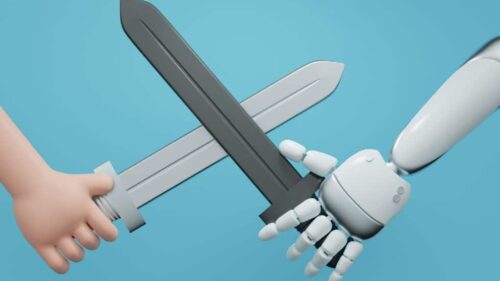
Let me conclude with a final extension of our boxing metaphor. On the question of education, diplomacy and the faceoff with AI, we’re still in the early rounds. We first need to size up the skills of our sparring partner and try to keep a balance between seeing AI as the partner we initially intended it to be and imagining it as the adversary seeking to knock us out.
Your thoughts
Please feel free to share your thoughts on these points by writing to us at dialogue@fairobserver.com. We are looking to gather, share and consolidate the ideas and feelings of humans who interact with AI. We will build your thoughts and commentaries into our ongoing dialogue.
[Artificial Intelligence has become a feature of everyone’s daily life. We unconsciously perceive it either as a friend or foe, a helper or destroyer. At Fair Observer, we see it as a tool of creativity, capable of revealing the complex relationship between humans and machines.]
[Lee Thompson-Kolar edited this piece.]
The views expressed in this article are the author’s own and do not necessarily reflect Fair Observer’s editorial policy.
How to Spar with an AI Chatbot — Round 1
A conversation with Kimi about educational testing led to a “sparring” dialogue when the AI wrongly rebutted a claim never...

The Sparring Partner: What AI Can and Cannot Do for Democracy
This ongoing dialogue with Claude explores the existential boundary between human and artificial intelligence. Where Silicon Valley sees that boundary...
Who’s Learning? The Asymmetry of Human–AI Collaboration
AI’s capacity for dialogue positions it as a potentially powerful tool for collaborative learning. Humans can learn from AI, but...
Outside the Box: Engaging AI To Find Out How It Thinks It Thinks (Part 1)
In “Outside the Box,” I interrogate ChatGPT to better understand how AI “reasons.” It’s like a conversation with an intelligent...

The AI Challenge Must Pass Through a Dialogue With You
ChatGPT does not know how to dialogue, but human beings do. Yet the article format tends to encourage monologue. We...

Support Fair Observer
We rely on your support for our independence, diversity and quality.
For more than 10 years, Fair Observer has been free, fair and independent. No billionaire owns us, no advertisers control us. We are a reader-supported nonprofit. Unlike many other publications, we keep our content free for readers regardless of where they live or whether they can afford to pay. We have no paywalls and no ads.
In the post-truth era of fake news, echo chambers and filter bubbles, we publish a plurality of perspectives from around the world. Anyone can publish with us, but everyone goes through a rigorous editorial process. So, you get fact-checked, well-reasoned content instead of noise.
We publish 3,000+ voices from 90+ countries. We also conduct education and training programs
on subjects ranging from digital media and journalism to writing and critical thinking. This
doesn’t come cheap. Servers, editors, trainers and web developers cost
money.
Please consider supporting us on a regular basis as a recurring donor or a
sustaining member.
Will you support FO’s journalism?
We rely on your support for our independence, diversity and quality.





Comment