






This month, Europe is enduring its fifth heat wave of the summer. On August 12, new temperature records fell across France and Wales, with towns in northwestern France reaching over 40° C. Heat has now killed more than 25,000 people across the continent this year. Meanwhile, thousands of miles away in Pakistan, disaster officials were issuing a “critical” weather warning ahead of what they fear could be a fourth consecutive year of punishing monsoon flooding, one forecast to strike with even greater intensity than the deadly seasons that preceded it.
Two continents. Two very different kinds of extreme weather. One underlying cause. A hotter atmosphere holds more energy and more moisture, and that same surplus is what bakes one region under a heat dome and loads the clouds that will break over another.
A summer of records, not by chance
Europe’s ordeal began in May, unusually early in the season, when a “heat dome” — a stubborn ridge of high pressure — parked itself over the continent and refused to move. On June 24, France had its hottest day on record, with temperatures in the west reaching almost 44° C. In less than a month, data from EuroMOMO, the mortality monitoring network backed by the World Health Organization (WHO) and the European Centre for Disease Prevention and Control, put the toll at over 10,000 excess deaths across Europe, more than 9,000 of them among people aged 65 and above as well as a surge in drowning deaths as people looked for respite in the rivers and lakes. Only around one in five European homes has air conditioning — a continent built for a cooler climate now improvising its way through a hotter one.
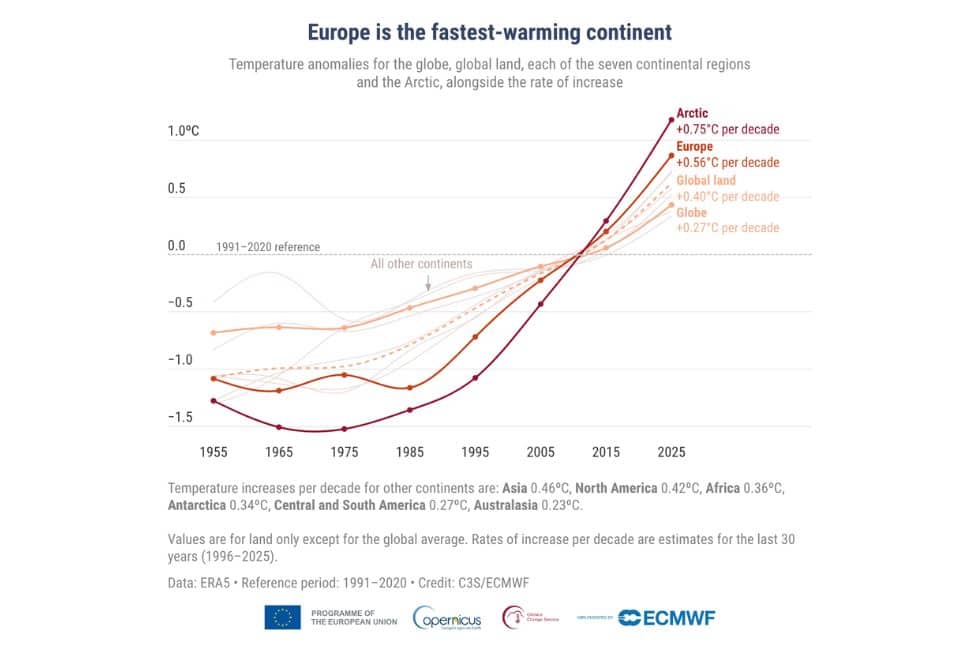
Scientists were unusually blunt about the cause. Rapid-attribution researchers concluded the heat wave would have been “virtually impossible” this early in the year without human-driven climate change. The World Meteorological Organization noted that Europe, the fastest-warming continent on Earth, has heated by roughly 2°C since the historic heat wave of 1976 alone.
Now the same atmospheric pattern that battered Europe has shifted west, locking a “historic” heat dome over the central and eastern United States just as the country marks its birthday. More than 200 million Americans are under some form of heat advisory, with cities from Boston to Washington forecast to see temperatures at or near all-time highs.
A different disaster, the same fingerprint
It would be easy to treat Pakistan’s monsoon season as an unrelated story — a regional weather pattern far removed from a heat dome over Paris or Philadelphia. But climate scientists increasingly describe both as symptoms of the same fever.
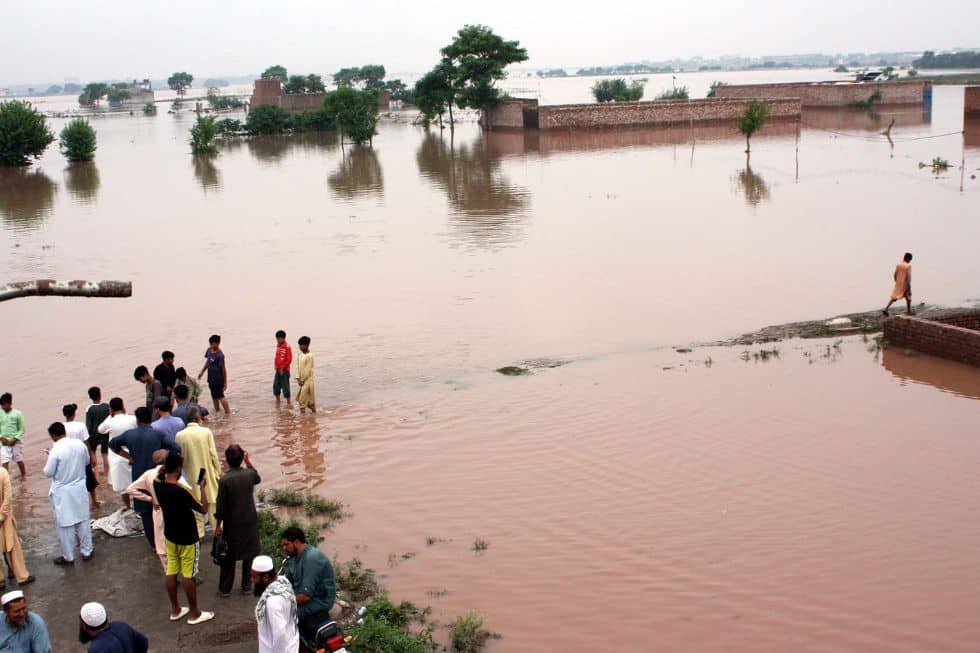
Pakistan is once again bracing for what officials have termed a “critical” monsoon season, with forecasts indicating the impending rains may be at least 20% more powerful than last year’s, which killed more than a thousand people and displaced millions. The physics is the same as what drove Europe’s heat: a hotter atmosphere holds more moisture, and for every extra degree of heating, the air can carry about 7% more water vapor. As that moisture-laden air finally breaks free over the foothills of the Himalayas and the Indus basin, it falls in torrential downpours — far more severe and concentrated than what any river, dam or drainage system was designed to handle.
A second climate mechanism largely absent from European narrative is glacial melt, which is a problem for Pakistan. The warming trend is causing glaciers to rapidly disappear, forming unstable glacial lakes that can suddenly and catastrophically produce outburst floods. Add a monsoon system supercharged by a warmer Arabian Sea and shifting jet streams, and the result is a nation that has repeatedly lost thousands of lives to flooding since the catastrophic 2010 deluge — including more than 1,700 deaths in the 2022 floods alone — despite contributing less than 1% of global greenhouse gas emissions.
A silenced warning system
Pakistan’s exposure this monsoon season is compounded by a second, distinctly human factor.
In April 2025, India suspended the 1960 Indus Waters Treaty, citing a deadly attack on tourists in Kashmir, which India blamed on Pakistan-linked militants — an accusation Islamabad has firmly denied. New Delhi has stated that the treaty will be “in abeyance” until Pakistan finally discontinues all cross-border terrorism, and Indian officials have warned that India will now determine the rivers’ flow without guaranteeing Pakistan its “due.” Pakistan deems any interference in the shared waters as war.
In addition to the water dispute itself, analysts at the Center for Strategic and International Studies note a subtler risk: the treaty also governed the sharing of hydrological information, river-flow data, water releases from reservoirs and flood warnings with Pakistan. That data-sharing agreement is no longer assured now that the treaty is suspended, and Pakistan has reported sudden, unannounced changes in the flow on the Chenab River. A country where flood-warning systems are a mix of upstream data from India, and which is expected to experience one of the worst monsoon seasons on record, could see less lead time to evacuate low-lying inhabitants before a flood surge hits, precisely as this monsoon is predicted to be one of the most severe in history.
No systematic failure in early-warning cooperation between the two countries has been reported, and Pakistan’s government has dismissed some social media reports of Indian-triggered floods as unconfirmed. But even occasional data gaps, on top of a monsoon already boosted by the warmer atmosphere, could mean a more dangerous flood season and a geopolitics-driven climate crisis.
Two symptoms, one diagnosis
This is the uneasy math of a warming planet. The same additional heat piling up in the atmosphere and oceans — baking Europe under record-breaking high-pressure systems — is also building the clouds that will inevitably fall, catastrophically, on the plains of Pakistan. Meteorologists increasingly caution that these are not individual weather reports to be assigned to various desks — foreign, domestic, climate — but chapters in the same story: events unfolding on different continents with differing casualties.
In richer countries, the crisis takes the form of heat stress, overloaded power grids and postponed festivals. In countries such as Pakistan, it takes the form of flooded villages, lost crops and a rebuilding cost that far exceeds available resources. Both are costly.
What comes next
Governments have responded to their own emergencies: France convening special cabinet sessions on heat resilience, Pakistan’s prime minister ordering early preparations for this year’s flood season. But the two crises are rarely discussed as one — and that may be a greater failure. If the same warming atmosphere can ground a heat dome over Washington and load a monsoon system over Lahore in the same fortnight, then adaptation plans drafted in isolation — a cooling center here, a flood barrier there — will always be a step behind a problem that does not respect borders, GDP or news cycles.
The heat will pass from Europe and America within days, as heat waves do. Pakistan’s monsoon has not yet begun in earnest. But scientists say both are the same story — a warmer world settling its account, one continent at a time.
[Ruqaiyya Jhandawala edited this piece]
The views expressed in this article are the author’s own and do not necessarily reflect Fair Observer’s editorial policy.






Join the conversation
Share your perspective
Log in to share your thoughts and take part in the discussion.