


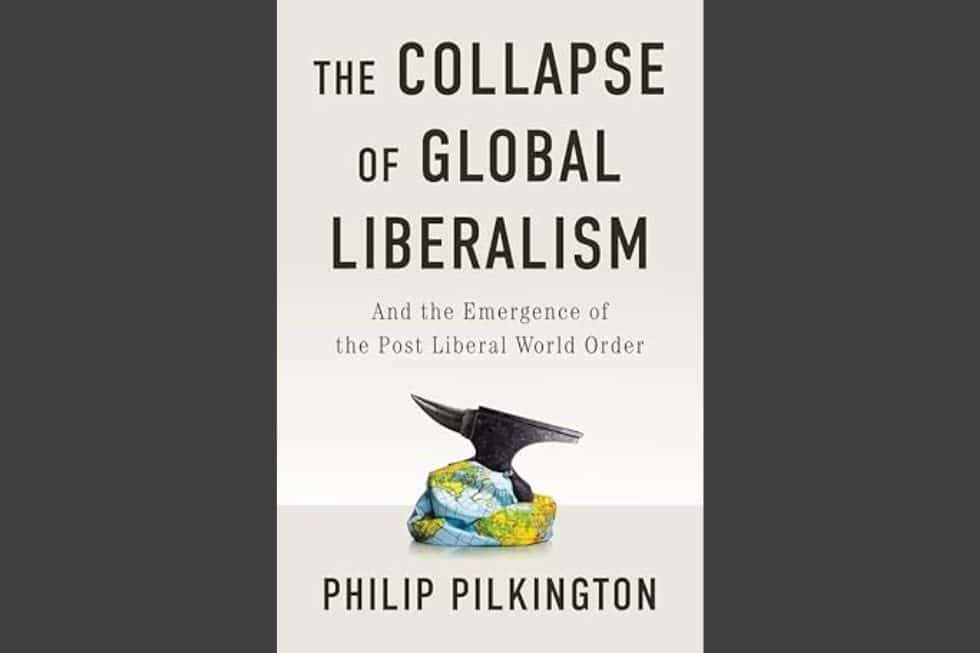



Question: Before we speak about the collapse of global liberalism, tell us what exactly is it?
Philip Pilkington: Well, there are two components to global liberalism. The first is liberalism itself. This is an ideology that is around 500 years old and goes right back to the English Civil War and John Locke’s famous work, Two Treatises of Government. Global liberalism is the development of this doctrine in its most extreme form in the West and the attempt by Western countries to try to impose this doctrine on the world. Global liberalism first manifested in the form of the British Empire and then became integrated into the post-WWII global order, which is increasingly today referred to as the American Empire.
Q: After the collapse of the Soviet Union, both the left and the right converged. Both Bill Clinton and Tony Blair embraced the Third Way. Francis Fukuyama’s The End of History emerged as the theology of this new era. You have called this once triumphant vision delusional. Why?
Pilkington: Because liberalism is an inherently unstable ideology in my reading. Liberalism is geared toward attempting to undermine hierarchies of various types. It starts in the English Civil War — which was really the first of the modern revolutions — as an attempt by Oliver Cromwell and the Puritans to kill the King and destroy the Church of England, but it is never satisfied with just this. As time goes on, more and more hierarchies are questioned by liberals. As we enter the hyperliberal period, which is how I refer to the end of the Cold War, liberals are starting to question the hierarchies on which familial relations rest. This has led to the demographic crisis that we see today because societies that absorb these liberal values are unable to reproduce themselves. As global liberalism reached its peak — roughly in the second Obama administration — the hierarchical question became truly crazy, and people started to question whether “gender hierarchies” should exist, which seemed to mean that people should be able to change their genders. This is not a stable ideology, and it was inevitable that, first, it would become extreme, and then it would collapse.
Q: Explain to us what you mean by the dialectic of liberalism and illiberalism.
Pilkington: These cultural developments of late liberalism generated resistance in non-liberal societies. You see this very early in China, for example. As late liberal cultural products began to penetrate Chinese society in the early 1980s, the country’s leadership explicitly rejected them, recognizing that they would undermine social and political stability. This was later theorized by the Chinese thinker Wang Huning. Something similar happened in Russia. After experimenting with liberal ideas in the 1990s, Russian society rejected them as being destabilizing when Vladimir Putin first became President. I am not as familiar with the political debates in India, but my sense is that something similar happened there.
Q: Is demography destiny? If so, what is the alternative to immigration for richer societies such as Japan, South Korea, Germany and Spain?
Pilkington: Yes, it is. And some of these societies are too far gone. I seriously doubt Japan can reverse its demographic crisis. It seems unlikely that South Korea will either, which is why I assume that it will eventually be reunited with North Korea in a way that favors the latter. European countries, except perhaps Italy and the UK, have a better chance of escaping their demographic crises. But they need to get birth rates up very soon. To do this, a comprehensive family policy needs to be put in place. All of society’s resources should be mobilized around promoting the family. So far, only Hungary is really experimenting with these policies, but we need more collective action if we are to succeed.
Q: Explain financialization to us, how it hollowed out first-world economies and how it led to deindustrialization.
Pilkington: Financialization started around the time of the crisis of the Bretton Woods system in 1971. Between 1945 and 1971, the US dollar was pegged to gold. This ensured that the US could not run huge trade deficits with the rest of the world and kept the American economy balanced. After 1971, the US dollar was unpegged and allowed to exist as a pure “fiat money” system. This led other countries to accept paper dollars in exchange for goods and services, and these dollars were recycled into American financial markets. This allowed America to run large trade deficits, and this, in turn, hollowed out the American industrial base. This period of dollar hegemony is now coming to an end, and this will result in a fall in American living standards back to their equilibrium level.
Q: You call this commercial and civilizational madness. Expand.
Pilkington: Commercial and civilization madness set in with two related cultural trends in the West: drug legalization and the closing of psychiatric asylums. This has led to a mass problem with what is called in the West “homelessness.” Yet this crisis has little to do with a lack of homes. Rather, it is late liberal societies allowing people with mental illness and drug problems to live on the streets. This has turned Western cities into dirty and dangerous places that are becoming increasingly unattractive to visit or live in.
Q: You are a critic of universal history and the big green blob. Please flesh out your critiques.
Pilkington: There’s an old saying: “Every great cause begins as a movement, becomes a business, and eventually degenerates into a racket.” Whether great or not, the green movement has followed precisely this trajectory. Green lobbying in the West has become an enormous industry. Its roots are esoteric and buried deep in 1970s counterculture, but today it is a massive lobbying game that I call the “big green blob.” It is motivated by profit and is not concerned with energy security in the countries it affects. The big green blob explains why many countries in the West — especially in Europe — are unable to provide for their own energy needs today.
Q: What is your manifesto for a postliberal future?
Pilkington: In the book, I propose a number of policies to help get the world back on track after the misguided liberal experiments, but I suppose the overarching theme is that we should return to natural law principles. That is, we should stop trying to judge everything on the basis of efficiency and so-called “rationality” and return to judging outcomes based on how well they align with human flourishing. From a global perspective, this means that we should all start returning to our civilizational roots — a process that my co-author David Dusenbury and I call “recivilization.” I would hope that a new era of recivilization can bring with it a new time of global peace. Liberalism has only brought with it chaos, both domestically and globally.
The views expressed in this article are the author’s own and do not necessarily reflect Fair Observer’s editorial policy.
Resilient Liberalism: Reimagining Freedom in an Age of Disruption
The liberal international order faces decline amid authoritarianism, ecological crisis and social fragmentation. Resilient liberalism advocates adaptable continuity, emphasizing individual...
A Post-Political World and the Powerless Public
Western democracy has devolved into a system of elite-managed spectacle, where real political choice and public agency have all but...
The Death of Liberalism Has Been Proclaimed Before
The current wave of populism calls to mind the mood of the early 20th century when liberal values in England...

Support Fair Observer
We rely on your support for our independence, diversity and quality.
For more than 10 years, Fair Observer has been free, fair and independent. No billionaire owns us, no advertisers control us. We are a reader-supported nonprofit. Unlike many other publications, we keep our content free for readers regardless of where they live or whether they can afford to pay. We have no paywalls and no ads.
In the post-truth era of fake news, echo chambers and filter bubbles, we publish a plurality of perspectives from around the world. Anyone can publish with us, but everyone goes through a rigorous editorial process. So, you get fact-checked, well-reasoned content instead of noise.
We publish 3,000+ voices from 90+ countries. We also conduct education and training programs
on subjects ranging from digital media and journalism to writing and critical thinking. This
doesn’t come cheap. Servers, editors, trainers and web developers cost
money.
Please consider supporting us on a regular basis as a recurring donor or a
sustaining member.
Will you support FO’s journalism?
We rely on your support for our independence, diversity and quality.





Comment